
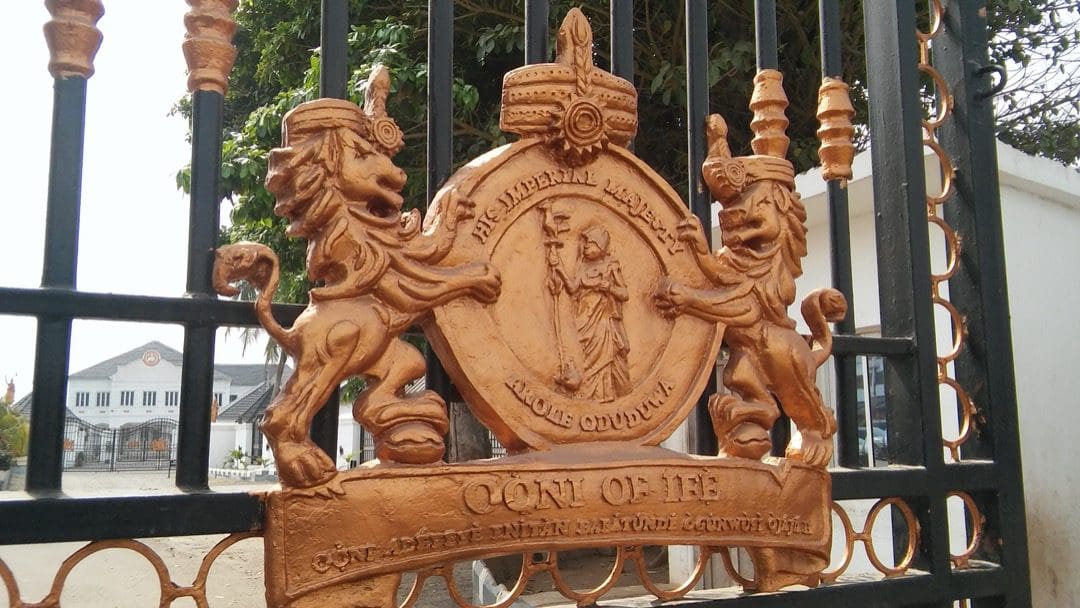

IT is not for nothing that the gate to the palace of the Ooni of Ife is one of a kind. It doesn’t carry the familiar ensembles that adorn most palace gates I have seen – just a crown at its centre. The Ooni is first among equals, the most regarded king in Yorubaland, for the fact that Ife was where Oduduwa, the ancestor of the Yoruba, first reigned. The Ooni’s special status among Yoruba traditional rulers is enhanced further by the fact that the Are Crown, believed to have been first worn by Oduduwa, is in his territory.
“There is no other crown like that anywhere in the world,” one of the Ooni’s chiefs says as he shows me through the palace. “It is very heavy and the king wears it only once in a year, during the annual Olojo festival. It never dirties and it is never washed. All the 50 Oonis since the time of Oduduwa have worn it during their reign.”
The crown is worn only after some sacrifices have been performed. And that sacrifice is what makes the crown lighter for the king to move about in. “All these must be done days before the king is to wear the crown,” Oseni says.
On a brickwall and above a black, solid panel door within a built-up section of the palace called Ile Nla hangs a black-and-white (8’ by 10’) photograph of the king wearing the Ade Are. To the left of it is a metal work of an elephant; and to the left of that stands a life-size tusk. An Elephant in Yoruba world view symbolises strength and it is a component of some royal emblems I have seen across Nigeria’s south-west region; it is believed that for an individual to aspire to kingship of his community he has to be brave, sturdy (in mind and body) and fearless.
And once a prince is enthroned in Yorubaland, he has to report to Ife to receive a royal sword from the Ooni— so long as he traces his ancestry to Oduduwa. The sword-giving ritual takes place at a spot called Idi Oranyan, one of 200-plus ritual sites scattered around Ife. A typical sword hangs on the wall in Ile Nla, just below the Elephant.
In the past, Ile Nla was where the Ooni sat to listen to and address all domestic and civil cases brought to him by the locals. “Back then, the Oba’s court was like a Supreme Court,” my guide explains, standing by a bust of Oduduwa, five foot high. “The judgement you got there was final. It couldn’t be appealed.”
Nowadays, however, to meet with the volume of cases that pour into the palace and to give room for fair hearing, that responsibility has been spread over four distinct ‘courts’, each a step higher than the one preceding it.
The Emese Court is the first port of call for all complaints and domestic conflict. If the petitioners are dissatisfied with the way the case has been resolved they have the right to take the same case to the High Chiefs’ Court; if that still doesn’t seem fair enough, it gets to the Ooni himself. If after the king decides on a case the parties involved feel justice has yet to be served, the king then sends them to the Ile Ase (Temple of Wisdom).


The Temple is believed to be where the first-ever blacksmith on earth descended to from heaven on a chain; he fashioned many tools for human use until things went awry years later forcing him to vanish into the ground; a stone marks the exact spot of his retreat from earth. Here, there are no mortals to speak to; just a white courtyard and a spot splashed all over with palm oil, salt, palm-wine and roast yam, evidences of previous rites.
Ile Ase is where you pleaded your case on oath and expected the repercussion, good or bad. “The guilty one dies seven days after coming here to swear,” my guide says, after sharing a brief history of the Temple. “It happens even now.”
Back in the days, kings were never buried. “They vanished into thin air or turned into some creature,” according to Chief Oseni. And so, there is no grave anywhere for all past Oonis of Ife, except for three deceased kings near Ile Nla: that of Olubuse 1, Ajagbon Lawarekan 2 and Oba Adesoji Aderemi.
Oseni, by the way, is one of 80 or so Emese (traditional palace guards) on the palace’s payroll. Dedicated to particular lineages, the Emese are easily identifiable by the unique hairstyles they wear, which is one half of the head shaved clean – from front to back.
When the Ooni travels anywhere, he goes with a couple of them in tow; and when he is away, the ones left behind oversee the affairs of the palace.
Pelu Awofeso is a winner of the CNN/ Multichoice African Journalist Awards for tourism reporting. He has published four books based on his travels around Nigeria.


1 comment
… [Trackback]
[…] Find More Information here to that Topic: naijatimes.ng/inside-the-oonis-palace/ […]
Comments are closed.