
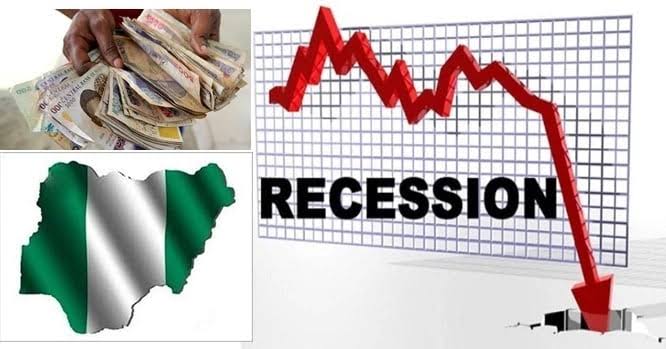

The Central Bank, on Tuesday, released a depressing October monthly Purchasing Managers’ Index (PMI)… The best description of the data set on employment, demand outlook and production is contraction. Key indices – employment, new orders, business activity, production level and supplier delivery time – contracted, some at a depressing rate.
IF the country’s economy had been tumbling, it is plunging even faster following the seven-month ravaging coronavirus pandemic and now the national unrest.
For the first time, even the federal government does not need to wait before it happens to admit it.
President Muhammadu Buhari with key members of his economic team – Minister of Finance, Budget and National Planning, Zainab Shamsuna Ahmed and the Governor of the Central Bank of Nigeria (CBN), Godwin Emefiele – has confessed that the moderate growth recorded from 2017 when the economy climbed out of the recent negative growth, is retreating.
The admittance may have cleared any doubt about the true state of the economy, implying that the country is merely awaiting official confirmation of a second recession in less than five years.
Hopefully, the National Bureau of Statistics (NBS) will reveal the scale and scope of the expected recession in a few weeks’ time.
For some reasons, the realisation that the country will plunge into a recession is more of a challenge than the actual downturn. The first and strongest of these: expectation distorts than the real cause in economic behaviour.
In expectation of poor revenues, companies have stopped engaging new employees, which will increase the unemployment rate. And in expectation of declining incomes, households are cutting down on consumption, which will reduce aggregate demand and increase inventories. These are as bad as, or worse than recession.
Already, economists have warned that the depth of the negative growth expected would depend on the government’s handling of the economy, and ultimately its willingness or unwillingness to change its recalcitrant attitude.
But while the debate on what the new fiscal approach should be was still on, the unexpected struck – the bottled up anger of many decades was let loose.
Dr. Olufemi Saibu, a development economist at the University of Lagos, said the unrest alone may have widened the scope of the expected recession as “confidence has dipped and losses recorded” across different sectors.
Other experts have also warned that it could take the country more than a year or more to recover from three-week violence that shut down the entire economy for days.
Godwin Owoh, a professor of applied economics, also believes the unrest is a major distortion that may have wiped out any substance left behind by the coronavirus outbreak. He, however, said confidence in the country’s readiness to embrace a new culture and shun official graft would result from a sustained demonstration of the people’s will to hold the government accountable.
Yet, the economy continues to scorn Owoh’s optimism.
BEYOND the grandstanding of soothsayer economists, the capacity utilisation of the country has been tested by an institution of the government – CBN. With a combination of other factors, the unrest of the past few weeks and the intractable impacts of the coronavirus outbreaks have stressed the economy enough to raise a serious concern.
The Central Bank, on Tuesday, released a depressing October monthly Purchasing Managers’ Index (PMI). To put it in local parlance, “the figures are not smiling.” The best description of the data set on employment, demand outlook and production is contraction. Key indices – employment, new orders, business activity, production level and supplier delivery time – contracted, some at a depressing rate.
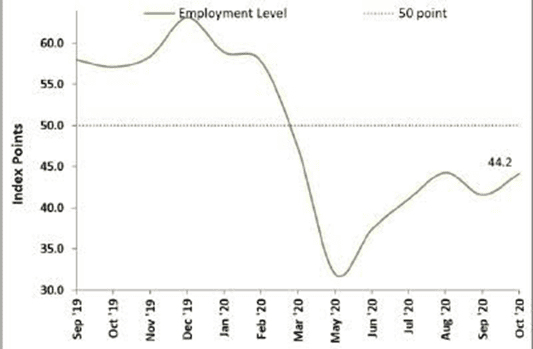
Unemployment is a cause and effect of a sliding economy. Hence, it comes top on economic outlook analysis. As the country went in flame in the past few days, the labour market bit the bullet, with both manufacturing and non-manufacturing sectors losing a considerable number of jobs across frontiers.
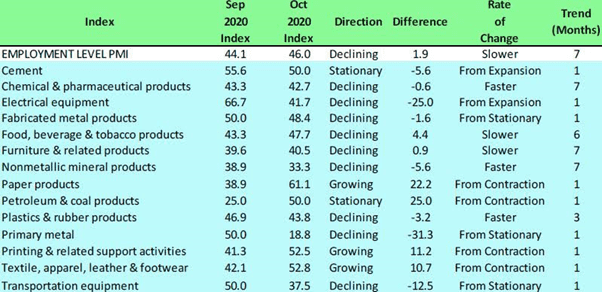
For manufacturing, the employment index stood at 46 points. This translates to a contraction for the seventh consecutive month. Nine subsectors in the manufacturing industry recorded declining employment and against three areas with moderate employment growth. Jobs in the remaining two subsectors were static.
Of note, the most productive subsectors including food/beverage/tobacco, petroleum/coal and cement received a haircut, showing that the problem is deeper than just a mere number of industries that lost jobs. Yet, manufacturing fares better in share of contribution to already-bloated jobless Nigerians.
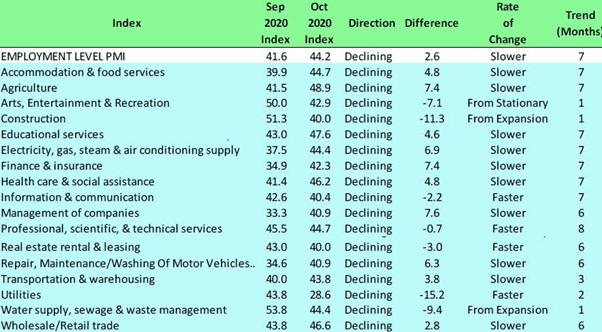
According to the report, employment also fell across all the 17 subsectors of non-manufacturing. Employment in accommodation and food services, agriculture, arts/entertainment/ recreation, construction, educational services, electricity and gas/steam/air conditioning supply has contracted in the month.
The areas where employment nosedived in the month were finance/insurance, healthcare/social assistance, information/communication, real estate/leasing, transportation/warehousing, professional services and utilities.
The service sector was a major source of employment for young people. Now, economic risk is clouding the potential of the sector, which now churns young people in their hundreds to the labour market. The unemployment situation has reached a crisis point as confirmed by the recent unrest across different parts of the country.
According to an NBS report, one in every two Nigerians was either unemployed or underemployed as at the second quarter of 2020. Nigeria’s unemployment rate, as of June, climbed to 27.1 per cent (up from 23.1 per cent it was in quarter three of 2018, the last time the figures were reported before the recent one).
Similarly, the underemployment rate increased from 20.1 per cent it was in 2018 to 28.6 per cent.
As gloomy as the figures are, Dr. Olufemi Saibu, a development economist at the University of Lagos, warned that the days ahead could be more depressing except the government acts fast and engages the private sector constructively. The economist said the government needs to urgently restore confidence by assuring the manufacturers that the days ahead would, indeed, be better than where the country is coming from.
Other economists have also called on the government to begin to aggressively market what it is doing to curb insecurity, stabilise the Naira and restore confidence in the investment market. Otherwise, the capital flight will continue, as investors cut their losses.
When poor household spending begins to clog aggregate demand, the government is expected to throw in its omnipotent strength by way of intervention to boost the public buying power. In that case, demand will increase; inventory goods down; production picks up and factories increase capacity utilisation, which include more labour.
When President Barack Obama assumed office in 2009, he practically ‘dashed’ Americans dollars to go out to buy. That was how he turned on the US economy. Many economies have equally spent out of recession. But this is an option a depressed Nigeria may not have the capacity to afford.
First, at 13.71 per cent, the inflation is already at its 31-month high. The CBN said it could hit 14 per cent at the end of the year – still a conservative estimate. Excessive spending will worsen the inflation rate, making the cost of living even unbearable.
Also, the government does not have the financial strength to fund a serious intervention that can reverse economic direction. About 40 per cent of the 2021 proposed spending is deficit while about one-fourth of the entire appropriation will be spent servicing existing loans.
Increasingly volatile oil prices are crushing the fiscal positioning of the federal government. The revenues of the state are not also as good as any other. Most states have had to rely on the Federal Account Allocation Committee (FAAC) to pay salaries and meet other basic needs. For instance, in the first half of 2020, only Lagos, Ogun state and FCT, were able to realise over 50 percent of their total revenues from internationally generated revenues (IGRs).
Lagos IGR, which was about N204.5 billion, constituted 80.3 per cent of the total revenue of the state. But whatever gain the state may have recorded on its revenue-generating capacity is being wiped by its excessive debt burden which peaked at N493.3 billion as of June 30, 2020.
With the state government’s disclosure that it would need N1 trillion to restore the infrastructure vandalised by #EndSARS protesters, its financial state is even worse than projected about a month ago.
Notwithstanding Lagos’ huge debt, many states are in more precarious situations. Jigawa state generated N3 billion as IGR for the whole of the first half of the year. Yobe, Niger and Taraba states generated N3.9 billion, N4 billion and N4.1 billion respectively.
IGRs share of the states’ total incomes of the states in the first half was 33.4 per cent, with the balance coming from FAAC. The last five years’ trend is not different. FAAC allocations are in the region of 65 per cent of states’ funds on average. Some states are 90 per cent dependent on FAAC to fund their activities.
Now FAAC source – crude sale – is in a dire state. Niger Delta militants are threatening oil installation as part of their way of hitting back at the government for several years of poor human rights credentials that the #EndSARS campaign centred on.
As of June 30, the federal government’s debt stood at N26.8 trillion. The government is expected to concentrate its efforts on repayment of the debt. Still, it is taking more and more loans amid dwindling incomes. How would such a government spend its way out of the recession?


5 comments
… [Trackback]
[…] Info to that Topic: naijatimes.ng/recession-is-here-though-statistics-office-is-yet-to-confirm-it/ […]
… [Trackback]
[…] Read More Information here to that Topic: naijatimes.ng/recession-is-here-though-statistics-office-is-yet-to-confirm-it/ […]
… [Trackback]
[…] Find More Info here to that Topic: naijatimes.ng/recession-is-here-though-statistics-office-is-yet-to-confirm-it/ […]
… [Trackback]
[…] There you will find 52271 more Info to that Topic: naijatimes.ng/recession-is-here-though-statistics-office-is-yet-to-confirm-it/ […]
… [Trackback]
[…] Find More to that Topic: naijatimes.ng/recession-is-here-though-statistics-office-is-yet-to-confirm-it/ […]
Comments are closed.