
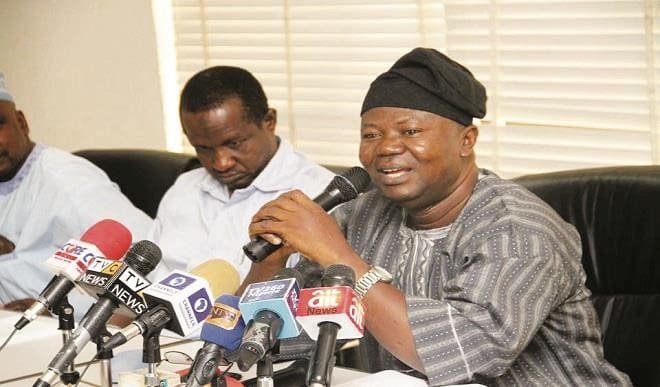

THE prolonged industrial dispute between the federal government (FG) and the Academic Staff Union of Universities (ASUU) has entered its eighth month and it has become a national embarrassment. It is rather unfortunate that government and the university teachers are still playing hide-and-seek at the expense of students as if they do not matter. When two elephants fight, the grass suffers; Nigerian students are at the receiving end of this ugly situation which is not good for the image of the country. For the sake of the future of Nigerian children, we urge the two sides to shift grounds and open the gates of our universities while negotiations continue.
It is a sad commentary that in a democratic dispensation, university students are made to stay out of school for almost a full academic session while both government and the lecturers’ union keep trading blames. They do not seem to bother about the fallouts of their action on the school system and the fate of students who have been made to languish at home almost indefinitely. This is why we in Naija Times are calling on both parties to put a stop to the current propaganda game and let the students return to school.
The FG/ASUU face-off is becoming a perennial affair. Each additional year seem to come with new or upgraded issues. The issue of the Revitalisation Fund for universities/NEEDS Assessment, Earned allowances, Visitation Panels, change in the headship of the Renegotiation Panel on the 2009 Agreement, as well as the IPPIS versus UTAS payment system have been at the centre of the dispute, with some of the cases dating as far back as 2009.
This time, ASUU tabled nine demands, out of which the federal government claims it has met six. Labour Minister, Chris Ngige, claimed recently that the federal government has met a substantial portion of the demands put forward by ASUU but the Union’s President, Professor Biodun Ogunyemi, says government is being economical with the truth. According to Ogunyemi, the withheld salaries of its members which are between four and eight months have not been paid. It is the same story for Earned Academic Allowances. Others are: failure of government to raise visitation panels for the universities; failure of government to address the issue of proliferation of universities by state governments as well as government’s reluctance to negotiate with ASUU over the 2009 Agreement. The union is also complaining about government’s refusal to negotiate with it over the 2019 Memorandum of Action, which is yet to be implemented.
In what appears to be a reaction to ASUU’s position, the federal government last Friday announced that it is making further concessions with an offer of N65 billion to the universities to address some of the union’s demands. It is also ready to pay outstanding salaries of lecturers using an older payment platform, GIFMIS, instead of the controversial IPPIS. The N65 billion seeks to address the issue of earned allowances and for the “revitalisation of universities”. Although there were indications at the weekend that ASUU might call off the strike this week, the union is yet to make an official pronouncement to that effect.
It seems both the FG and ASUU are not taking their primary responsibility for the growth and development of knowledge and the multiplier effect on the overall development of society seriously. ASUU should reflect on why it was formed in the first place (in 1978), as a successor to the Nigerian Association of University Teachers (formed in 1965). Government must, both in its pronouncements and actions, demonstrate serious commitment to the growth and development of education in the country. Government should study how universities are run in developed countries and apply same to the system in Nigeria. This perennial disruption in the academic calendar of public universities has been allowed for too long and something urgent must be done to stem it.
What is happening to the public university system in Nigeria is symptomatic of the general situation in the larger Nigerian society. The university system in the country does not seem to have engagement platforms for mediation, arbitration and dispute resolution. It is one of the reasons why disputes in the system are thrown to the usual unending negotiations that often create more disputes than resolve them. In the process of negotiations, propaganda takes the centre stage instead of strategic engagement. Given the state of affairs, some analysts have argued that unless there is a legislation forbidding government functionaries from sending their children and wards abroad to acquire knowledge, the school system in Nigeria is not likely to witness any positive turn around.
Those who are of this view, point to what happened in Western Nigeria when Chief Obafemi Awolowo was Premier. They argue that it was when he stopped his cabinet ministers from sending their children and wards to schools abroad that Government College, Ibadan became one of the best schools in the continent. It was also then that the University College Hospital (UCH), Ibadan became the fourth best Teaching Hospital in the entire Commonwealth countries. The rot in the country’s education sector began with the involvement of the military in the political leadership of the country. Since then, things have not remained the same in the sector.
Outside the issue of salaries and wages, there seem to be a more profound, though silent, reason why university lecturers are constantly at loggerheads with government. It is the issue of academic freedom or university autonomy. Tradition has it that academic freedom means two things. Firstly, it means that universities are autonomous and should be completely free from any external constraint and political pressure. Secondly, it means that internal decisions such as government research or staff appointments should not be influenced by political considerations — all should be free to have any belief, as long as they live within the university by the accepted academic standards.
For historical reasons, which are connected with the origin of the traditional formula, universities are supposed to be formally self-governing as independent institutions whose membership is absolutely based on a purely intellectual franchise. Unfortunately, over the years, the function of the university has been in large measure the subject and not the object of a programmed social change. Training in orderly thinking, fostering methods for independent scholarship, laying down a common cultural background and the informal ties based on this background between elites in all areas of social life — that was the primary role of university education for the great majority of students.
Yet, beyond the organisation of learning is the challenge of university financing. There was a time in this country when government made deliberate efforts to fund the universities: lecturers were well paid and adequately motivated, students were paid bursaries regularly and scholarship was awarded to indigent and brilliant students. In many federal universities, students were fed free by government. There were also grants for research and wealthy individuals and corporate organisations were at liberty to endow chairs to encourage research and learning. All these started diminishing following the second coming of the military in 1984.
It is now obvious that the burden of funding universities in the country cannot be shouldered by government alone. University administrators should therefore strive to always think outside the box. There are a number of other sources from which universities can raise funds for research, development and staff support other than subventions from government. Many private universities across the world, even in Nigeria, explore these alternative sources of revenue. While not suggesting that universities should be run like a commercial enterprise, universities in Nigeria can emulate what the University of Lagos did in the 1990’s when more than 60 per cent of the revenue needed to run the system was generated internally through Unilag Consult, an enterprise fully owned by the university.
The face-off between the federal government and ASUU has lingered for too long. There is an urgent need for a speedy resolution of all outstanding issues through strategic engagements, not by ultimatums and confrontations. A more tactical process should be put in place to address the contentious issues once and for all. For now, both parties should come to an agreement and let our students return to school immediately.


2 comments
… [Trackback]
[…] Read More on that Topic: naijatimes.ng/fg-asuu-face-off-let-students-return-to-school/ […]
… [Trackback]
[…] Read More on to that Topic: naijatimes.ng/fg-asuu-face-off-let-students-return-to-school/ […]
Comments are closed.