

By Uche Onyebadi
As I sat and wrote this article, eyes glued onto my computer screen, and pondering the cataclysmic effect Covid-19 is having on humankind as we welcome year 2021, I said to myself: It could have been worse.
“It could have been worse” was how a friend of several decades always put a bright face on tragedies. As we mourn the dead, take necessary precautions, commiserate with the afflicted, pray for frontline workers fighting Covid-19, celebrate the development of vaccines to combat this lethal disease, and hope that our leadership at federal, state and local levels worldwide will have the wisdom to lead us out of this calamity, it is easy to forget how lucky we are in this tragedy.
Covid-19 did not magically descend on our shores around March 2020 when we began to really feel its grisly impact. American and other experts tell us that this terrible pandemic had been with us since January of the same year. Others say that it was with us as far back as December 2019. So, how did we survive it with no social distancing or face masks at Christmas (2019) and New Year (2020) celebrations? Did we not hug one another and socialise in many ways as we looked forward to another year? Now that I look back to those celebratory periods of rollicking and frolicking, I say to myself: The result of the coronavirus pandemic could have been worse.
Think back to the Spanish Flu of 1918. History tells us that the deadly influenza pandemic of that era is unrivaled in its consequence. It lasted about two years, afflicted about 500 million people or nearly one third of the global population at that time, and possibly led to an estimated 50-100 million deaths. I shudder to think about that horror.
While the Spanish Flu savaged humankind, did people who lived through it have access to the Internet? No. Did they have the population of scientists and health care personnel we have today? Absolutely not. Did they have all other trappings of modern science and technology we use to cope with the coronavirus pandemic? Never. How did people in those days cope with quarantining themselves? Compared to the world of 1918, we have cause to seek some solace in the wise words of my longtime friend: It could have been worse.
I do not intend to diminish the agony of the present. But it is important not to imprison our minds in some dungeon of hopelessness. One of the ways to fight this pandemic is to be positive that sooner than later, coronavirus will fade away, maybe not go away, but will certainly take its place in the archives of history of lethal diseases that tried but failed to wipe away humankind. Time was when syphilis was a global killer. So did cholera. How about HIV-AIDS? And malaria? The Bubonic Plague? Ebola? Not to think of other debilitating ailments like cancer, diabetes, measles, chickenpox, herpes, polio, smallpox, SARS, Avian influenza (birds flu), leprosy, hepatitis b and c etc. that are still with us. The list is too long. In all cases, humankind triumphed in the end and medical science produced what was used to cope with the tragedy.
Not too long ago, we were all pessimistic about the quick emergence of the modern-day Alexander Fleming, the man who discovered the antibiotic, penicillin, to fight Covid-19. Very few believed that globally, scientists will work to give us the vaccine to combat Covid-19 before it kills all of us. But, they did. Today, we have quite a number of these vaccines even if its distribution has become another logistics nightmare. However, what is most important is to use the power of human energy to challenge and conquer this virus. Experts tell us that Covid-19 and its mutated varieties, derive their oxygen from, and thrive on, human-to-human transfer. So, we can use our human willpower and intelligence to asphyxiate the virus by cutting off the human-to-human transfer chain. In simple terms, that is what the experts tell us: Maintain social distance, wear your mask, wash your hands, avoid crowds, and the virus will go “crazy” and die or at least cease to be a pandemic. You cannot argue that since we now have vaccines, we have the license to pretend that life has suddenly gone back to normal and we can simply do as we please. No. You do not jump off the roof of a 10-storey building because you know that doctors, especially orthopedic surgeons, are there to repair the damage you inflicted upon yourself.
We’ll have to accept the fact that life will no longer be the same in the post Covid-19 era. Why should it be? Our world, our lives, are like a flowing river. Nothing ever remains the same. Or stagnant. As human beings, we don’t remain physiologically and intellectually the same as we were in our toddler years. Was life the same after we became children of the Internet era? Those of us old enough know what life was before the coming of the computer, desktop, laptop, cellphone and other modern technological gadgets, even those we now use to save lives. How about the mode of traveling before the era of motor cars and airplanes? The common factor between the past and present killer diseases, and the advent of the Internet is that they all changed our lives; the former, negatively and the latter positively. So, life will not be the same, post coronavirus. We only pray and wish for more positive discoveries to change our lives, not things that have some negative rings around them.
There used to be a time when going for an appendicitis surgery looked like a mini death sentence, with family and friends sending supplications to heaven for everything to go well. Not anymore. These days, you can have the surgery and literally proceed to your office a few hours later or go to a stadium to watch a football game. And so it shall it be with the coronavirus affliction. My sense of optimism informs me that we’ll soon look back, wear crowns of joy, since corona is the Latin word for crown, and refreshingly and gleefully proclaim: It could have been worse with the coronavirus!
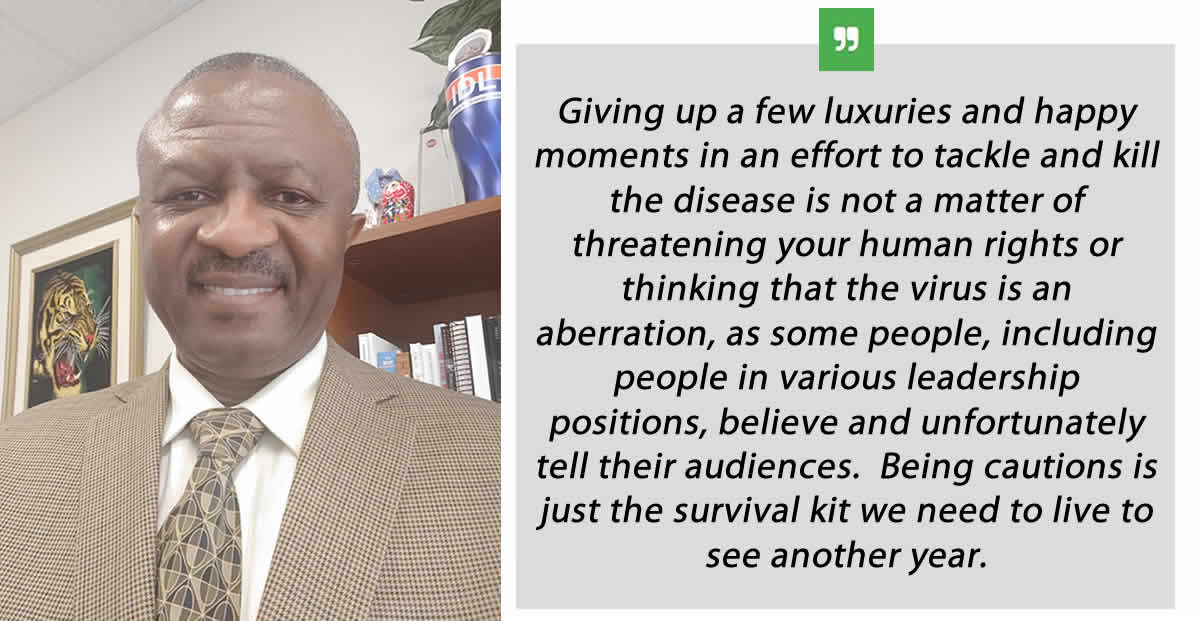
Giving up a few luxuries and happy moments in an effort to tackle and kill the disease is not a matter of threatening your human rights or thinking that the virus is an aberration, as some people, including people in various leadership positions, believe and unfortunately tell their audiences. Being cautions is just the survival kit we need to live to see another year. Or, what is the wisdom in insisting that corona virus is not real, hence you must enjoy yourself, only to become a victim, perhaps die, and leave your survivors to bear the pain of your arrant stupidity and mind-boggling selfishness?
Coronavirus is real, whether we want to wish it away and pretend that it is a fairytale. Unfortunately, it is like a spirit: We cannot see, touch, or feel it; neither does it have a body, or can we hear its voice. We only know about its arrival when it has already commenced its wild and weird death-dance in our bodies. Nonetheless, like all preceding diseases, it is conquerable by medicine and human resolve.
May your year 2021 be filled with optimism and the strong will to personally challenge and conquer this lethal nuisance called Coronavirus.
Happy New Year!
- Prof. Onyebadi, Chair of Journalism Department, Texas Christian University, USA, is on the Editorial Advisory Board of Naija Times


5 comments
… [Trackback]
[…] Information to that Topic: naijatimes.ng/coronavirus-optimism-in-times-of-gloom/ […]
… [Trackback]
[…] Read More Information here to that Topic: naijatimes.ng/coronavirus-optimism-in-times-of-gloom/ […]
… [Trackback]
[…] Find More to that Topic: naijatimes.ng/coronavirus-optimism-in-times-of-gloom/ […]
… [Trackback]
[…] Information to that Topic: naijatimes.ng/coronavirus-optimism-in-times-of-gloom/ […]
… [Trackback]
[…] Find More here on that Topic: naijatimes.ng/coronavirus-optimism-in-times-of-gloom/ […]
Comments are closed.