

- …Growth patterns more relevant for fresh telecom investments
By Joseph ‘Afamhe
DATA analytics has validated what many consider a growing goldmine in Internet subscription service. But the market may be narrowing after all as the biggest three telecommunication giants continue to eat into the market share of the fringe players.
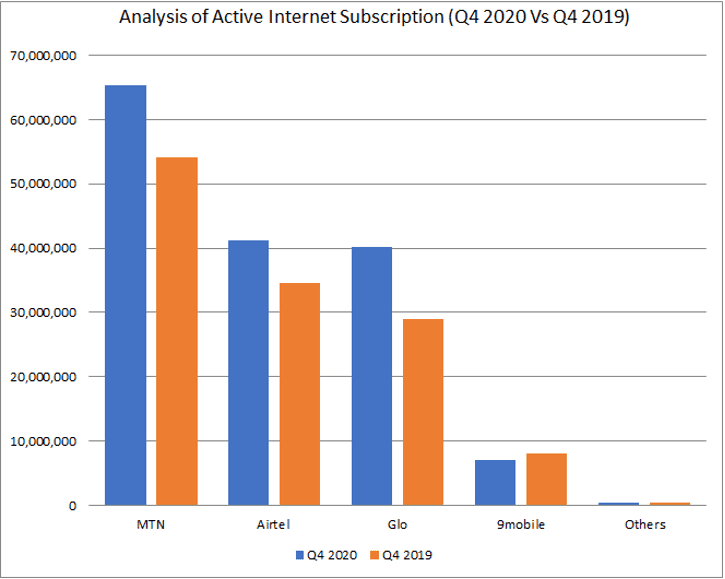
Last year closed with the active Internet subscription expanding by 22.38 per cent year-on-year (YoY). The number of Internet subscribers grew from 126.08 million reported in Q4 2019 to 154.3 million as at the close of the year.
In the period, Globacom led the growth in data subscription, growing its network from 28.9 million to 40.1 million, an equivalent of 38.5 per cent increase. MTN, which controls about 42 per cent of the market, was second on data growth, with 20.8 per cent top-up expansion.
Airtel also grew its Internet subscriber base from 34.5 million to 41.3 million, translating to a 19.6 per cent rise in the 12 months.
Sadly, the struggling 9mobile dropped in the number of data subscribers, tumbling 11.7 per cent, from its 8.07 million to 7.1 million. It lost almost one million subscribers to other networks.
The residue players made up the remaining 427,409, falling from 440,845 held in the last quarter of 2019. Like 9mobile, they lost about three per cent of their data customers to the big three.
Even Covid-19 can’t rein Nigeria’s resilience
NIGERIA, indeed, defied the Covid-19 slump in global demand for phones and other consumables. For instance, data by the International Data Corporation (IDC) shows that smartphone shipments into Nigeria increased 13.7 quarter quarter-on-quarter (QoQ) in Q3 2020.
Another survey by the technology research organisation said the country’s smartphone market grew 12.1 per cent QoQ in Q4 2020 as against a global rebound of eight per cent. Still, IDC did not capture the activities of the burgeoning used-phone market, where Nigeria leads in the millions of units shipped to different regions, especially Africa, through unofficial channels daily.
NaijaTimes’ dipstick study conducted in the course of this report suggested that at least two in every five smartphone users buy from the used or refurbished market. A merchant in Ikeja Computer Village, Paul Ayoson, said he sells twice in volume as his neighbour who sells new units.
Last quarter, data service was doing a fast catch-up with the voice subscription market, which seems to have hit its peak. Yet, the drained voice subscription segment expanded by 10.8 per cent last year. Here, MTN led the growth with 17.5 per cent increase in its already-huge base, securing a more comfortable market share of 40 per cent or over six fold of the slice of 9mobile, which grew by -5 five per cent.
Airtel and Globacom, which had competed neck-in-neck in the past few years, currently stand at 55.6 per cent and 54.8 per cent respectively. While Airtel grew by 10.8 per cent to surpass Globocom, which was ahead in 2019 by about 1.5 million voice call subscribers, the Nigerian carrier expanded by a little above six per cent.
New growth pattern investors can’t dismiss
FOR some curious reasons, Edo was atop states with the most improved voice subscription, reporting a percentage increase of 87.7 per cent. It was followed by the Federal Capital Territory (FCT) and Benue, which recorded 58 per cent and 50.5 per cent respectively.
Ebonyi State was number one from the bottom of the table with 55.2 per cent decline in voice call subscription. Bayelsa and Cross River states also shed 42.4 per cent and 25.7 per cent respectively.
Perhaps, a better justification in data analytics to support the claim that the data service segment is the gold is the fact that no state recorded a negative or zero growth in the number of Internet subscribers. Notwithstanding, some states shew better prospects. The data shed a huge opportunity across the board, with strong resilience recorded in all the six geopolitical zones.
Yet, northern states seem to hold the ace for individuals looking at investment opportunities in data service. Estimates by data said the number of Internet subscribers in Yobe grew by almost 50 per cent while those in Sokoto came close with 46 per cent. Zamfara Internet subscribers also jumped up by 37 per cent just as Katsina’s soared by 34 per cent.
Across the country, rural as against urban-states are currently leading the growth in Internet service subscribers – a possible explanation on why states like Edo, Ondo, Kebbi, Kogi and Oyo were above the average growth while Lagos and Ogun states sat far below the mean level cooling off.
If Internet subscription data were not supportive of Lagos as choice for new investment, voice data are simply disparaging of the state famous for its role as the gateway to Nigeria’s consumer market. Lagos seemed to be hibernating at five per cent growth. A possible explanation on why it has not lost a part of its share is that it has continued to attract other countrymen and women from insecurity hotbeds in the north and other famished states around the country.
If the concept of exponential moving average is still relevant for investment analysis and prediction, these recent figures are more valid for those who want to follow the money than the data of yesteryears when the likes of Lagos and Rivers led the pack and pattern of growth of the telecommunication market.


4 comments
… [Trackback]
[…] Find More Info here to that Topic: naijatimes.ng/data-service-explodes-with-huge-opportunities-for-investors/ […]
… [Trackback]
[…] There you will find 41317 additional Information to that Topic: naijatimes.ng/data-service-explodes-with-huge-opportunities-for-investors/ […]
… [Trackback]
[…] Read More on to that Topic: naijatimes.ng/data-service-explodes-with-huge-opportunities-for-investors/ […]
… [Trackback]
[…] Read More on to that Topic: naijatimes.ng/data-service-explodes-with-huge-opportunities-for-investors/ […]
Comments are closed.