
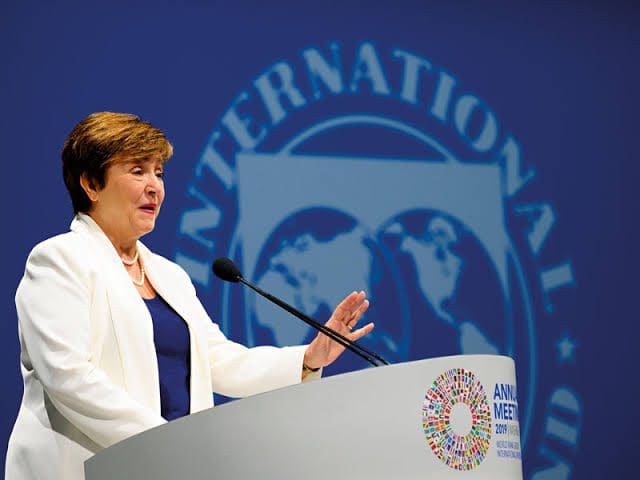

INTERNATIONAL Monetary Fund (IMF) Managing Director Kristalina Georgieva has proposed a new public payment system to connect various payment systems.
According to a statement on the it’s website, Georgieva said the new payment system would help offset the fragmentation of the world monetary system hastened by Russia’s invasion of Ukraine.
The IMF boss revealed that over the last three decades, global economic integration has sustained growth and lifted more than one billion people out of extreme poverty.
“Some countries may develop parallel payment systems to mitigate the risk of potential economic sanctions.
“While private digital money providers are promising cheap cross-border payments, but often within a closed network of users.
“These ‘payment blocs’ would only worsen the impact of broader ‘economic blocs’, creating new inefficiencies and imposing new costs.
“This would harm productivity and living standards in all countries,” Georgieva told a conference in Zurich hosted by the IMF and Swiss National Bank.
A new public payment system, which employs technology to connect multiple forms of money, according to the managing director, might make payments work for everyone in all countries.
Commercial bank deposits, as well as central bank digital currencies and possibly some stable coins, are among the numerous types of money, according to her.
Countries must collaborate to develop new highways, railways, bridges, and tunnels, according to Georgieva, using public digital platforms to connect payment systems.
“This would make international payments more efficient, safer, and more inclusive. Crucially, it would reduce the risk of fragmentation.
“Indeed, we must think like a mountaineer in three ways: use state-of-the-art equipment, adapt to the existing terrain, and rely on our team.
“First, we must use state-of-the-art equipment, especially new technologies. This brings me to my second point, just like good mountaineers, we must adapt to the terrain.
“This means building platforms that allow countries to continue pursuing their policy objectives especially when it comes to capital flows.
“My third point is that mountaineers never climb alone. They rely on their teams and their well-rehearsed reactions and signals to deal with unforeseen situations.
“This approach is essential to modernise the international payment system and mitigate fragmentation. It means, above all, getting governance right,” she said.
Countries, according to Georgieva, will ultimately decide on governance issues such as who will oversee these platforms.
While international organizations like the IMF, the Bank of International Settlements, and the Financial Stability Board, she continued, may play a key role.
“Together, we can put the international payment system on a sounder footing.
“To support the digital world of tomorrow, to foster an international monetary system that can bring greater stability and prosperity for all,” she said.

