
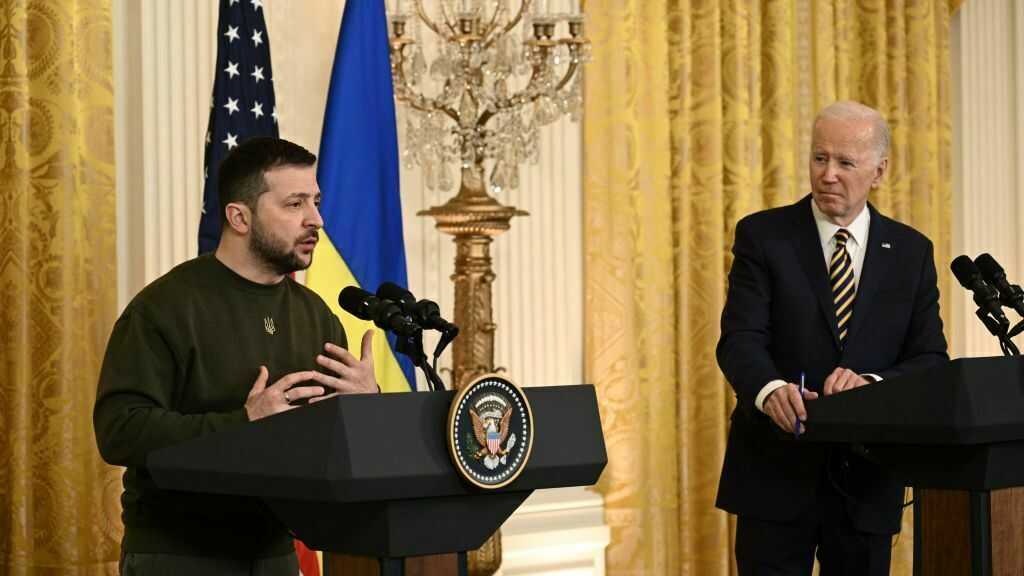

It is one year since Russia’s full-scale invasion of Ukraine began. America is a major force that has helped Ukraine to withstand Russia. SADIQ YISHAU takes a look at what America has done in the last one year to support Ukraine.
The briefing was at the Washington Foreign Press Center. The theme was “One Year Later: Helping Ukraine Win the War and Secure Peace”. Moderated by Doris Robinson, three high-level guests, Deputy Administrator for Policy and Planning with USAID Isobel Coleman, USAID’s Assistant Administrator in the Bureau for Europe and Eurasia Erin McKee and Assistant to the Administrator for USAID’s Bureau of Humanitarian Assistance Sarah Charles took on the topic headlong.
Deputy Administrator Coleman went down memory lane. Coleman said Ukrainians from Kyiv to Mariupol woke up to bombs dropping on their country. “And while the warning signs of Russia’s full-scale invasion of the country had been growing for some time, people still just couldn’t believe it was actually happening. It was inconceivable that this unprovoked expansion of the conflict would take place,” the deputy administrator said.
Within days, Coleman added, it was apparent that President Vladimir Putin would not relent.
“Ukrainians not only fought back but inspired the world with their resiliency and ingenuity,” Coleman said.
According to Coleman, as the days progressed, Russian forces continued to brutalise innocent people.
The deputy administrator said: “They targeted civilians, bombing homes and apartment buildings, and committing crimes against humanity, including the rape and torture of civilians in places like Bucha and Zaporizhzhya. They’ve used food, energy, and critical infrastructure as weapons of war by blocking grain shipments and bombing ports, targeting heating, water, and electricity hubs to deliberately freeze out civilians throughout the winter.
“Putin clearly didn’t understand just how self-defeating it would be to bet against the Ukrainian people. We’ve seen farmers continuing to work their fields wearing flak jackets. We’ve seen engineers designing portable stoves so that people can cook foods in community centers. And we’ve seen civilians banding together to make flak jackets out of household supplies.”
USAID in Ukraine
To support the people of Ukraine, Coleman said, USAID has provided over $15 billion in development, economic, and humanitarian assistance to address urgent needs.
“We’re investing in Ukraine’s economy and helping to resuscitate it after the Kremlin’s attacks on its civilian infrastructure, and we’re helping restore the country’s energy and heating system to counter Putin’s attempts to use winter as a weapon against the people of Ukraine. We’re protecting public health from the deadly consequences of Russia’s war and supporting Ukraine’s health system to restore services while advancing reforms that are critical.
“And we’re also continuing our longstanding work in Ukraine to help Ukrainians fight corruption at every level to build public trust, to maintain donor support, attract private-sector investments, safeguard the country’s institutions, and speed its integration with the rest of Europe.
“The Ukrainian people have shown us that they’re not just capable of winning the war but of winning their future, securing their own prosperity, independence, and democracy. And the United States and USAID will continue to support the Ukrainian people however we can for as long as it takes,” Coleman added.
Ms Coleman said victory is a term for Ukrainians to define, not for the United States. “So I will continue to underscore the fact that we will stand with Ukraine, walk with Ukraine, for as long as they need us to,” she said.
According to Ambassador Mckee, the United States has provided greater development assistance to strengthen democratic institutions as well as direct budget support to help offset the increase in energy prices.
Ukraine, he said, pulled from the Russian grid and tapped into the EU’s grid last December in anticipation of Putin’s threats to leverage of energy as a weapon of war.
Estimates of environmental damage of the war
McKee said America is working with the World Bank and other partners to look at the environmental impact. “As long as the conflict continues, we don’t have a final number, but as you know, the United States is deeply committed to Ukraine’s vision of its future, and that is a strong, sustainable, green country after they ensure Putin’s strategic failure. And so alongside the World Bank and the other partners that we’re working with on the ground to both assess the damage and where the response is most needed, environmental assessment is a key element of that analysis. I don’t have a figure for you right now, but you are right, it is something that must be factored into – as we move into recovery and ultimately restoration, that that cleanup work is on an order of magnitude alongside the destruction.”
Coleman added that the environmental toll is not just confined to parts of Ukraine, where the fighting is going on.
“I think, where it’s most acute, but you’ve seen – because energy has been used as a weapon of war, you’ve seen countries now resorting to using more coal just to get through the winter. When I was in Kyiv a few weeks ago, the air was heavy with coal dust, and this is not a city that had to rely so heavily on coal before. And with the Black Sea being closed for so many months, you saw a lot of exports having to take a much longer route and using up much more energy to try to get critical goods out of grains to feed the world out of Ukraine. So the – I think the environmental toll is – has not been calculated, but we know it’s very, very large,” she said.
The Black Sea Grain Initiative
Coleman described this initiative as critical and added that the agreement should be both extended and expanded for the full year that the Ukrainians are requesting so that farmers and other agribusinesses have the confidence to be able to plan out for a year. “We are hearing reports that farmers are not planting their full fields for fear of not being able to export. And so much of the world’s poor and hungriest depend on grain from Ukraine, and so it’s really important to have the consistency of this agreement and also to expand it to include other ports, such as Mykolaiv, so that the Ukrainians can export more of their grain and other products to the word,” she said.
Allies
Coleman hailed countries that have partnered with America to help Ukrainians. “Countries from around the world have rallied to Ukraine’s side, providing everything from financial support to autotransformers to military equipment. Japan has just announced a significant contribution of financial support to Ukraine, as has Norway and many other countries. And I think it’s a reflection of the fact that countries around the world understand that this is not just about Ukraine but about the – really the defense of freedom and democracy and the future of a values-based world,” she concluded.

