

Book Excerpts
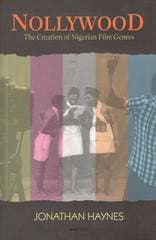
(Being the preface to Jonathan Haynes, Nollywood: The Creation of Nigerian Film Genres. Bookcraft, Ibadan, 2017.)
“SURULERE is nice,” Bond Emeruwa said, and I agreed. It’s the Brooklyn of Lagos: a relatively low-density neighborhood and therefore neighborly and relaxed, and it’s full of creative people—the concentration of Nollywood filmmakers like Bond, longtime president of the Directors Guild of Nigeria, is what draws me there. It has the buoyancy of a neighborhood on the way up, with money pouring into it. Generally, it’s a fine place to have a beer in the cool evening while the conversation flows, to run into friends and acquaintances, to laugh and float in the current of news and gossip.
But Surulere is shaped by the same forces and structures or lack of structures that produce a dreary monotony across the whole city and all Nigerian cities: burglary bars, imposing metal gates, embedded glass topping cinderblock walls, concrete blackened by urban pollution and tropical mold, informal commerce and parked cars crowding the cement aprons of businesses and sidewalks (in the rare cases where sidewalks exist), motorcycles weaving through stalled traffic so that walking is taxing and hazardous. A thick tangle of electrical wires hangs overhead and cobwebs the sides of buildings—illegal connections that overload and short out the grid and keep it from economic viability. Not that anyone feels sorry for the electrical power authority. Nigeria’s electricity problems are legendary: twenty billion dollars have been invested in the sector since the end of military rule at the turn of the new millennium without visible results.
Power blackouts are constant in Surulere, like everywhere else. Businesses have to create their own infrastructures for water, sewage, and security as well as power, which increases their expenses by at least a quarter—a tremendous drag on the economy and a deterrent to investment. Since Surulere is a middle-class neighborhood, many people can afford to have generators, so the roar of traffic is supplemented by the roar of thousands of generators. This background din is hard to keep off the soundtracks of Nollywood films, which is one problem they have in getting into international film festivals.
The population of Lagos has grown to about twenty-one million. Even Victoria Island, once the green and pleasant part of the city that the British colonial elite claimed for themselves, has been relentlessly built up and paved over, gleaming bank towers and car dealerships replacing comfortable bungalows with their surrounding vegetation. But no amount of investment buys insulation from the ambient chaos just beyond the marble steps and wrought-iron fences. The city has grown without planning (or, to be exact, without enforcement of plans) and no sense of the common good, of public space. One night in the pouring rain, lurching and floundering through the flooded, potholed streets of Victoria Island looking for a way around a particularly intractable “go-slow,” I noticed that the small street next to the Lagos residence of the Delta State governor—a position that permits unregulated and unlimited access to oil money—was choked with an eight-foot-high mound of garbage. On another occasion I was being put up for a few days at a fancy hotel on the Lekki Peninsula, a sandbar stretching east from Victoria Island, inhabited by a few fishermen twenty or thirty years ago and now a vast construction site of McMansions. The hotel was said to be owned by the former vice president Alhaji Atiku Abubakar, and inside the marble was kept admirably polished. But the road to it hadn’t been completed—there was a story about the work being suspended immediately after the last election. As our car entered the gate its oil pan hung up on the threshold, the threshold between public and private, and we had to get out and walk.
Adeniran Ogunsanya Street is one of the main thoroughfares of Surulere. At the southern end, fast-food restaurants on the American model cluster around the roundabout. Such fast food is expensive in Nigeria, and these places have doormen and are settings for dates in romantic films. Near the roundabout, a dilapidated old open-air shopping mall has been replaced by an enormous, spiffy enclosed and air-conditioned one, anchored by a Shoprite grocery store, part of a South African chain. The new mall has a first world sense of space utterly unlike anything seen in Surulere before. It stays open late for weary shoppers who have been stuck in traffic. Families bring their children to stroll around the mall’s wide smooth corridors. In 2013 a multiplex cinema opened in an adjacent, still-newer mall.
The current governor of Lagos State, Babatunde Raji Fashola, and his predecessor and mentor Bola Ahmed Tinubu have been pioneering a novel (for post–oil boom Nigeria) form of governance: collecting taxes from citizens (as opposed to running the state on the federal government’s allocations of oil revenues) and visibly delivering services in return. Most neighborhoods have not yet profited much from this—half the population lives on less than two dollars a day, and their lives have hardly changed—but Adeniran Ogunsanya Street has been resurfaced and its gutters fitted out with neat covers from one end to another. The northern end terminates in another traffic circle, this one under the flyover of Alhaji Masha Road. The Surulere Central Mosque with its bulbous minarets stands on one side of the circle, and Hausa money changers occupy the sidewalk on the other side. The supporting walls of the flyover used to be plastered with film posters, but the government now rigorously scrubs them off.
A few years ago Adeniran Ogunsanya Street was dotted with cybercafés, which often doubled as international internet telephone call centers. Now they are almost all gone, since wireless modems and internet connection plans have become affordable, laptops are common, and smartphones are essential status symbols. In 2010, $2 billion was invested in transatlantic fiber optic cables into Nigeria. Satellite television is cheap and ubiquitous. Apartment buildings sprout dishes down their sides like orderly lichens. Every bar and restaurant, most hotel lobbies, and many offices have plasma TVs tuned to the Africa Magic channels from M-Net, part of a South African media conglomerate that also owns the satellite television provider Multichoice. Africa Magic broadcasts Nollywood films twenty-four hours a day, seven days a week, transfixing the population. This is bad for the film business: why buy films when they are always on television for free? Nollywood’s business model is in perpetual crisis even as it has achieved hegemony as a cultural force.
Western Avenue soars, sometimes elevated, over the eastern side of Surulere, part of the ambitious highway building of the oil boom era of the 1970s. As it sweeps south over the bridge onto Lagos Island (the oldest part of the city, the business and administrative center), it provides panoramic views of the skyline of high-rise office buildings and, across tide-roiled waters, ocean-going freighters tied up to the Apapa wharfs. This is the biggest port in West Africa, feeding the vast industrial areas of Ikeja in northern Lagos and filling the trucks that, at night, sit parked lining for miles and miles the road north to Ibadan and the interior of the country. The ships arrive heavily laden and leave high in the water; to balance the trade, oil flows out of Niger Delta ports, Port Harcourt, Bonny, and Escravos.
When I was first learning to pilot my way around Lagos in the early 1990s the highways were horrific. Where the guard rails hadn’t been stolen to be melted down into cooking pots, they recorded a history of appalling vehicular violence, yard by yard, smashed, twisted, blackened. When traffic reached the speed for which the highways were built, the potholes became lethal. The signature vehicle was the moluë, a bus locally constructed on a truck chassis, packed solid with passengers, belching black smoke. One assumed they didn’t have functioning brakes. Young men hung precariously to the outsides as the vehicles careened along. A school of literary critics named itself bolakaja after the challenge shouted by the rough bus conductors: “Come down and fight!” Not the least of the problems on the roads were the many roadblocks manned by the menacing foot soldiers of the military regime and predatory police. They extorted money and shot people to death with impunity: “Sorrow, tears, and blood / dem regular trademark,” Fela sang. The nation seemed to be in a death spiral under the malign auspices of the self-styled “evil genius” General Ibrahim Babangida. The economy collapsed, and in the general social disintegration armed robbery depressed nightlife (putting an end to cinema-going, for instance). The soldiers and police were not being paid enough to live on so they had little choice but to turn to extortion, and they were probably under orders to kick back money to their superiors. It was generally understood that the police were often in league with the armed robbers.
Now, more than a decade after military rule ended in 1999, the roadblocks and military personnel are almost all gone, contracted into dark, silent riot vehicles parked at strategic locations—closed up and so ominously dark they seem to absorb all the light and sound around them. The armed robbers have mostly been chased off into other parts of the country. The moluës are gone too, replaced by big red and blue buses with their own express lanes. A company given a contract to put up street signs actually did so. A few vehicles now track their progress with GPS navigation systems. But Lagos is still a city that wears its citizens out in traffic. Bone-weariness from hours of buffeting by fumes and noise and nervous tension is a fundamental Lagosian sensation.
Just south of Surulere, the National Arts Theatre sits on swampland. It is also an expression of the oil boom, of the era when Nigeria, “the giant of Africa,” flush with cash and self-confidence, hosted FESTAC, a lavish celebration of world black culture. The theater’s sweeping curved lines recall Eero Saarinen’s TWA terminal at JFK airport. Some say it looks like a military officer’s hat; it also suggests a crowned head, the dark glass facades seeming to veil something potent—an imposing presence in the cityscape, as it was meant to be. Water rises from the sodden ground to have its way with the pavement, at one point the roof leaked and the air-conditioning didn’t work, and the institution has been repeatedly threatened with neoliberal privatization. But it is still the national theater. On Sundays, families troop in as they have always done to watch new Yoruba films.
What has gone on in the grounds around the theater has been as important as what happens inside it. The Actors Guild has its headquarters in a bare outlying building. Casting calls take place under the trees. Under the trees—Abe-Igi—actors from theater, television, and film meet to drink beer, gossip, and talk shop. (Or they used to: in 2013 a new director of the National Theatre, evidently a person with no sense of the ecology of creative communities, ordered everyone but staff employees away from the area. The actors relocated to a bus stop nearby.) In 1991, in the immediate prehistory of Nollywood, Okechukwu (“Okey”) Ogunjiofor, then a recent graduate of the Nigerian Television Authority’s training program but unemployed because of budget cuts and a hiring freeze and reduced to hawking things in the street, happened upon a group of actors rehearsing a play under those trees and began offering unsolicited advice. So began his integration into the social network that would produce the first Nollywood film, Living in Bondage, based on his own story.
The National Stadium is just to the east of Western Avenue, where Alhaji Masha Road crosses under a flyover. The adjacent Stadium Hotel was for years an epicenter of highlife music, the soundtrack of the independence era. In 1991, Okey Ogunjiofor got a job videotaping a social event at the stadium; the celebrants cultivated his acquaintance and he eventually discovered they belonged to a secret cult—the germ of the story of Living in Bondage. Babangida’s henchman and successor as military dictator, Sani Abacha, demonstrated with brutal clarity the principle that as long as a military ruler controlled the oil wellheads, could make deals with complicit foreigners for the oil’s immediate export, and was willing to shoot protesting citizens down in the streets, he could stay in power almost indefinitely. Babangida’s way, by contrast, was to expand the already robust cohort of corrupt Nigerian politicians and organize them into an elaborate masquerade of democracy. The oil money kept flowing as the country sank into misery, finding its way through secret channels to fund the kind of display of wealth and social power that Ogunjiofor was filming. Gaudy arrogance, with barely disguised roots in corruption and dark wickedness, dominated the public scene.
The western side of the stadium structure, facing Surulere, now houses O’Jez Restaurant, with an open-air courtyard below where beer and pepper soup are served. The owner, Joseph Odobeatu, is a businessman dealing in industrial equipment with a strong interest in sports and show business, and the nightclub was established as a celebrity hangout. A swirl of stories surrounds O’Jez, like everything else in Nigeria. With Chinese partners, Odobeatu built factories in Lagos to replicate Nollywood films on video compact discs (VCDs), which replaced VHS cassettes as the standard medium for Nigerian films. (Until these factories were built, Nigerian producers took their films to Singapore for digital duplication.) But Odobeatu was cheated by his Chinese partners and nearly ruined. Jahman Anikulapo, who for years was arts editor of the Lagos Guardian and is the doyen of Lagos’s cultural nightlife, worked withOdobeatu and the veteran broadcaster Benson Idonije to organize a series of highlife nights at O’Jez from 2000 to 2008. This was a work of cultural reclamation: Nigeria is reckless with its history, and the great musicians of the sixties and seventies were mostly growing old in poverty and obscurity. The concerts returned them to the limelight, if only briefly, and resurrected a whole bygone era. But finallyJahman and Idonije got fed up with Odobeatu’s refusal to share his fat profits with the musicians and angrily withdrew.
Once when I was leaving for the airport, Western Avenue and the other main roads were clogged so the taxi driver took the back route, north and west through Surulere to Itire Road. The driver was an old Yoruba man, thin with a gnarled hand on the gear shift, wearing Yoruba-style clothes sewn from boldly printed fabric and hoarse from his constant commentary to other drivers and pedestrians. His spare, angular VW was like him, not yet a rattletrap but weathered, of a piece with the whole environment of Lagos’s streets and roadways. His driving was aggressive and highly skilled—he was a master of the art of pushing through crowds.
I was noticing the architecture of the buildings along the streets, which for some reason was emerging out of the blur of the cityscape as if for the first time in my experience. I was noticing the buildings had architecture: the fabric of the neighborhood was detached two- or occasionally three-story buildings, each one different. The structures had common elements: shallowly gabled, soffited tin roofs, louvered or casement windows with burglary bars, water tanks mounted high up behind the buildings on rough metal piping, the dreary electrical wires draped around everywhere recording a history of failed and makeshift connections. The predominant style was distinctly modernist in its cheerful use of standardized industrial materials and its clean, functional geometries, window frames popping out of subdued flat stucco surfaces. But this deck was constantly reshuffled, and many buildings were fanciful and original, with bold asymmetries and the same kind of curved poured-concrete architectural shapes found in the extravagant mansions Nollywood likes to use as sets.
There are blocks of uniform, government-built housing units in Lagos and even some high-rise apartment buildings (though living nine floors up in a building where the elevators often don’t function because of power outages is a problem), and new corporate architecture—an unbelievable number of bank buildings, mostly—lines some streets. But overwhelmingly Lagos is composed of small structures, built in an unplanned, unregulated environment for private use or by a landlord for rental. Each construction is an individual project, an independent, small-scale initiative.
Old buildings in the Yoruba style began to appear amidst the modernist urban structures along Itire Road. Heavy-walled, with the pitched, rusted corrugated tin rooflines so redolent of the colonial era, they could have been transported from Oshogbo or Ibadan—J. P. Clark’s “Ibadan”: “running splash of rust / and gold—flung and scattered / among seven hills like broken / china in the sun.” Here the sunlight had trouble reaching them, it being the rainy season, with thick rolls of cloud slowly lifting over the city. They were also a bit overshadowed by the buildings around them, though they seemed impressively solid and enduring—not relics, still very much part of life. My taxi driver might live in such a place. Through the open front doors, over high sills that had been worn and darkened by the passage of many residents, I could glimpse cavernous rooms below street level; what daylight made its way in through the doors splashed color from the clothing of those gathered within. Later, they would light hurricane lamps. Then a street of shops selling car parts. We followed a line of vehicles through a rupture in the barrier separating the neighborhood from the Apapa-Oworonsoki Expressway, a chunk of concrete in the adjoining ditch making this unofficial on-ramp navigable, and so up into a prospect of warehouses and billboards and, in the distance, the airport, with a plane glinting above it.
It occurred to me that the basic character of the Lagos urban fabric was the same as the structure of the film industry, which also is gigantic, astounding in scale, filling the horizon farther than the eye can see, but all generated by small-scale independent producers. They can work quickly and cheaply because of the stock of interchangeable elements, but each product is unique. The predominant style is resolutely modern, but there are enduring, much older structures and occasional gleaming postmodern edifices. The film industry also, in its way, provides a place for Nigerians to live.
Living in Bondage appeared in 1992. In 1994, in recognition of the “video boom,” the Nigerian government reorganized and renamed the Federal Film Censorship Board as the National Film and Video Censors Board. By the end of 2010, the NFVCB had registered more than fourteen thousand Nigerian feature films made on video.
{~?~IM: insert figure 2 here.}
This is a very, very large number. In contrast, Nigeria produced a total of about one hundred films on celluloid between 1970, when the first Nigerian film appeared, and 1992, when celluloid production ground to a halt. The rest of sub-Saharan Africa (excluding South Africa) produced fewer than four hundred celluloid fictional feature films between 1964 and 2006 (figures compiled from Armes 2008). In twenty years, Nigeria has indisputably created one of the largest film industries in the world.
The Nigerian film industry is not synonymous with Nollywood. The term “Nollywood,” which was coined by New York Times reporter NorimitsuOnishi in 2002 (Onishi 2002), refers primarily to the English-language films emanating from the production and distribution system based in Lagos and in the eastern Nigerian cities of Onitsha, Asaba, Enugu, and Aba. Nollywood is sometimes said to be an Igbo thing, and it is true that the marketers who have always been the dominant force in the industry are overwhelmingly Igbo. Living in Bondage and the other earliest Nollywood films were in the Igbo language. English-language films did not begin to appear until 1994, after which they quickly eclipsed Igbo-language films. The medium of English allowed people from many southern Nigerian cultures to enter the industry, and they have played such important roles that Nollywood can certainly not be thought of as “owned” by the Igbos. (In general, Nigerians often talk as if the country were divided among the Igbos, Hausas, and Yorubas, the three largest ethnicities, but there are two hundred and fifty ethnic groups in the country, and the “big three” together amount to only half the population of 170 million.) Under the aegis of Nollywood, films are made on a small scale in “minority” southern languages such as Bini/Edo and Efik.
In northern Nigeria, there is a quite separate film industry making films in Hausa, which few people would include as part of Nollywood. Most Hausa filmmakers see their films as an expression of specifically Hausa (and Muslim) culture and values, and one can read Hausa film culture as a reaction to and against Nollywood. The aesthetics of Hausa films resemble those of Nollywood in some respects but are different in others, most obviously the Hausa films’ obligatory song-and-dance numbers in the Indian style. Nollywood and Hausa films are never carried in the same distribution systems, few personnel cross over, and Nollywood filmmakers and audiences tend to have only a dim awareness of Hausa films.
A large and sturdy tradition of filmmaking in Yoruba descends, for the most part, from the Yoruba traveling theater by way of television appearances and celluloid films. The relationship of this segment of the industry to Nollywood is ambiguous. Yoruba filmmaking exploits specifically Yoruba cultural resources and has a core of distinct social and business networks. The Yoruba, Hausa, and Nollywood branches of filmmaking all have their own separate professional associations. But many people cross over between the Yoruba and Nollywood industries, their aesthetics overlap a great deal, and mutual awareness is strong. The Yoruba branch of filmmaking is recognized as different, but out of courtesy and recognition of its historical priority and continuing vitality, it is often treated as part of Nollywood.
Yoruba filmmaking has continued fairly steadily as the English- and Hausa-language industries have gone through cycles of boom and crisis, so the ratio among the three branches has fluctuated. Over the last twenty years the total number of films in Yoruba has been somewhat lower than those in English, with Hausa production at about half the level of the other two.
Yoruba and Hausa films are carried to wherever there are people who speak those languages, in adjacent countries and throughout the African diaspora. But it is Nollywood that has become the powerful international brand—“the Pan-Africanism we have,” in John McCall’s resonant phrase (2007)—watched across the African continent on the same Africa Magic satellite channels that Surulere tunes into and sold to Caribbean immigrants in Brooklyn who probably have no inkling that Nigeria makes films in languages besides English. The Nollywood brand is now so powerful it is sometimes used to refer to all Nigerian filmmaking.
This book follows the contours of “Nollywood” as I have just outlined them. English-language and Pidgin films are its subject. I take a friendly interest in the Yoruba tradition but do not pretend to anything like a complete treatment of the topic. I cheerfully leave Hausa films to those who are qualified to talk about them. (See the excellent works by Abdalla Uba Adamu, Brian Larkin, Matthias Krings, and Carmen McCain.) Because films from Ghana’s film industry, which closely resembles Nollywood, are carried in the same distribution system and many actors cross over, I refer to them occasionally. (On Ghana, see the excellent works by Birgit Meyer and Carmela Garritano.) I do not discuss the earlier celluloid films except incidentally. (Readers should consult the proper authorities, including Hyginus Ekwuazi, Frank Ukadike, Françoise Balogun, and OnookomeOkome.) Nigerian video film culture has effectively become Nigeria’s film culture: a generation has grown up in a world saturated with video films but with little or no chance ever to see the films made in the period of celluloid production, though those films do perhaps continue to exercise some gravitational pull, like a dark star.
First and last, my interest in Nollywood has sprung from a fascination with Nigeria itself. The films are a record and interpretation of contemporary Nigeria, a social and emotional history. Nollywood’s characteristic themes and its distinctive and original set of genres arise out of Nigerian society and address its values, tensions, and historical experiences. Africans have had to struggle to get their stories told on film as well as in other media, and in this respect Nollywood is a triumph of enormous proportions, all the more impressive and interesting because it is a popular art form whose perspective must stay close to that of its broad audience of ordinary Nigerians or risk commercial disaster. Of course the stories Nollywood tells and the way it tells them don’t spring spontaneously from the mind of “the people”—they are mediated by the complex nature of the film industry itself. My story about the unfolding of Nollywood’s central themes and genres is intertwined with an account of the nature and evolution of the industry.
The Nollywood business model is to produce movies cheaply (the average film budget is about $65,000) and quickly (often just a few months from start to finish) and to recoup the investment within another month or so. This model is enforced by the glut of films on the market and widespread piracy, both of which limit the shelf life of films and potential profits. The resulting movies are inherently and essentially generic: individualizing a film costs time and money, and a film that does not give off strong generic signals will get lost in the market. Even beyond such necessities, Nollywood’s culture is conservative, working and reworking a durable set of themes and plot types. (The conservatism coexists with a relentless quest for novelty, varying or recombining existing forms and exploiting topical material. The quest for novelty also has commercial motives.) Individual films almost all disappear from the market to make room for others after only a very few weeks, so if a story hits a nerve with the audience, it needs to be retold to stay in public consciousness. The stories that are repeated, that don’t wear out or that do so only after almost infinite repetition, have a special power: they are the most motivated and essential, the most deeply embedded in the tensions of contemporary Nigerian life. Much of the films’ meanings lie in their common forms and thematic complexes, and these are what I try to map and explicate.
In naming genres I have followed common usages of the film industry and fans. (The one exception is what I call “diasporic films,” which seem to have no generally accepted name.) These usages are not altogether consistent or systematic. Internet sites selling Nollywood films often dump them into Hollywood’s generic categories, which is usually misleading (Haynes 2010b). The terms I have adopted from the parlance of video shops in Nigeria indicate how different Nollywood’s genres are from Hollywood’s, how profoundly they express the intensions of Nigerian society.
I understand genre to be a messy business, not a matter of neat taxonomies. My shifting methodological approaches reflect that sense—you can’t see a masquerade by standing in one place, as they say. I dwell on origins, borders, and the evolution of genres as they react to changed circumstances and generate new genres by dallying or mating with one another. Nollywood genres are often defined by their settings, so something like a sketchy social geography will emerge as Nollywood opens out a succession of social spaces for representation.
By now a lot has been written about Nollywood,[i] but nothing like a full-scale survey of its genres. I have tried to be comprehensive but the results seem (even to me) to be personal and essayistic. There are simply too many films and too many kinds of films. Other writers naturally will draw lines, name things, and place emphases differently. At least I have made a start.
The same is even truer for the book’s historical dimension. Originally I didn’t intend an historical dimension, in part because I appreciated how little had been done along those lines and how much work it would be. I provide a rough scaffolding at best, certainly not the thorough, detailed history Nollywood deserves. As I repeat on every possible occasion, the materials for such a history urgently need preservation, beginning with the films themselves, many of which exist only on videotape now decomposing in tropical heat and humidity. Memories also decay and those who hold them disperse and die, so personal testimonials need to be gathered systematically and preserved in permanent form.
We are still close to the beginning of one of the world’s important film cultures. Nollywood has grown and changed at a phenomenal rate, but some solid foundations appear to have been laid. “No condition is permanent” is a phrase often emblazoned on Nigerian vehicles. I’ve tried to remember this even as I’ve searched for what seems enduring in the young Nollywood tradition.
My accounts of the genres place a proper African emphasis on foundings and seniority. Of course people love to argue about such matters, so unfortunately this is not a terribly effective method of avoiding complaints that I have favored some films and filmmakers over others. I am certainly not attempting to discuss all the important ones and I beg for understanding and forgiveness from those whose contributions are overlooked here. My purpose is to outline some basic aesthetic forms, historical shapes, and social meanings, to provide some aids to navigation in this vast sea of stories.
The book’s first part describes the foundations on which the industry was built and the initial genres, which remain hallmarks of Nollywood: the “money ritual” film, in which occult practices become a figure for social predation under military rule; films about “senior girls,” independent career women hungry for power, money, and sex; and the “family film,” often about a marriage threatened from within or without. These early chapters contain extended readings of several key films and accounts of the artistic visions of important founding filmmakers, including Kenneth Nnebue and Amaka Igwe. An entire chapter is devoted to Tunde Kelani’s films. The chapters in part 2 reflect a partial shift in Nollywood’s center of gravity from Lagos to Igbo southeastern Nigeria. The village is the crucial horizon of the imagination in “cultural epics” about the precolonial past and its values, and in some of the other genres emerging around the turn of the millennium that dealt directly with the crisis levels of violence and disintegrating governance as well as with the anxieties attending longer-term historical changes. “Political films” became possible after the end of military rule in 1999, and comedies reprise some of the same themes in a more buoyant spirit. Part 3 describes genres about Nigerians living outside of Africa and on university campuses—far removed from the rooted culture of village films. The Internet, satellite television broadcasting, and new multiplex cinemas, along with other factors, have unsettled the economic basis of the industry and led to segmentations of filmmaking and audiences. As it enters its third decade, Nollywood continues as a vigorous popular art, while a “New Nollywood” aspires to escape the constraints of the old Nollywood marketing system.
From the time Nollywood began I’ve believed that it deserved sustained, respectful attention as an expression of popular consciousness. Karin Barber laid down the principle that the products of African popular culture are no less complex as signifying systems than other kinds of art and that if we don’t see this, it is because we are not understanding what these arts mean to those who produce and consume them (Barber 1987). I find complexity in Nollywood films and even certain kinds of subtlety and delicacy—subtlety not so much of emotion or characterization or technique, but as a wisdom that comes from a shared experience of living with multiple cultures and frames of consciousness, the assumption that individual lives have layers and a whole repertoire of potential responses shaped by a history of rapid, uneven development. The delicacy is that of the balance of contending forces, of wavering battle lines or the quick, precise movements of straining wrestlers.
I’m annoyed by simple and often dismissive generalizations of Nollywood as being this or that. However we choose to value the films, in order to understand them well enough to make judgments we needed a more differentiated view of the movies and of the industry they come from. Genre provides such differentiation: each genre creates a different world, seen through a different lens. There are also segmentations, duly noted, along cultural, class, and generational lines. But there is an overarching unity to Nollywood based on the bedrock values of its audience: moral purpose and the sense of community. I try to always keep in sight and in mind the world that Nollywood films emerge from, the rough cement, the turbulent, disrupted circulations of vehicles, electricity, and trade goods, and have no wish to ignore the whole mass of motives, high and low, that brings the films into being, or the consequences of working on astonishingly low budgets. I keep watching the films because they are addictively entertaining, but also because I take Nollywood’s values seriously—not just those of a few exceptional films, but the values embedded in basic generic forms across the whole range of production. I believe Nollywood deserves credit for its roles as a chronicler of social history, as an organ of cultural and moral response to the extreme provocations and dislocations of contemporary Nigeria, and as the bearer of a true nationalism. It arose in Nigeria’s hour of need, when everything was crumbling, including the ideologies on which the state was based. In the midst of a general retreat into exclusionary, Manichaean forms of religious and ethnic thinking and—most of all—into a sheer head-down struggle for survival, Nollywood managed to stage debates about fundamental issues and sustained an image of the nation as resilient, grounded, tolerant, plural, certainly tormented and suffering but also managing to laugh and to get on with life. The films were always good at expressing aspirations, and now that things are better—for some people, at least—Nollywood is a symbol and source of Nigerian pride, the most visible dimension of the new buoyancy, projecting Nigeria’s self-image across the African continent and beyond.
[i] See my literature review (2010a), agenda for research (2010b), and bibliography (2012) of the academic literature on Nigerian and Ghanaian video films.


5 comments
… [Trackback]
[…] Read More Information here to that Topic: naijatimes.ng/lagos-in-the-movie/ […]
… [Trackback]
[…] Here you will find 99660 more Info to that Topic: naijatimes.ng/lagos-in-the-movie/ […]
… [Trackback]
[…] Read More on that Topic: naijatimes.ng/lagos-in-the-movie/ […]
… [Trackback]
[…] Read More Information here to that Topic: naijatimes.ng/lagos-in-the-movie/ […]
… [Trackback]
[…] Info on that Topic: naijatimes.ng/lagos-in-the-movie/ […]
Comments are closed.