

LIKE most 60-year-olds, Nigerians are looking at the nation’s diamond birthday with a mixed sense of accomplishment and frustration. Six decades after the British handed power to its independence leaders, Nigeria remains far less than its potential offers, and lags well behind other former British colonies like Ghana and India in providing for the wellbeing of its people. Despite billions of dollars in oil earnings since 1970, Nigeria still suffers with some of the worst social indicators in the world, and drifts near the bottom of the UN Human Development Index at number 158 out of 189 countries. Boko Haram is only the top of a list of insurgencies and security crises gripping the country, with the military currently deployed in nearly every state of the federation, and citizens nationwide living in daily fear of being kidnapped or seeing their community attacked by bandits. It is no surprise that some Nigerians are saying they would be better off in a Biafra, an Oduduwa Republic, or a host of other political options that would consign Nigerian democracy to the dustbin of history.
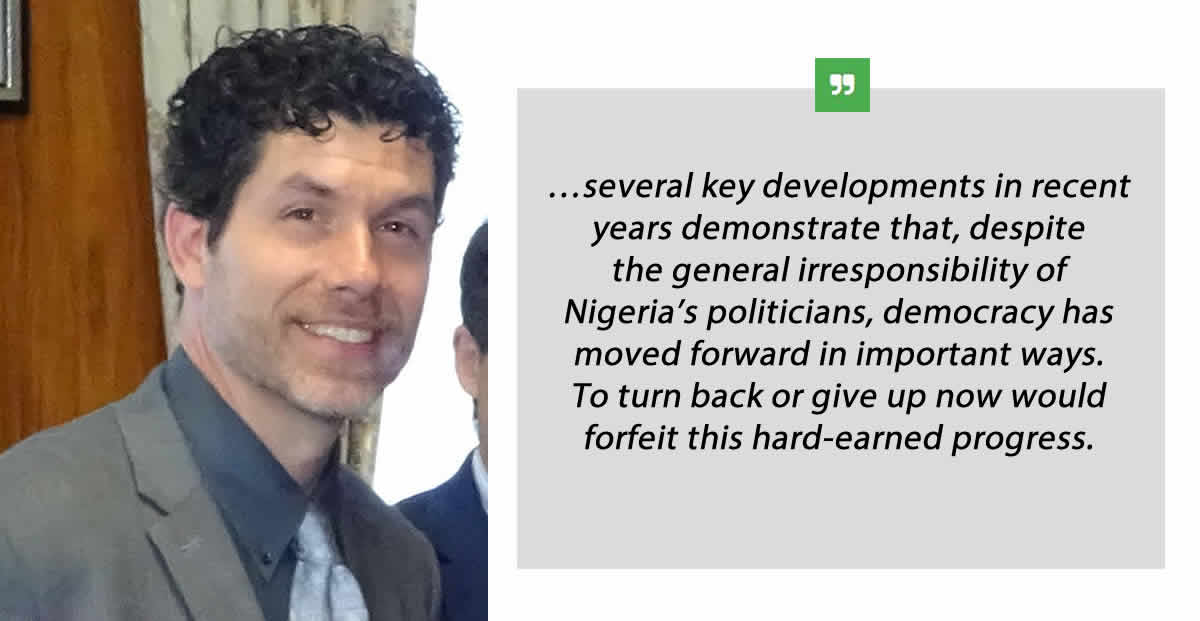
Despite these enormous challenges, however, Nigeria and its democratic system are far from dead, and the nation has made important strides forward since the military handed power to the civilians in 1999 and launched the current Fourth Republic. Often this progress has been made under the surface, or at least below the radar of the international media, which tends to focus on Nigeria’s problems and speculate over its imminent demise. Nonetheless, several key developments in recent years demonstrate that, despite the general irresponsibility of Nigeria’s politicians, democracy has moved forward in important ways. To turn back or give up now would forfeit this hard-earned progress.
Democracy is not an ideal process. We tend, however, to focus on its higher values, such as principled compromise, accountable representation, responsible governance, clean elections, and so on, and we rightly become frustrated when our leaders fall short of the mark. That is as it should be, because our responsibility as citizens in a democracy is to hold our leaders’ feet to the fire of serving the public interest. Nonetheless, democracy is a messy, thoroughly human system as well. It means that you are governed by your neighbours, such that you are sometimes subject to the decisions of incompetent people – just look at the United States at the moment. In new democracies like Nigeria, politicians and institutions take time to learn their roles and to develop responsible patterns of behavior and the networks to support these.
Consequently, one of the most important bright spots in Nigeria’s democratic progress has been the rise of the bargaining culture in politics, particularly at the federal level. At first glance, this may seem like a minor point, but politicians who are willing and able to negotiate solutions to their differences are critically important to democracy. This is especially true in countries like Nigeria that are deeply divided by ethnicity and religion.
Recall that a driving factor in the collapse of the First and Second Republics – leading to civil war and military coups – was the centrality of ethnic-based bargaining. Ethnic politics leads to zero-sum thinking, in which one side’s gain is seen as the other’s loss, resulting in increasingly little room for compromise and leading to conflict escalation. Ethnicity and religion certainly remain the primary vehicles for political mobilisation in the Fourth Republic, but these have been tempered by the culture of bargaining that politicians have developed in recent decades. Many of the major crises of the last 20 years, such as the titanic struggles over President Yar’Adua’s incapacitation and death, or President Obasanjo’s third term gambit, would certainly have provoked coups or worse in the first few decades after independence. Despite these system shocks, Nigeria’s politicians continue to negotiate outcomes that are sufficiently inclusive enough to keep most of them interested in continuing to work within the system.
Note that this does not mean that the politicians are producing good governance overall as of yet, but that at least there is a growing sense of the common good and a shared destiny that is a necessary precondition for responsible public policy to arise. Moreover, without a doubt, part of this bargaining culture is predicated upon corruption, and some of this relative cohesiveness of the political class of the Fourth Republic has been greased by the practice of “settling” political allies and opponents alike.
Yet an extremely important positive product of this bargaining culture has been the rise of multiethnic political parties, especially the APC and the PDP. Ethnic parties like those of the First and Second Republics have a core interest in playing up ethnic differences in order to win elections and solidify their base. Multiethnic parties, on the other hand, have an interest in negotiating identity differences within the party in order to compete more broadly and nationally with other multiethnic parties. Consequently, both the PDP and the APC have generally sought to include as many groups as possible within their ranks in order to gain and hold power nationwide. In addition, in order to promote this sense of inclusion, most of the political parties have implemented an unofficial principle of ethnic rotation of political offices after elections, so that groups have some assurance that key offices will eventually rotate to their community for a four- to eight-year period.
Although elections have been extremely problematic in the Fourth Republic (see below), the fact that they have occurred at the federal and state levels on a regular basis every four years since 1999 is also an important accomplishment. Election quality in Nigeria showed dramatic improvement after Professor Attahiru Jega assumed leadership of the Independent National Electoral Commission (INEC) in 2010 and instituted a number of key reforms. Regular elections have provided important opportunities for changes in leadership, and the fact that the PDP handed power to the APC after losing the 2015 elections marks a key milestone in democratic development.
Another important sign of progress has been the growing independence of key federal institutions like the National Assembly, the Supreme Court, and the federal appellate courts. Although the executive remains by far the dominant branch, the federal legislature and courts have demonstrated occasional willingness to check the presidency. Civil society also remains vibrant, particularly in urban areas.
Several worrisome trends in recent years, however, threaten to undermine this slow but steady progress toward democratic consolidation in Nigeria. Perhaps most concerning is the lack of democratic progress at the state level. Governors still hold tremendous unchecked powers within their states, with little challenge or scrutiny to reinforce public accountability or responsible policies. Much of their power derives from their lockhold on state and local government funds. State assemblies and LGA councils are constitutionally entitled to control these funds, and recent constitutional amendments and federal regulations have sought to reinforce their rights, but the governors by and large still directly or indirectly retain firm control of the purse strings in their states. At the LGA level, gubernatorial supremacy is also maintained by the imposition of caretaker committees in many states, despite the fact that the Supreme Court clearly declared these unconstitutional in 2016. In addition, those LGAs that have held elections, as well as those of state assemblies, are still run by state election commissions, which the governors tightly control.
Election quality in general has fallen in recent years, as the APC and PDP in particular have found more ways to circumvent the electronic and other safeguards that INEC has set in place. The APC, like the PDP before it, has also utilised the police and security forces to their advantage in elections. Civil liberties at the federal level have also come under stress in recent years, as journalists have been increasingly harassed for publishing stories critical of office holders. Three particularly damaging bills have been introduced in the National Assembly on social media regulation, hate speech, and NGO registration, which if passed would severely undermine media and civil society watchdog roles. So far, civil society activists and reformists in the Assembly have managed to block these bills, but the chilling effect that these and other efforts to restrict opposition have had has been unmistakable.
This narrowing of political space along with the growing insecurity across Nigeria has also damaged the political bargaining culture as well. The APC has grown less tolerant of opposition in general, and has yet to signal whether it will consider honouring ethnic rotation in the presidency after President Buhari’s term ends in 2023. In addition, although the APC is widely multiethnic, many southerners see its leadership as increasingly northern. If popular perceptions continue to move in the direction of seeing the APC as the northern, Muslim party and the PDP as the southern, Christian party, as happened in 2015 when Buhari and Goodluck Jonathan were the candidates, the religious and regional polarisation that would result would continue to increase volatility in the system. The PDP, for its part, has failed to reorganise itself as a popular nationwide alternative to the APC, which is an essential check on the ruling party. Internal party democracy remains a major concern overall.
These trends are only a few of the key issues facing democracy in Nigeria today. Corruption remains a fundamental part of politics, ensuring that politicians and government actors are more focused on self-enrichment than providing responsible policies for broad-based development. Massive poverty, tepid job growth, and the incredible surge in population stand ready to overwhelm the few services that government is able to provide in the years to come. Breaking the monopolies of power that the governors hold at the state and local levels would help to start putting state and LGA institutions back on track to addressing public needs at the community level. Greater freedom and competition at the federal level, particularly within and between the APC and PDP, overseen by a vibrant civil society, are also important steps toward putting Nigeria back on track toward democratic development.
Kew is Assoc. Prof. Dept of Conflict Resolution, Human Security, and Global Governance; McCormack Graduate School, Univ of Massachusetts, Boston, USA; and member of Naija Times Editorial Advisory Board


5 comments
… [Trackback]
[…] Read More on that Topic: naijatimes.ng/nigeria-at-60-how-well-is-democracy-doing/ […]
… [Trackback]
[…] Info on that Topic: naijatimes.ng/nigeria-at-60-how-well-is-democracy-doing/ […]
… [Trackback]
[…] Read More here on that Topic: naijatimes.ng/nigeria-at-60-how-well-is-democracy-doing/ […]
… [Trackback]
[…] Info on that Topic: naijatimes.ng/nigeria-at-60-how-well-is-democracy-doing/ […]
… [Trackback]
[…] Info on that Topic: naijatimes.ng/nigeria-at-60-how-well-is-democracy-doing/ […]
Comments are closed.