

• More citizens borrowing for consumptions
• Households unable to repay loans
• Lenders restrict facilities to only those in the cities
THE number of Nigerians surviving on loans has increased by about 10 per cent point since the outbreak of the Coronavirus Disease 2019 (Covid-19) outbreak, says a survey conducted by the National Bureau of Statistics (NBS) and the World Bank.
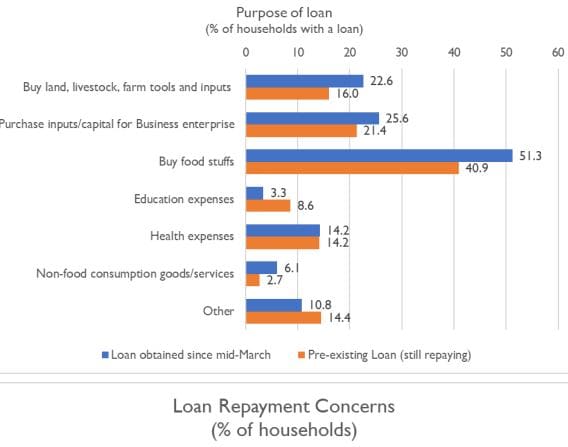
According to the report obtained by NaijaTimes, households who have borrowed to buy food increased from 40.9 per cent to 51.3 per cent since mid-March when the government imposed lockdown measures.
By implication, one in every two Nigerian households has borrowed to feed, owing to the impacts of Covid-19 on livelihoods and incomes. It means an increasing number of citizens borrow to feed than any other purpose, a situation that may have pushed society deeper into the primary level of existence.
An independent analysis of the research shows that the percentage of those who take loans to buy food outweighs the total sum of those who do to fund education, healthcare, enterprise, inputs/tools.
Interestingly, the research also shows that more households embraced farming following the Covid-19 outbreak. It will be recalled that many businesses, including aviation and recreation, had closed shops for close to six months this year. More Nigerians had to embrace farming as alternative means of generating incomes and kill boredom.
The research disclosed that 22.6 per cent of Nigerians borrowed money to buy land, livestock, farming tools and inputs between mid-March and August as against 16 per cent that did the same before the outbreak of Covid-19.
The number of those who borrowed to fund non-farming businesses also increased, but slightly — from 21.4 per cent to 26.9 per cent – while the percentage of those whose loans were channelled to healthcare remained constant. The health category of borrowers, perhaps, was unchanged as most people who handle health challenges took to traditional medication as a phobia for hospitalisation became rampant in the wake of pandemic.
It is not surprising that the number of households that took loans to fund tuition and related matters dropped from 8.6 per cent to 3.3 per cent, a fall of over five percentage points. Schools are just re-opening after seven months of closure.
Citizen’s inability to repay loans increases
THE pandemic has worsened households’ ability to repay loans taken before and during the pandemic. The research says 67.1 per cent of households are “very worried” about their ability to offset the loans they took during Covid-19.
On the other hand, 54 per cent of the respondents are said to express the same concern about loans taken before the pandemic. Only a combined percentage of 4.1 said they have repaid the loans taken before and during the outbreak just as 5.9 per cent are not worried about how they would repay their debts.
The survey also unveiled another interesting character of Nigeria’s retail credit market – it is still extremely informal. According to the findings, over 55 per cent of the loans were obtained from friends and relatives while 16 per cent were from cooperatives and savings institutions.
The proportion obtained from formal institutions was just nine per cent underscoring the barriers Nigerians have continued to face sourcing loans from money deposit banks (MDBs).
Covid-19 also triggered risks in the financial system, raising the risk wariness of the banks. For instance, smart lenders which many households run to for quick loans, have started pulling the rug.
An investigation by NaijaTimes shows that some of them have suspended lending to customers outside Lagos, Abuja and Port Harcourt for fear of default, which is rising at an alarming rate. Some of the financial technology lenders exercise extra care in their handling of salary loan applicants for fear of job loss that may hamper payment plans.
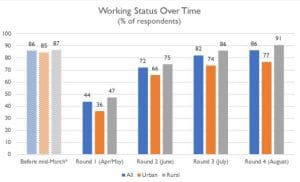
“Even though the overall share of respondents who are working is back to pre-pandemic levels, there continues to be some evidence of people moving in and out of work. Only 34 per cent of respondents have been working continuously since April/May, while 60 per cent have experienced periods without work and six per cent have not worked at all since the start of the pandemic. This indicates that there continues to be instability in the job market,” the report pointed out in its summary note.
Households have also taken into new survival tactics since the global outbreak among which is asset sell-off. About 27 per cent of the households surveyed admitted they routinely sell livestock to survive. However, the pandemic resulted in an additional 17 per cent of those who sell their livestock to survive. This indicates that households are shifting to the sale of livestock as a coping mechanism in the face of the pandemic.
The study noticed that the shift to livestock sell-off as a result of the coronavirus crisis was more common among poor households.
Yet, another socio-economic finding was that the crisis has not only affected families considered the most vulnerable as some households looked up to poorer ones for help during the full lockdown.
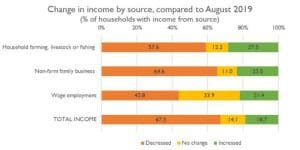
According to the report, across the three main income-generating activities – wages, agriculture and non-farm enterprises – a significant percentage of households reported a decrease in earnings. Over 67 per cent of households reported that their total income decreased compared to the same period last year. The decrease was evident across the three main sources of income.
However, non-farming business activities experienced the highest decline in income. About 65 per cent of households reported a decline in non-farming businesses as against 58 per cent of farming households who reported a fall in their incomes. Wage-earning categories were the least affected with 43 per cent reporting income decline.
Banks restrict loans to only major cities
MEANWHILE, another report by NBS has revealed that the historical lopsidedness of bank loans has continued as thousands of underfunded Nigerian businesses gasp for life. The credit distribution by states as of June 2020 stood at N18.9 trillion out of which 14.9 trillion was processed, approved and granted in Lagos.
But for a few businesses and individuals outside Lagos that visit headquarters in the city to process loans, the disclosure implies that about 80 per cent of the bank loans are retained in Lagos.
A bulk of the remaining 20 per cent is retained in the Federal Capital Territory, Rivers and Delta states. Kano State, the second most active business hub of the country, got a paltry N177 billion, which is less than one per cent of the loans.
Further analysis of other economic statistics suggests a positive correlation between bank credit, internally generated revenues (IGRs) and debts owed by the states. For instance, Lagos is the most favoured in terms of bank credit. It also generates the largest IGRs (about 33 per cent of the entire amount realised by the 36 states and FCT in the first half of the year) whereas it is also the most indebted state.


4 comments
… [Trackback]
[…] Read More here to that Topic: naijatimes.ng/covid-19-and-economic-woes-more-nigerians-borrowing-to-survive/ […]
… [Trackback]
[…] Info on that Topic: naijatimes.ng/covid-19-and-economic-woes-more-nigerians-borrowing-to-survive/ […]
… [Trackback]
[…] Read More on on that Topic: naijatimes.ng/covid-19-and-economic-woes-more-nigerians-borrowing-to-survive/ […]
… [Trackback]
[…] Find More on to that Topic: naijatimes.ng/covid-19-and-economic-woes-more-nigerians-borrowing-to-survive/ […]
Comments are closed.