


… Nigerians campaign for political, economic restructure
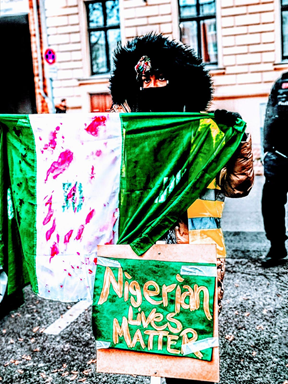
IT was a new low in the affairs and reputation of the Nigerian Embassy in Berlin, as the Ambassador, Yusuf Maitama Tuggar, hid himself away from addressing Nigerians who trooped in from all over Germany to convey to him their concerns about the state of their home country, and the perceived poor services of the embassy over the years.
Tagged March-to-Berlin, Nigerians mobilised from across Germany gathered in Berlin on Thursday December 10 for a double demonstration in solidarity with the agitations to reform and restructure Nigeria. The Berlin action is also in solidarity with the #EndSARS protests which brought millions of youths to the streets across Nigeria in October, but which was repressed through brigandage by perceived sponsored-thugs, and the October 20 shootings by men in Nigerian army uniform at the Lekki Tollgate in Lagos.
The first leg of the Berlin demonstration, from 10am till noon, took place at the Nigerian Embassy. The second protest, from 2pm to 4:30pm was held at the office of the German Federal Chancellor, Angela Merkel.
The Nigerian Embassy Berlin, venue of the opening rally, has been rocked in recent weeks by a highly embarrassing Sex Scandal, where a security official identified as Martins, was caught naked on camera in a hotel room, blackmailing a married woman into having sex with him as a condition for renewing her Nigerian passport.
The video, which has gone viral, is seen by many as confirmation of widely spread rumours in the Nigerian community for years, that Nigerian Embassy and Consulate officials abroad extort sex, money and other favours from customers who come seeking their visa, and passport-issuance services.
Additionally Nigerians in Germanyhave repeatedly complain about long waiting times for interviews and; about the rudeness and unprofessionalism of the staff of the embassy and consulate in Berlin and Frankfurt respectively.
These issues were high up on the list of grievances that Nigerians went to Berlin to air. The main point on the agenda, however, was Nigeria itself. Buoyed by the recent #EndSARS demonstrations in Nigeria, Nigerians in Germany joined other diasporean Nigerians to stage demonstrations in solidarity with the masses back home.
‘Anger over Envoy’s absence’
Tensions ran high as the protesters, many of whom had journeyed by train all night — from different parts of Germany — to attend the March-To-Berlin action, became aware of the ambassador’s fear and reluctance to come out, receive their resolution, and address the people who he is supposed to be representing and protecting.
The feeling of betrayal was then taken to a new level as the news filtered through the crowd that a batch of 43 Nigerians were deported to Nigeria that very day. The deportation coincided with the International Human Rights Day celebration all over the world.
‘Protest at German chancery’
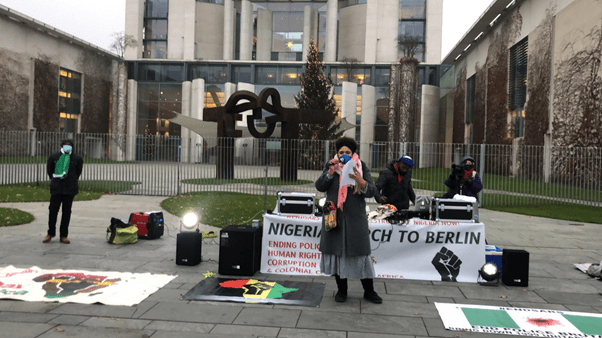
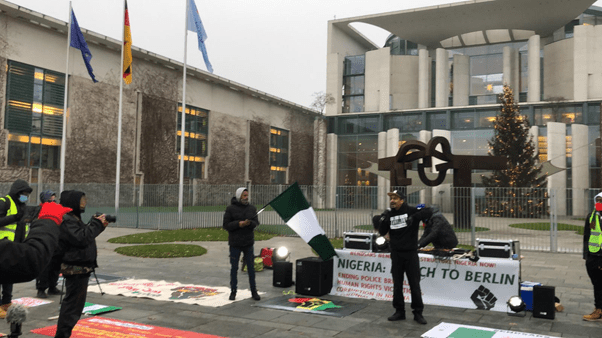
The atmosphere was charged — same December 10 — as Nigerians, after demonstrating at the the embassy in Berlin, moved across the city to the German seat of government and staged an #EndSARS protest in front of the office of Angela Merkel, the Chancellor, delivering a strong message to the Nigerian government and the international community.
Because of the sensitive security nature of the location, only a limited number of people were allowed to approach the gate. After the police had checked and cleared the technical equipment and the protesters, under the fading daylight and in the freezing 1° cold, the demonstrators spoke in solidarity with the demand to reform and restructure Nigeria, charging the Nigerian government to institute reforms, and accusing the international community of colonial continuity and economic neo-imperialism in cooperation with corrupt Nigerian and African leaders.
The demonstration took place across the square from the same German Reichstag building where in 1884/85 Africa was divided up amongst European powers — in the infamously tagged ‘Scramble for Africa.’ This was the origin of the modern African States with their arbitrary borders drawn for the convenience of easy economic exploitation, and fracturing of ancient age-old African states.
‘Nigeria as example of a Failed State’
“Nigeria, with her 200 million people and more than 250 ethnic nationalities, is a perfect example of these modern, irrational and badly governed, corrupt and exploitative African States,” said a leader of the protesters.
He continued, “Despite being the 6th largest producer of crude oil in the world for more than 5 decades — Nigeria has an unemployment rate of 27.1%; poverty rate 40%; adult literacy 62%; and is 13th on the Failed State rankings; 3rd most terrorised nation on Global Terrorism ranking. The country is bedeviled by many seemingly insolvable challenges: Boko Haram rampage; violence by terrorist Fulani herdsmen; kidnappings and banditry; police brutality; poor infrastructure; epileptic electricity supply; underdeveloped public health and public education system; ranking 146/180 on Transparency International’s Corruption Perceptions index; having highest PM10 (air pollution) levels in the world; and scoring 108/128 on Rule of Law.
These and other factors have given rise in recent years to strong calls — from different ethnic/regional quarters — to restructure or break up the country. These failings agitated Nigerians in their thousands to hit the streets in a mass protest that originally started as a demand to end police brutality but quickly upgraded itself into a wholistic call for the thorough reform and restructuring of the country. However, the demonstrations were brutally crushed by police and army might as the Nigerian Army shot at and killed protesters.
In solidarity with the rising tide of change-seeking agitations in Nigeria, diasporan Nigerians all over the world have since then been staging demonstrations and holding rallies and adding to the diplomatic pressure on the Nigerian government and system, with the aim of triggering steps towards meaningful reforms.
In Germany several demonstrations were organised in Frankfurt by the “Concerned Panafricanists”, and in Cologne by Pay Day Africa, as well as in many other German cities. The March-To-Berlin 2020 was powered by a coalition of Nigerian and African groups in Germany under the organisation of Peter Donatus of Pay Day Africa.


3 comments
… [Trackback]
[…] Info to that Topic: naijatimes.ng/the-march-to-berlin-2020-action-when-nigerians-tackled-home-issues-abroad/ […]
… [Trackback]
[…] Read More on on that Topic: naijatimes.ng/the-march-to-berlin-2020-action-when-nigerians-tackled-home-issues-abroad/ […]
… [Trackback]
[…] There you can find 82835 more Info to that Topic: naijatimes.ng/the-march-to-berlin-2020-action-when-nigerians-tackled-home-issues-abroad/ […]
Comments are closed.