

Smuggling continues to determine cost
SMUGGLING of petroleum motor spirit (PMS) may have continued in spite of the recent deregulation of the downstream sector by the federal government.
Sales figures have continued to reflect historical factsheets.
Prices for September, as reflected in the last figures released, show that residents of states located at borders notorious for fuel smuggling paid more for PMS than their inner land counterparts by a similar historical differential.
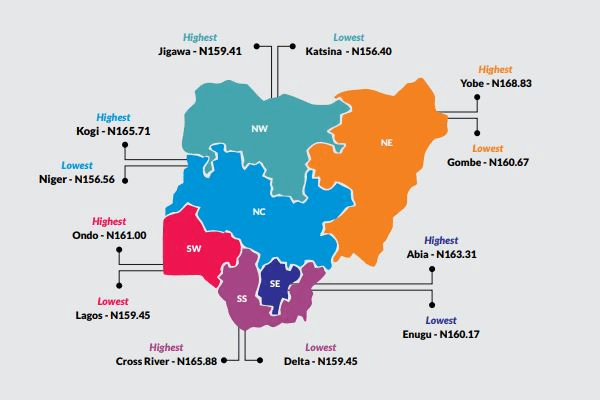
For instance, the cost of the commodity was higher in Yobe and Taraba than in any other state in September. The states, which are notorious for cross-border informal trade, are bordered by a territory controlled by Cameroon, where part of the PMS imported into the country is believed to have been smuggled.
In the past, fringe states, especially border local government areas, had to pay above national official prices of PMS in Nigeria owing to artificial scarcity created in those areas by smugglers.
Government officials had argued that deregulation would curb illegal export of the products.
Unfortunately, price data of the first month after the controversial deregulation, show that the ancient price disparity between inner states and those located at the border still continues. At least, two of such states top the post-deregulation prices.
According to figures sourced from the National Bureau of Statistics (NBS), consumers in Yobe and Taraba, the hotbeds of PMS smuggling, bought a liter of PMS for N168.83 and N166.43 on average. The figures are N7.77 and N5.37 (or five percent and 3.3 percent) higher than the national average price – N161.06.
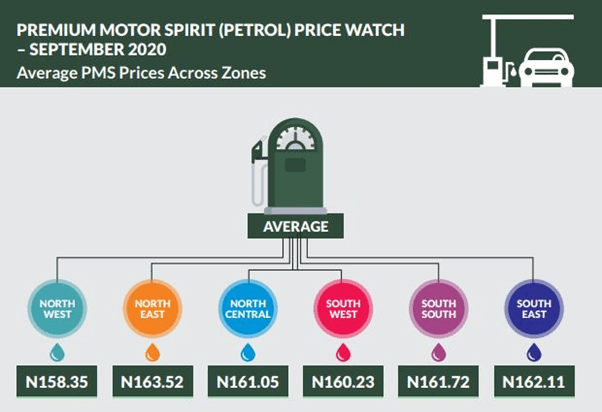
North-east is said to be the most active PMS smuggling route. The price of the essential commodity in the region has but sustained the claim. Last month, the price in the region justified the argument as the average price per liter was N163.52 or 1.5 percent above the countrywide average price.
Interestingly, the north-west, a more economically vibrant zone than the north-east, got the product at the cheapest price – N158.35 – in the month reviewed. North-west and northeast are almost the same distance from Lagos port facilities, where petroleum products are lifted.
Figures from other zones reflected the market correlation between price and cost of transportation, on one hand, and cost and demand, on the other. In the South-West (highly energetic but very close to the ports), PMS sold for an average price of N160.23 whereas it sold for N161.72 in the South-South. Marketers increased the price to N162.11 for the South easterners and N161.05 for consumers in the North-Central region.
In terms of economic activities – a key factor that determines demand and price – the North-West is more active than its neighbouring North-East. That PMS was cheaper in a geopolitical zone that records more commercial and industrial activities show that other factors different from the interplay of demand and supply would have pushed up the price in the north-east.
Cross River, another state with a porous international border, also recorded an unusual higher price in September. It came third on the top price chart with an average price of N165.88 per liter across the state. In the neighbouring Akwa Ibom, PMS was N3.11 cheaper than Cross River just as the South-South average cost was also N4.16 per liter cheaper.
THE Yobe, Taraba and Cross Rivers examples suggest that smuggling remains a possible factor determining the prices and availability of PMS in far-flung states even after deregulation. Checks by Naija Times suggested that black market activities have continued to hold sway at many communities located along international borders.
A resident at Mubi North local government area of Adamawa said he could not “remember the last time he got fuel to buy at a petrol station.” He said many fuel stations in the area had not opened for years as they always “claim they don’t have products to sell”.
Against the natural economic principles, however, Kastina, Niger and Zamfara top states with the cheapest prices of PMS last month, with residents in those places paying an average price of N156.40, N156.56 and N157.90 respectively. The three states are located in the north-west and north-east zones with considerable additional transport cost from Lagos, the host of the landing ports.
The data showed that PMS cost much more in Lagos, Ogun and Oyo markets, which are the closest to the port facilities, than the northern states. This may have suggested that cost (measured by overheads on haulage inclusive) may not necessarily guide oil marketers in fixing PMS prices in the deregulated market.
Non-economic factors like moral attitude and the cost of doing business in different states could be a major factor.


4 comments
… [Trackback]
[…] Find More here on that Topic: naijatimes.ng/oil-deregulation-pms-prices-across-nigeria-not-shifting-in-attitude/ […]
… [Trackback]
[…] There you will find 20823 more Info on that Topic: naijatimes.ng/oil-deregulation-pms-prices-across-nigeria-not-shifting-in-attitude/ […]
… [Trackback]
[…] There you can find 89067 additional Information to that Topic: naijatimes.ng/oil-deregulation-pms-prices-across-nigeria-not-shifting-in-attitude/ […]
… [Trackback]
[…] Read More on to that Topic: naijatimes.ng/oil-deregulation-pms-prices-across-nigeria-not-shifting-in-attitude/ […]
Comments are closed.