

JP Clark inaugurated Lagos Book & Art Festival, says Akinosho
ON October 13, when the death of celebrated poet and playwright, Professor John Pepper Clark-Bekederemo, was announced, the country was in the heat of the #EndSARS protests to address the highhandedness of a rogue unit of the police.
His death and swift burial three days after denied many literary buffs and fans an opportunity to pay a ‘proper’ last respect.
“My father was a very simple man,” Ilaye said of his late father’s wish to be buried simply.
“He did not want to be on display. He did not want to be laid in state. He did not want to spend too long in a mortuary. He literally wanted to be buried simply and without much fanfare. Obviously the Lord moved mountains in order for my father to have his wishes.”
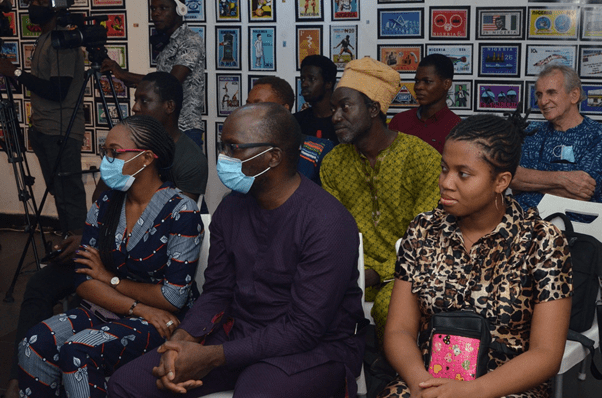
Though JP got his wish to be buried simply, on Wednesday, November 11,the poet from Kiagbodo, got a deserved public celebration at the 22nd Lagos Art & Book Festival, LABAF, on Wednesday, November 11.
Physically at Freedom Park, Lagos and online, fans gathered for reminiscences, reading and performances.
In attendance physically to represent the family was his son, Ilaye Clark, while JP’s wife of 56 years, the literary scholar, Professor Ebun Clark, and their two daughters attended via zoom.
Writers like Odia Ofeimun, Iquo Diana Abasi, Dagga Tolar, and students were also in the Kongi’s Harvest of the Freedom Park, where the event held. Contributing virtually were Ogaga Ifowodo and Efe Paul Azino.
This year’s edition of LABAF was themed; A State of Flux: Literacy in a Period of Languor and held from November 9 to November 15.
Dramatist and Poet, Professor Hope Eghagha, who gave the lead talk, said JP Clark was the first indigenous professor of English at University of Lagos and was a ‘father’ to him.
Eghagha also said that JP was a head of department of English at University of Lagos and helped to organise the department “at a time when there were just five teachers in the late sixties and early seventies.”
Eghagha spoke of circumstances that led the Delta State government to donate a building in honour of JP at the University of Lagos. According to Eghagha, professor of English, who was a Commissioner for Higher education in Delta State at that time, the Delta State governor, Emmanuel Uduaghan, came to deliver a talk at the Faculty of Arts, University of Lagos. After the lecture, the Dean, Professor duro Oni, requested a building from the governor.
In response, Eghagha said: “The governor talked to me and said he would donate something on one condition – that it should be named for JP Clark.”
The governor then announced a pledge of N100m towards a building on the condition that it should be named for JP Clark.
And so, the JP Clark Centre at the University of Lagos was completed a few months later.
Echoing JP’s request for a swift burial devoid of ceremonies, Eghagha read from JP’s poem titled My Last Testament:
‘This is to my family/ Do not take me to a mortuary/ Do not take me to a church/ Whether I die in or out of town/ But take me home to my own/ and To lines and tunes, tested on the waves/ Of time, let me lie in my place/ On the Kiagbodo River.
‘If Moslems do it in a day/ You certainly can do it in three/ Avoiding blood and waste/ And whatever you do after/ My three daughters and my son/ By the only wife I have/ Do not fight over anything/ I may be pleased to leave behind.’
Evidently, JP Clark prepared for his passage and even dug his grave before his death, according to Eghagha. But he was also purposeful in life.
“He created a bridge between himself and others not only through his works but through his personal interactions,” Eghagha concluded.
Earlier, publisher of Oil + Gas Report and Secretary General of Committee for Relevant Arts (CORA), Toyin Akinosho, relived how he met JP.
In 1983 as a fresh corps member from the University of Ife, who was freelancing as a journalist, Akinosho went to the PEC Repertory Theatre in Lagos founded in 1982 by JP and his wife, a former director of the Centre for Cultural Studies at the University of Lagos.
Akinosho’s mission was to meet JP Clark and learn theatre from him. Akinosho said he met actor Jab Adu at the gate who took him to Professor Ebun Clark. But JP’s wife asked Akinosho to return to meet her husband.
Upon meeting JP, Akinosho said that the poet asked him what he studied and what he wanted. When Akinosho said he studied Geology and was interested in Theatre, he told the audience that JP said: “I’m interested in your interest.”
Akinosho’s boldness to confront the poet however, earned him a free pass to the Theatre which cost N90 then for a year’s subscription. In the eighties, N90 was big money.
Akinosho also said it was JP that spurred his confidence in pursuing the arts.
“The whole idea of doing CORA came from that confidence,” Akinosho, who wrote art reviews for The Guardian, said.
“People would tell me that Prof actually likes your reviews.”
Akinosho revealed that he could have been fired from his job but was saved when JP visited the rutam house of The Guardian for a board of directors’ meeting and praised Akinosho’s writing.
“I kind of like his strange way of analysis,” Akinosho reported JP Clark as saying to Lade Bonuola, then editor, who had Akinosho’s sack letter on his table.
But that praise from Clark, Akinosho said, prevented his sack at The Guardian.
Akinosho also said that the founding of CORA in 1991 was based on interactions which began with JP Clark.
“So, in a sense, JP Clark inaugurated the Lagos Book &Art Festival,” he said.
Others who paid tributes to JP by reading his poems included Iquo Diana Abasi, Dagga Tolar and Ogaga Ifowodo and Efe Paul Azino
Azino described Clark’s contribution as a poet, playwright and cultural producer as significant.
“He was an inspiration not just as an artiste but also as a cultural producer,” Azino said.
“The significance of Professor’s Clark’s place in Nigerian history is quite obvious. This was a generation that in a sense, created a new kind of literature, post-colonial experience writing in literature with African sensibility. And he was at the forefront of that.”
Gifted Steppers, the young dancers being honed and taken care of by Oma Harrison, also gave dance performances just as attendees honoured JP with poetry readings.
JOHN Pepper Clark-Bekederemo was born on April 6, 1935 in Kiagbodo, Delta. He had his primary education at the Native Authority School, Okrika (Ofinibenya-Ama), in Burutu LGA before proceeding to Government College, Ughelli, both in Delta. He then went to the University of Ibadan where he obtained a BA degree in English. As an undergraduate, Clark edited various magazines, including The Beacon and The Horn.
After graduating from University of Ibadan in 1960, Clark worked as an information officer in the Ministry of Information, in the old Western Region of Nigeria, as features editor of the Daily Express, and as a research fellow at the Institute of African Studies, University of Ibadan. He served for several years as a professor of English at the University of Lagos, a position from which he retired in 1980. While at the University of Lagos he was co-editor of the literary magazine, Black Orpheus.
Clark was also held visiting professorial appointments at different institutions, including Yale and Wesleyan University in the US. In 1991, Clark was honoured with the Nigerian National Order of Merit Award for literary excellence.
Some of J.P’s poems such as Night Rain, Abiku, Ibadan and Olokun have been widely read in schools. And his death during the mayhem that followed the #ENDSARS protests resurrected the message in his poem, Causalities. Some other works include Ozigi Saga; State of the Union, Mandela and Other Poems, All for Oil, The Wives Revolt and The Raft. He is also known for the controversial book, America Their America, his portrayal of everyday life as he saw it in the US.
And Professor Femi Osofisan’s J. P. Clark: A Voyage, The definitive biography of the main animating force of African poetry’, the only biography approved by Clark, was produced to mark the late poet’s 78th birthday.


9 comments
… [Trackback]
[…] Information on that Topic: naijatimes.ng/after-private-burial-labaf-honours-j-p-clark/ […]
… [Trackback]
[…] Read More Information here to that Topic: naijatimes.ng/after-private-burial-labaf-honours-j-p-clark/ […]
… [Trackback]
[…] Read More Info here to that Topic: naijatimes.ng/after-private-burial-labaf-honours-j-p-clark/ […]
… [Trackback]
[…] Find More on that Topic: naijatimes.ng/after-private-burial-labaf-honours-j-p-clark/ […]
… [Trackback]
[…] Read More on to that Topic: naijatimes.ng/after-private-burial-labaf-honours-j-p-clark/ […]
… [Trackback]
[…] Find More Info here on that Topic: naijatimes.ng/after-private-burial-labaf-honours-j-p-clark/ […]
… [Trackback]
[…] Read More here on that Topic: naijatimes.ng/after-private-burial-labaf-honours-j-p-clark/ […]
… [Trackback]
[…] Info on that Topic: naijatimes.ng/after-private-burial-labaf-honours-j-p-clark/ […]
… [Trackback]
[…] Find More on that Topic: naijatimes.ng/after-private-burial-labaf-honours-j-p-clark/ […]
Comments are closed.