
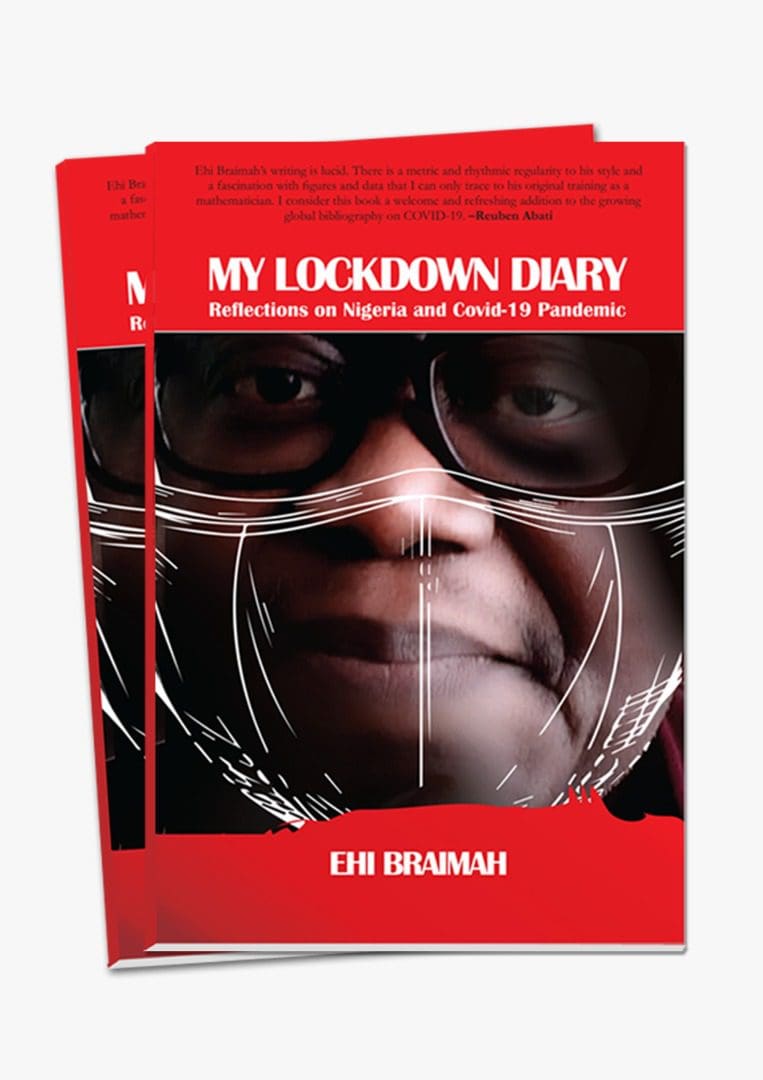

(MY LOCKDOWN DIARY, by Ehi Braimah; Bookcraft Africa, 2020)
Exploring themes such as effective leadership, building a better society, options for a vibrant economy, the new normal, and Nigerian heroes, Braimah examines the coronavirus pandemic from an entirely different perspective capturing our struggles to adapt to the changes taking place in a brand-new world.
OF course, 2020 is one year many across the globe have quickly deleted from their mental calendar. It is a year they would like to forget without any regret. Still, it is a year that will, one day, matter for the memories it has ingrained in our history as the one virus that upended the world and all in it, as we know it today. In other words, while one can grant us our anger and momentary disgust, disdain, and desperation to forget it and meet a new year, there will come a time in no distant future when we, for different reasons, will NEED to revisit the events of the year.
This is where we will be grateful to an Ehi Braimah for documenting this moment in history. Complete documentation of his Covid-19 moments, the book covers how he coped with the coronavirus in his self-isolated or socially distanced corner. Readers will be happy he did this piece because, as Reuben Abati puts it in his introduction to the book, Braimah’s fascination with figures and data has given the book a strength that makes it a compelling memoir to have in your collection.
Stating dates, time and contexts of events that happened within this period, MY LOCKDOWN DIARY… Reflections on Nigeria and Covid-19 Pandemic will become in coming weeks, months and years, one book many would easily reference and read when they want to reflect on events that have characterised the Covid-19 world we have found ourselves in today.
For all of us, Covid-19 changed our world in a way we may never get back the groove, we had pre-pandemic and this is succinctly captured on page xix, the second page of the Preface:
“Life took on a new meaning and devolved into a simple routine: wake up, warm the cars, walk around, read and write, monitor the news, eat, drink coffee and make telephone calls. Zoom meetings/webinars became popular and I participated in some of them including our weekly Rotary meetings…”
IN the last 26 years, Braimah has consulted for a wide range of multinational organisations such as Nigeria Breweries, Cocacola, Unilever, PZ, Promasidor, and so many others. He is currently the Chairman/CEO Neo Media and Marketing, a company he founded in 2008, Chairman/CEO Adna Hotel; also the Vice President and Chairman, Publicity Committee of Nigeria-America Chamber of Commerce, member, Publicity and Communications committee, Nigeria-British Chamber of Commerce, Mentor, Tony Elumelu Entrepreneurship Program (TEEP), and an honorary Fellow of the Business Process Management Institute and many more. As one with all these responsibilities, you can, thus, imagine the damage the 120-day lockdown did to his schedule, energy, and psyche. Many in his category, higher or lower, will easily identify with his cinematographic description of his Covid-19 days and events in this easy-to-read book.
Rather than be bitter or develop anxiety over the negative impact of the virus on his life, business, and relationships, the author converted the seemingly limitless free time he had into a productive enterprise.
The lockdown allowed me to stay focused and put my thoughts together…
Indeed, it did. Besides keeping him busy, the lockdown also helped keep the Industrial Mathematician’s muse alive and lubricated with his creative juice. He was fully in control of his time and process enough to capture the four most dreaded months –April-July 2020 — as reflected in the 32 articles he wrote during the period. The articles transformed into 32 of the total 40 chapters that make up his whole narrative of the Nigerian experience pre and during Covid-19 lockdown. The eight chapters he added to the lockdown episodes were articles he wrote before the lockdown.
IN the introductory page, Ehi gives an in-depth historical perspective of pandemics rare to find, even in mainstream media. Yes, we heard about the 1918 Spanish flu, in which an estimated 500 million people or one-third of the world’s population became infected, with at least 50 million deaths worldwide and no fewer than 675,000occurring in the United States alone. Over 199,325 lives were lost in Nigeria. But Braimah goes back centuries to unearth the ghost of past pandemics to examine their impact on humanity in their era.
Fast forward to the modern-day, his book reminds us of how IMF/World bank predicted a global economic contraction of about 3.4% and the over $3tn projected by Bill Gates and all the predictions made years before Covid-19 bared its fangs on the human race.
In the second chapter titled, Coronavirus, your days are numbered, we see the pandemic in action as fear of its unknown features loom large all over the world. Daily, people are dying due to complications arising from infections of the virus. From Dr. Anthony Fauci, a former head of US Covid-19 response Team with over 50 years’ experience as an infectious disease expert and Director of US National Institute of Infectious Diseases (who daily briefed the world about the pandemic) to Dr. Chikwe Ihekweazu, the Director-General of Nigeria Center for Disease Control (NCDC), the book showcases their efforts in confronting the relentless force of the pandemic that is sweeping across the earth; taking lives, destroying whole economies, sinking jobs and burying businesses in its wake.
Mirroring the helplessness of the experts we all look up to, Braimah takes the concourse of the discourse to the realm of superstition when he asked (on page 7): is this virus a reset button for the world to know peace and do away with evil practices?… pre-empting a possible backlash from this insinuation, he quickly adjusts his position in the same breath: this idea probably belongs to the realm of superstition but it is open for discussion…
The third chapter, ‘Abba Kyari: An enigma even in death,’ reminds us of the situation that surrounded President Muhammadu Buhari’s late Chief of Staff, Abba Kyari right from when news broke that he had contracted the coronavirus to his death in the hands of the pandemic. Braimah got it when he said at the beginning of the chapter that when the late Chief of Staff, who many believed was the powerful arrowhead of the cabal rumoured to be running Buhari’s government, tested positive, the last thing on the minds of everyone including his avowed enemies, was his death. This view Kyari himself buttressed in his statement six days into quarantine, as captured in the book: These jobless rumour merchants use social media to spread fake and false news all the time. I hope to be back at my desk soon…
He never returned to his desk and he never made it out alive. The rest, they say, is history. The news that the reviled but powerful Chief of Staff to Buhari had Covid-19 till his demise drew national attention to the virus and that was when many more Nigerians began to take notice of the pandemic. The one Nigerian who was touched by Kyari’s coronavirus death is his boss, Buhari. According to the author, the president is yet to recover from the shock, as would be expected.
The fourth chapter dwells on the Secretary to the Government of the Federation (SGF) and head, Presidential Taskforce on Covid-19, Boss Mustapha’s admission he did not know that Nigeria’s healthcare system has collapsed. What baffles Braimah is the man’s denial after he had been attacked on Twitter and social media. Perhaps, he should either have apologised or kept quiet and allow it to go away silently, with time. In Boss Mustapha’s Unforced Error, Braimah reflects on what may have sparked outrage against Mustapha’s gaffe. The author tells us that in the 2019 Healthcare Market insight report on Nigeria by Medic West Africa, less than 90% of 200 million Nigerians live without health insurance. Meanwhile, over one billion dollars ($1bn) is spent annually on outbound medical tourism.
SOME chapters touched on the author’s relationships. One very loud piece is in chapter 10, where he celebrates Dele Momodu, My Publisher. He hits the nail on the head when he said writing a special tribute in honour of Momodu for his 60th birthday can fill a book because of Momodu’s versatility, prodigious talent, and multi-dimensional nature. Momodu, aka Bob Dee, has been Braimah’s very close colleague, dating back to their days as younger men in the practice of active journalism. Back in the day, they lived life like it was Hollywood. Here, the author seizes the opportunity to tell how he got into the journalism profession, the history of Ovation, and how the vibrancy of the media industry in the country operated with all the challenges thrown its way in the dark days of the military.
If you did not know the man Tony Elumelu beyond what you see on television or read in the papers, by the time you read Braimah’s tribute to the billionaire businessman and philanthropist, you will be convinced that indeed, the astute banker is as the chapter says, is a God’s Gift To Africa. Braimah talks about how the Tony Elumelu Foundation (TEF), the philanthropic arm of Heirs Holdings, is breaking grounds and charting courses in redefining a new Africa in terms of building the capacity of young ‘Africa-preneurs’ to take over the economic-space and position Africa for the coming economic boom for the continent.
INTERESTINGLY, the appeal of this collection is the fact that each chapter leaves you with information that aids, and widens, your capacity to learn more about the subject he treats in the particular section of the 255-page book. And each chapter prepares you for the next so that you are eager to complete the one you are reading to get to another. It makes a compelling read. His commentaries are largely on public policy issues and events as they transpired in Nigeria.
Exploring themes such as effective leadership, building a better society, options for a vibrant economy, the new normal, and Nigerian heroes, Braimah examines the coronavirus pandemic from an entirely different perspective capturing our struggles to adapt to the changes taking place in a brand-new world.
In the end, this riveting read takes you on a ride through issues to solution-based thoughts and you find yourself identifying with the subject to the point you are inspired to take the matter to the next level. Such is the power of Braimah’s writings, which Abati aptly describes in his blurb for the book.


4 comments
… [Trackback]
[…] Here you can find 41905 more Info on that Topic: naijatimes.ng/unlocking-the-lockdown-diary/ […]
… [Trackback]
[…] Find More on on that Topic: naijatimes.ng/unlocking-the-lockdown-diary/ […]
… [Trackback]
[…] Information on that Topic: naijatimes.ng/unlocking-the-lockdown-diary/ […]
… [Trackback]
[…] Find More Information here to that Topic: naijatimes.ng/unlocking-the-lockdown-diary/ […]
Comments are closed.