

IN the third quarter of last year (Q3 2019), non-oil commodities contributed about 20 per cent to the country’s total export earnings. The figure was considered a far cry from the country’s ambition to increasingly hedge the concentration risk of crude and rescue the economy from the Dutch disease the hydrocarbon business has inflicted on Nigeria.
And as Covid-19 spread across the globe in the second quarter of the year (Q2 2020), the oil market sneezed and infected the economies of crude producers with another form of flu, which some energy economists have labeled ‘coro+oil’ crisis. Nigeria’s economy quaked as well, after which the conversation about the non-oil commodities restarted in earnest.
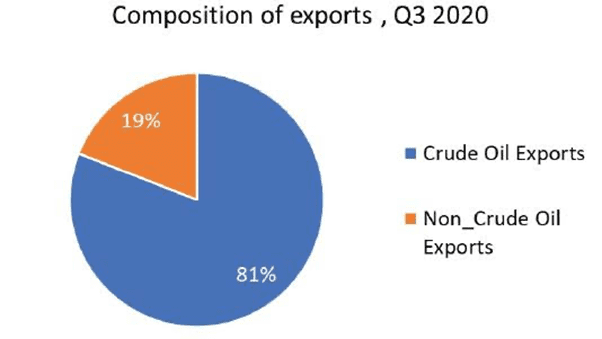
Still, the contribution of non-oil commodities has decelerated even lower, falling short of the double-digit entry point in the third quarter of the year (Q3 2020). While crude’s share of the export value was 81 per cent, the mineral product basket (which defines oil-related commodities chief of which is crude) controlled as much as 93.2 per cent, leaving a paltry seven per cent for the non-oil sector.
From 2017 to 2019, the contribution of mineral products to the total export value averaged 92.5 per cent. 2019 was the best year for non-oil commodities. In summary, it contributed 12.8 per cent to the nation’s exports.
In 2017 when it bailed the economy out of recession, mineral products contributed a total of 96.2 to the export earnings, underscoring the paradox of an economy that claims to be transiting from a narrow base to a diversified one. That a sector with less than nine per cent contribution to the gross domestic product (GDP) holds over 91 per cent of the country’s export injections is like turning normalcy on its head. But it has become the regular trend of the country’s economy.
Also, in 2016 when Nigeria plunged into recession, oil recorded a full-year growth of -14.45 per cent. The recession itself was triggered by the crisis in the oil market. And as usual, agriculture, logistics, services, manufacturing, real estate and other key sectors, which historically depend on the fortune of crude for survival, were sent to the tailspin, leading to a contraction of the entire economy.
By the second quarter of 2017 (Q2 2017), the international oil market rebounded. Thus, local crude production grew by 3.52. And the economy responded, trudging out of the recession that lasted for over a year. This explains the importance of crude oil to Nigeria’s economy. But this nexus is a death knell of the economy.
First, the global move to decarbonise the industrial ecosystem leading to the search for cleaner energy is a threat to hydrocarbon even though Prof Adeola Adenikinju, a professor of energy economics at the University of Ibadan and member of the Monetary Policy Committee, said the impact may not be immediate. Secondly, the discovery of crude reserves in other parts of the world and renewed restiveness in the Nigeria Delta seem to add to the already volatile nature of the petro-dollar economy.
There are other reasons to be worried about the economy. While exports of non-oil products are not improving, there is a huge gap in the domestic market that is constantly yearning for imported commodities.
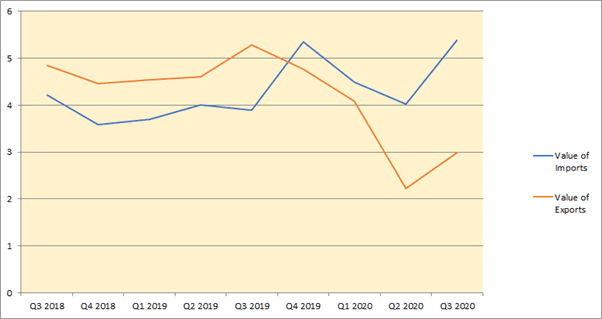
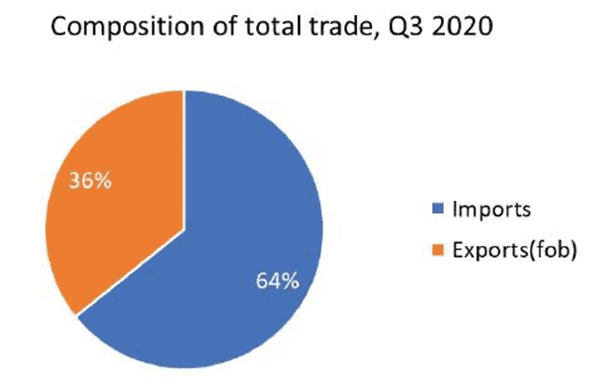
In recent years, Nigeria managed to squeeze a positive trade balance against all odds. But that changed dramatically since the beginning of the year. In the first two quarters of the year. The country recorded a trade deficit of 23 per cent in Q1 2020. It ballooned to 81 per cent the following quarter and stood at a frightening 80 per cent in Q3.
But more frightening is the fact that the volume of importation keeps rising. For instance, total imports rose by 33.77 per cent in Q3 2020 compared to Q2 2020 and 38.02 per cent compared to Q3 2019.
And more so is the increase in the value of imported consumables, including food. Example: imported agricultural goods increased in value by 21.13 per cent in Q3 2020 compared to Q2 2020 and 109.82 per cent compared to the corresponding quarter in 2019.
Also, manufactured goods imports rose in value by 23.18 per cent in Q3 2020 compared to Q2 2020 and 23.47 per cent year-on-year. Manufactured goods include items like clothes and shoes.
Interestingly, the foreign inputs of the so-called made-in-Nigeria goods have continued to increase. For example, the value of raw materials imported in Q3,2020 increased by 24.47 per cent compared to Q2 2020 and 114.95 per cent compared to the same quarter of last year.
The only explanation for the outrageous increase could be that manufacturers only spend more on foreign inputs owing to the fall in the value of naira or that materials hitherto sourced from the local market are not available anymore. This could be explained by the rising security in the north which has shrunk agro produce.
Otherwise, the increase in the value of imported raw materials should have shown translated to figures. Purchasing Manager Index (PMI) and other related surveys have not shown any radical expansion in the purchasing power of the people neither does the foreign trade statistics suggest a switch to local commodities.
The depressing picture is not what Nigerians, who crave the rise of alternative sources of national income, want to see. It also flies in the face of the ambition of the President Muhammadu Buhari administration before and when it assumed office.
“Since oil seems to be the cash cow of the Nigerian economy, we have no option but to return to agriculture as our mainstay. We need to return to old times, diversifying our economy can no longer be something we pay lip service to,” Buhari told cooperatives of farmers somewhere in Yenagoa, Bayelsa State, a few years ago.
Before and after the Yenagoa promise, the President made a similar statement a countless number of times. Members of his cabinets have turned the diversification agenda into a sort of an anthem. It was among the cardinal campaign agenda on which he rode to power in 2015. Days have rolled into weeks; weeks have turned to months and months have changed to years. Yet, the promise has remained a dream.


7 comments
… [Trackback]
[…] Find More to that Topic: naijatimes.ng/analysis-scary-image-of-a-monolithic-economy/ […]
… [Trackback]
[…] Find More on on that Topic: naijatimes.ng/analysis-scary-image-of-a-monolithic-economy/ […]
… [Trackback]
[…] Read More Information here to that Topic: naijatimes.ng/analysis-scary-image-of-a-monolithic-economy/ […]
… [Trackback]
[…] Read More here on that Topic: naijatimes.ng/analysis-scary-image-of-a-monolithic-economy/ […]
… [Trackback]
[…] Find More to that Topic: naijatimes.ng/analysis-scary-image-of-a-monolithic-economy/ […]
… [Trackback]
[…] Info on that Topic: naijatimes.ng/analysis-scary-image-of-a-monolithic-economy/ […]
… [Trackback]
[…] Find More here to that Topic: naijatimes.ng/analysis-scary-image-of-a-monolithic-economy/ […]
Comments are closed.