

*’Take out Lagos, Rivers, FCT and Delta, you would think Nigeria does not exist elsewhere’
By Joseph ‘Afamhe
A PROBE into the revenue generation data released by the National Bureau of Statistics (NBS) yesterday has revealed that the internally-generated revenues (IGRs) of 18 states dipped by an average of 19 percent last year compared to 2019 performance.
This comes as the Edo State Governor, Godwin Obaseki, Minister of Finance, Budget and National Planning, Zainab Ahmed and the Central Bank of Nigeria (CBN), Godwin Emefiele have continued to throw jabs at one another on the state of the economy.
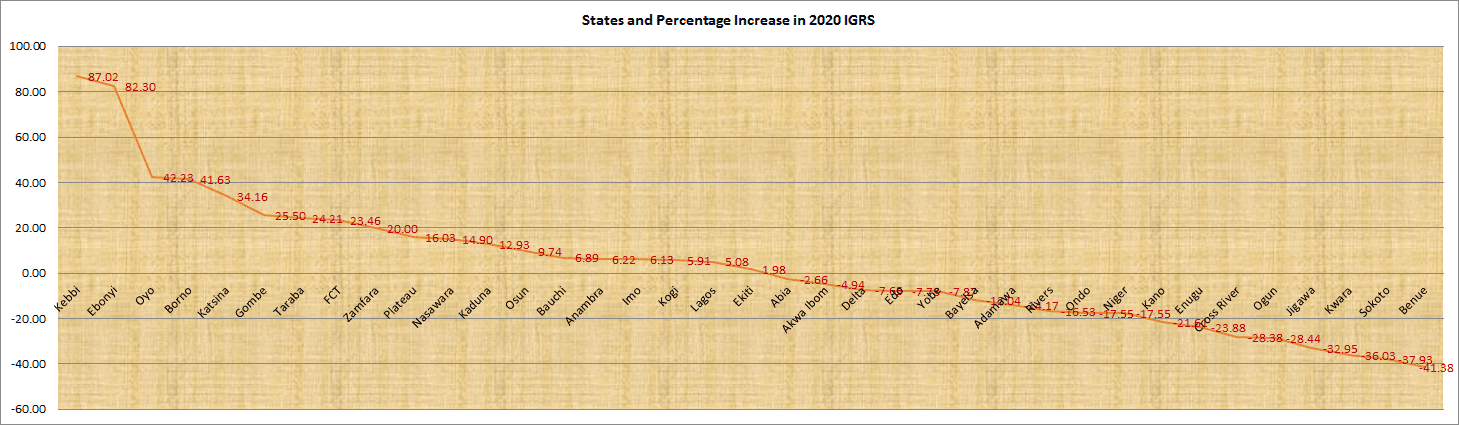
Interestingly, Obaseki, whose courageous revelation triggered the controversy, lagged behind many of his counterparts in revenue mobilisation as his state’s IGR sloped by 7.8 per cent. Edo generated N27.2 billion, which amounted to 2.1 per cent of the entire IGRs of the 36 states and the FCT in the period being reviewed.
At a negative growth of eight per cent (approximately), Edo performed better than many of its counterparts, notwithstanding.
Benue State, which ranked the worst-performing in the year, had its self-generated revenue cut by 41.4 percent while Sokoto’s slipped by 37.9 percent. Kwara, Jigawa and Ogun states sunk deeper into the historical challenge by 36 percent, 33 per cent and 28.4 per cent to join Benue and Sokoto at the bottom on the chart.
Abia, Akwa Ibom, Delta, Yobe, Bayelsa, Adamawa, Rivers, Ondo, Niger, Kano, Enugu and Cross River also recorded negative growth in IGRs, a situation that may have worsened their fiscal position and weakened their economic viability.
Overall, states’ IGRs grew year-on-year -1.9 per cent as the total revenue generated by the state slipped to N1.03 trillion. That puts the estimated total figure generated per state for the entire year at N35.1 billion or N2.9 billion per month.
Sadly, this simple estimation does not reflect the severity of the problem facing the states. The mean figure, as always, does not give a true picture of the uneven performance of federating units, which is where the real devil lurks.
If one takes out the earnings of Lagos and Rivers and FCT and Delta out, one possibly would think Nigeria does not exist elsewhere. Lagos alone contributed almost one-third to the entire IGRs, and that reflects a historical trend. Its share of the IGRs of the states has hovered around 33 per cent in recent years.
Lagos alongside Rivers, FCT and Delta jointly cornered 53 per cent of the revenue while the remaining 32 states scampered for less than half of the pile.
But alas, that is far from the truth – not the figures but the suggestions conveyed by the words – ‘cornered’ and ‘scampered’.
States’ IGR mobilisation is never a zero-sum game, each state has a limitless potential to pull as much as it can possibly imagine but only Lagos has demonstrated over the years that it has the capacity to scratch the surface of the enormous possibility.
THERE is a ready justification for the poor revenue mobilisation – the COVID-19 was an albatross of a sort last year. You will probably hear that worn-out tagline from over 50 per cent of the governors in the coming days as they defend their records and make bogus promises on how they intend to make the states self-reliant before the end of their administrations.
But while the COVID-19 eroded everything good about the country, a few states scored high in revving up their IGR profile. Kebbi, breaking away from tradition, topped the most improved states, topping its 2019 record with 87 per cent. Ebonyi, another fringe state, followed with 82.3 per cent. Oyo, Borno, Katsina, Gombe, Taraba, FCT, Zamfara, Plateau, Nasawara and Kaduna also recorded what one could describe as impressive improvement, increasing their IGRs within the range of 12 per cent and 43 per cent.
Interestingly, a good number of the most-improved are those with scars of banditry, terrorism and other cases of insecurity last year. Borno, Kastina, Zamfara and Kaduna, for instance, have been hotbeds of terrorist and bandit killings.
Notably, 11 northern states as against eight from the relatively peaceful south improved on their IGRs, raising salient questions on the real cause of the widespread underperformance by most of the states.
Further analysis shows that the states depended on Abuja for upward of 64 per cent of their total revenue last year, reflecting once again the viability concern raised by advocates of regionalism and restructuring. But FAAC allocations to Lagos, Ogun and FCT made up over 50 per cent of the states’ revenues. In extreme cases, over 90 per cent and 85 per cent of Bayelsa and Adamawa’s revenue came from the centre.
That the states run to Abuja for monthly stipends is not new to Nigerians. What is perhaps, new is that while they depend on the centre to fund their expenditures which are majorly recurrent, they also explore CBN’s reckless Ways and Means (W&M) facilities to supplement whatever they get from FAAC.


4 comments
… [Trackback]
[…] Info to that Topic: naijatimes.ng/18-states-dip-by-about-a-quarter-in-igr/ […]
… [Trackback]
[…] Here you will find 9388 more Information to that Topic: naijatimes.ng/18-states-dip-by-about-a-quarter-in-igr/ […]
… [Trackback]
[…] Read More here on that Topic: naijatimes.ng/18-states-dip-by-about-a-quarter-in-igr/ […]
… [Trackback]
[…] Info to that Topic: naijatimes.ng/18-states-dip-by-about-a-quarter-in-igr/ […]
Comments are closed.