
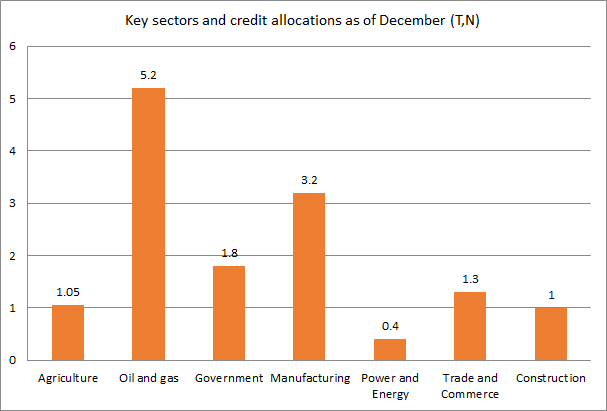

NIGERIA’s total commercial loans to individuals and businesses rose to N20.4 trillion last December, according to industry data released by the National Bureau of Statistics (NBS) today.
But the most unproductive sectors – the public sector as well as oil and gas – have gulped a large chunk of the facility. About 33.8 per cent of the loans, approximately N7 trillion, has gone to the two sectors.
Government, federal and states, cornered almost N1.8 trillion out of the entire loan. The amount, which is added to other soaring domestic and external loans, is 8.7 per cent of the loan written by the commercial banks.
The amount is about 18 per cent increase from N1.5 trillion posted in December 2019. That leaves the public sector share of commercial loans growing 18 per cent year-on-year basis.
Public sector loans have been a sore point in national economy discourse. The country’s total debt stocks hit N32.9 trillion last year, with many hanging undisbursed and awaiting approval facilities. Bonds that were matured for liquidation for a year were refinanced as debt servicing almost wiped the country’s meager revenue.
The states, as much as the federal government, are guilty of unrestrained accumulation of debt. Last year, the states’ debt profile climbed up to N6 trillion, which was almost five times their total revenues.
Experts say the country is gradually falling into debt traps and that while a slightly higher than 30 per cent debt to gross domestic product (GDP) ratio is tolerable, the debt to income ratio, which is estimated at 58 per cent between 2015 and 2020 could cripple the country’s economy.
The increasing commercial banks’ loans come amidst caution that the government’ rising penchant for domestic loans is inadvertently crowding out the private sector. As government officials knock the doors of banks’ chiefs for advances, the private sector operators are increasingly denied the available credit lines or pay more to get funding for productive engagements, thus stifling private investments.
Manufacturers have complained that access to funding is a major challenge that limits their competitiveness. The DG of the Lagos Chamber of Commerce and Industry (LCCI), Dr. Muda Yusuf, says access to affordable credit is a variable that must be put on the table to make Nigerian businesses competitive in the regional market.
While the private sector cry wolf of poor funding, the public sector sucks the banks dry. At the turn of 2019, public sector loans stood at N1.4 trillion, rising through the year to settle at N1.5 in December.
Last year also witnessed a continuous build-up of advances to the public sector. It stood at N1.6 trillion at the end of September 2020 with the last quarter adding about N0.2 trillion.
The rolling mean of government share of the total commercial loans has been 8.5 per cent in the past two years. That could dramatically increase as the government gasps for life under the financial crunch.
Oil/gas, another exclusive sector that contributes little to employment, took the lion’s share of the loan, over a quarter of the entire loan portfolio. The exploration and service segments took as much as N5.2 trillion while agriculture was allocated a meager N1.05 trillion.
The troubled power and energy sector is among the least funded with a paltry N0.44 trillion facility.
According to the data, the total non-performing loan (NPL) increased moderately from 6.01 per cent to 6.02 per cent year-on-year, which is 1.02 percentage points above the five per cent industry’s benchmark.
The NPL has retreated from its peak of about 38 per cent recorded in 2010 but yet to fall within the Central Bank of Nigeria (CBN)’s target.
In its executive summary, the report said: “A total volume of 3,464,811,083 transactions valued at N356.47 trillion was recorded in Q4 2020 as data on electronic payment channels in the Nigeria banking sector revealed. Online transfers dominated the volume of transactions recorded; 2,227,449,949 volume of online transfer transactions valued at N120.27 trillion were recorded in Q4 2020.”
According to the report, the total number of banks’ staff reduced by 0.9 per cent, from 95,888 to 95,026, between October and December.


5 comments
… [Trackback]
[…] Read More Information here on that Topic: naijatimes.ng/govt-oil-and-gas-seize-34-of-banks-loans-2/ […]
… [Trackback]
[…] Read More here on that Topic: naijatimes.ng/govt-oil-and-gas-seize-34-of-banks-loans-2/ […]
… [Trackback]
[…] Find More here to that Topic: naijatimes.ng/govt-oil-and-gas-seize-34-of-banks-loans-2/ […]
… [Trackback]
[…] There you will find 32374 more Info on that Topic: naijatimes.ng/govt-oil-and-gas-seize-34-of-banks-loans-2/ […]
… [Trackback]
[…] Find More here to that Topic: naijatimes.ng/govt-oil-and-gas-seize-34-of-banks-loans-2/ […]
Comments are closed.