
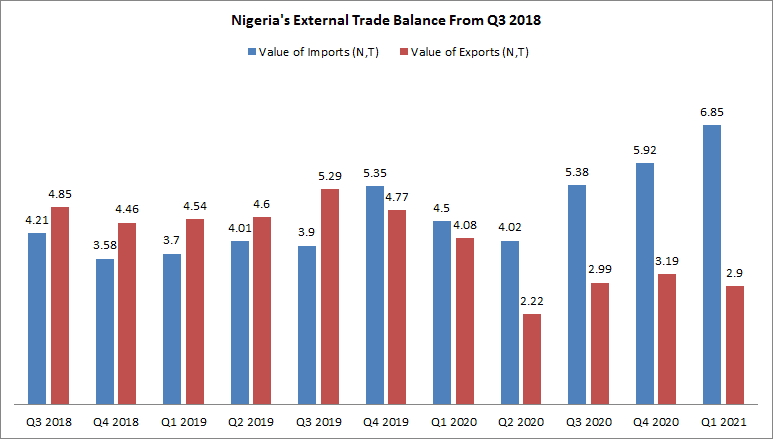

THE tendency towards a market-led foreign exchange market naturally bodes well for an economy that spent the past four decades battling a currency crisis. But trade figures of the first quarter of 2021 (Q1) suggest that the country may be heading towards a cliff as it seeks reform of the FX market notwithstanding the potential cut in historical forex misalignments.
While some economists believe a weaker or fairly-valued naira will lead to a stable economy, history has bucked at the theoretical postulation. For instance, the famous Structural Adjustment Programmme (SAP) never saved the weakening naira of the mid-1980s. Most recently also, a falling naira never translated to more exports as suggested by theorists.
In reminiscence of SAP, data do not suggest that Nigeria will, anytime soon, wriggle out of the perils of currency devaluation to harvest the enormous payoffs. The international market could be a zero-sum game; hence, one country’s loss is most likely another’s gain. Thus, countries put in their best to make their sectors competitive. That Nigeria is not competitive at the global market may be debated but data of its trading activities are less contestable. Those have also not suggested that the economy will experience a remarkable transition, from an importing to an exporting country anytime soon.
The trade deficit widened in Q1 as the share of export in the total N9.76 trillion trade value was N2.91 trillion. It accounted for only 30 per cent of the entire figure, making the quarter the worst performance in recent years.
Nigeria maintained a surplus trade until the fourth quarter of 2019 when the value of its merchandise was five per cent less than the imports. The deficit has consistently expanded quarter-on-quarter.
Yet, the value of Q1 2021 export decreased by nine per cent compared with the figure posted in the last quarter (Q4) of 2020 and a whopping 29.3 per cent compared to Q1 2020, a trend suggesting that the country’s much-hyped export promotion has not achieved a modest result while the figures themselves are on ‘reducing balance’.
On the contrary, the value of total imports, which translates to leakages in the economy, rose by 15.6 per cent in the quarter compared to Q4, 2020 and 54.3 per cent higher than Q1, 2020 figure. The uneven growth in foreign trade activities is a mockery of the country’s ambition to reduce external imbalances and increase its export injections.
The performance of non-oil commodities is still not anywhere near splitting the country’s foreign earnings with crude and remained lacklustre even though it increased slightly.
From 2017 to 2020, the contribution of mineral products to the total export value was about 90 per cent. 2019 was the best year for non-oil commodities when it contributed 12.8 per cent to the national exports.
In 2017 when oil bailed the economy out of recession, the sector contributed 96.2 per cent to the export earnings, underscoring the paradox of an economy that claims to be transiting from a narrow base to a diversified one.
That a sector with less than nine per cent contribution to the gross domestic product (GDP) holds over 91 per cent of the country’s export injections is like turning normalcy on its head. But it has become a regular trend.
In 2016 when Nigeria plunged into recession, oil recorded a full-year growth of -14.45 per cent. The recession itself was triggered by the crisis in the oil market. And as usual, agriculture, logistics, services, manufacturing, real estate and other key sectors, which historically depend on the fortune of crude for survival, were sent to the tailspin, leading to a contraction of the entire economy.
By the second quarter of 2017 (Q2 2017), the international oil market rebounded. Thus, the local crude production grew by 3.52. And the economy responded, trudging out of the recession that lasted for over a year. This explains the importance of crude to the Nigerian economy. But this nexus is a death knell for the economy.
First, the global move to decarbonise the industrial ecosystem leading to the search for cleaner energy is a threat to hydrocarbons, the country’s mainstay, even though some energy experts say the impact may not be immediate.
Secondly, the discovery of crude reserves in other parts of the world and renewed restiveness in the Niger Delta seem to add to the already volatile nature of the petro-dollar economy.
There are other reasons to be worried about the economy. While exports of non-oil products are not improving, there is a huge gap in the domestic market that is constantly yearning for imported commodities. As the value of imports continues to increase, the poverty rate could only continue to increase especially as the value of the naira weakens.
The local currency retreated even last week, selling for N502/$ at the parallel market. Some online exchange platforms are selling dollars for as much as N505/$ while some financial experts suggest the greenback could hit N700 before the end of the year. The Central Bank of Nigeria (CBN) has adopted the pseudo-market investors and exporters’ (I & E) window as the default official rate, sending a signal that the country is moving toward full FX liberalisation.
The argument for liberalisation is that it would remove arbitrage and other FX misalignments and position the economy to compete for investment inflow and trade. But some experts said the fundamental fiscal challenges, insecurity and poor infrastructure are the real disincentives that must be addressed to pull offshore investments and increase trade competitiveness.
In recent years, Nigeria managed to squeeze a positive trade balance against all odds. But that changed dramatically since the beginning of the year. In the first two quarters of the year. The country recorded a trade deficit of 23 per cent in Q1 2020. It ballooned to 81 per cent the following quarter and stood at a frightening 80 per cent in Q3.
But more frightening is the fact that the volume of importation keeps rising. For instance, total imports rose by 33.77 per cent in Q3 2020 compared to Q2 2020 and 38.02 per cent compared to Q3 2019. And more so is the increase in the value of imported consumables, including food.


2 comments
… [Trackback]
[…] Information on that Topic: naijatimes.ng/external-imbalances-drags-economy-towards-cliff/ […]
… [Trackback]
[…] Find More Info here on that Topic: naijatimes.ng/external-imbalances-drags-economy-towards-cliff/ […]
Comments are closed.