

“The poor growth, of course, was highlighted by the report released by the Ministry of Finance, Budget and National Planning except that the authorities were not honest to point out the implication of mismatch between gross domestic growth (GDP) and population, which is expected.”
BUDGET implementation reports are meant for the archive and the researchers. But the 2020 report unwittingly serves another purpose: it reveals the depth of the falling economy.
In the year, the country’s economy grew at 0.11 per cent, which is far below its 2.6 per cent population growth rate. This means that fewer goods were available for an increasing number of people.
The poor growth, of course, was highlighted by the report released by the Ministry of Finance, Budget and National Planning except that the authorities were not honest to point out the implication of mismatch between gross domestic growth (GDP) and population, which is expected.
But troubles with the economy as contained in the budget are deeper than mere growth.
One, the report reveals the alarming growth in the country’s deficits. Nigeria has had to bear with unbroken deficit budgets since 2013 when the percentage of the budget deficit to GDP was 2.13 per cent.
It kept climbing and ballooned to 5.4 per cent in 2017 only to retreat to 3.9 per cent, which is far above the three per cent tolerated by the Fiscal Responsibility Act (FRA). But the newer challenge is the rate at which projected deficits are expanded in the course of budget implementation.
According to the report, the fiscal deficit stood at ₦6.6 trillion, which was approximately N2 trillion or 43 per cent higher than ₦4.6 trillion contemplated by the appropriation. The amount is about 14.2 per cent of the 2020 GDP and way ahead of the ₦4.2 trillion recorded the previous year.
The deficit was, like the previous ones, funded to the tune of ₦2 trillion from the domestic market and Ways and Means (W & M) advances, for which both the International Monetary Fund (IMF) and Fitch have faulted the Central Bank of Nigeria (CBN). The two international organisations warned that recourse to W & M was a source of inflation and macroeconomic instability.
The country’s inflation rate stood at 18.12 per cent in April while last month’s figures are being expected. Experts said the government’s aversion to borrowing from the Central Bank money outside monetisation is a major trigger of inflation.
The executive summary of the report may have also corroborated the fast rate of growth of the money supply.
In Q4 2020 alone, broad money supply (M2), that is money in circulation, increased by ₦3.03 trillion (or 8.68 percent), from ₦34.9 trillion in September 2020 to ₦37.9 trillion in December 2020.
The growth in M2 was mainly driven by the expansion in the net domestic assets. Net Domestic Credit (NDC) drove the expansion in net domestic assets (NDA) growing by 5.71 per cent (₦2.2 trillion) from ₦39.4 trillion in September 2020 to ₦41.6 trillion in December 2020, the report also revealed.
The creation of NDA is a function of credits to the government and private sector. According to the National Bureau of States (NBS), credit to the government increased by 18.54 per cent (₦1.8 trillion) from ₦9.7 trillion in September 2020 to ₦11.5 trillion in December 2020. In the same period credit to the private sector experienced a marginal growth of 1.5 per cent, from ₦29.7 trillion to ₦30.17 trillion in December 2020.
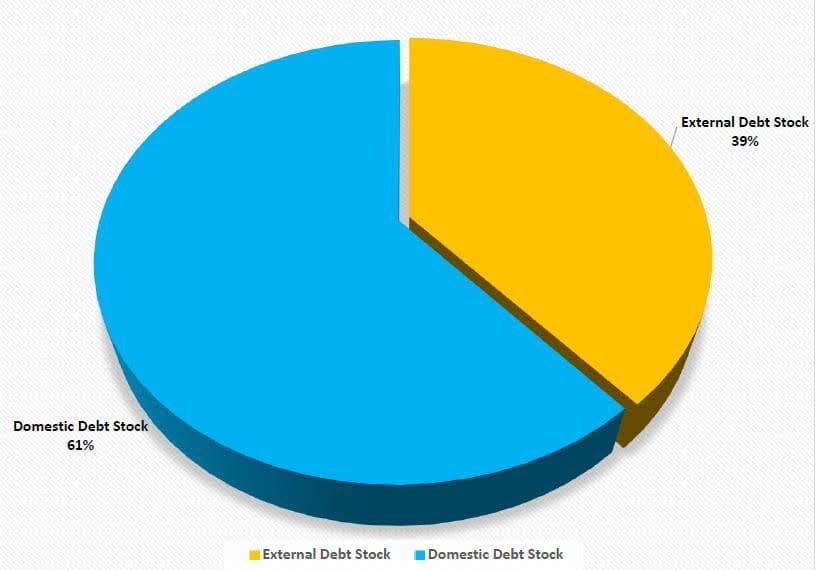
At the close of the year, the country’s national debt stood at N32.9 trillion, which the government claims is below its threshold of 25 per cent of GDP. The debt to GDP, indeed, was 23 per cent of last year’s GDP. But some economists have argued that debt to GDP rarely reflects a country’s ability to pay or service debts when comparing cash flow factors. This is especially relevant when one considers that the key driver of the country’s GDP, which is agriculture, is not strong in cash flow generation.
While the report does not dwell much on cashflow vis-à-vis debt, data obtained from the Medium-term Expenditure Framework /FSP report shows that in Q1 2020, Nigeria spent a total sum of ₦943.12 billion in debt service while the federal government retained revenue was ₦950.56 billion, implying a debt to revenue ratio of about 99 per cent. The quarter reference could be unique but financial experts say the country’s cash flow does not support its rising debt.


4 comments
… [Trackback]
[…] There you will find 3056 more Info on that Topic: naijatimes.ng/budget-scorecard-shows-depth-of-nigerias-falling/ […]
… [Trackback]
[…] There you will find 34322 additional Info to that Topic: naijatimes.ng/budget-scorecard-shows-depth-of-nigerias-falling/ […]
… [Trackback]
[…] Find More Information here to that Topic: naijatimes.ng/budget-scorecard-shows-depth-of-nigerias-falling/ […]
… [Trackback]
[…] Information to that Topic: naijatimes.ng/budget-scorecard-shows-depth-of-nigerias-falling/ […]
Comments are closed.