
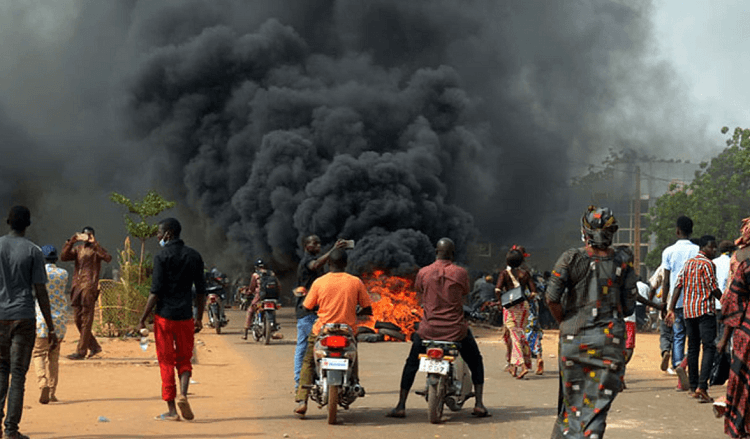

ALTHOUGH nearly every part of Nigeria is facing one form of insecurity or the other, the recent escalation of violent attacks in the South East calls for quick thinking, effective and sustainable solutions. For some months now the South East, particularly Imo State, has emerged as a hotbed of violence, resulting in serious losses in terms of lives, livelihoods and property.
The appellation “unknown gunmen”, has also become the byword for a generic description of those responsible for the steady break down of law and order. The human and material cost of the various coordinated attacks against institutions of the State, particularly those responsible for the smooth and effective running of the criminal justice system, indicates a rejection of the authority of the State. With the attempt to undermine the suzerainty of the State comes the insistence by the outlaws to impose their own rules of engagement.
One discernible trend from the push to violently undermine the state is that the prime targets of the violence have been the police, the correctional centres, the courts, individuals perceived to be outsiders and people who are considered to be insiders but have been tagged as saboteurs working for the interest of the Nigerian State. In line with this trend, there have been various premeditated attacks and killings targeting this category of institutions and individuals.
It is however pertinent to state that the developments in the South East have significant impact on what would be the reactions and counter responses from other parts of the country, particularly in the North. Resentment fuelled by real and imagined events have been eliciting angry reactions from the North. An example of this is the killing of Ahmed Gulak, a chieftain of the All Progressives Congress (APC). Gulak was attacked on his way to the airport, after a private visit to Owerri. He was said to be there as a consultant to the National Assembly. The demise of the politician has been latched onto by voices in the North to promote the narrative of consistent attacks against Northerners and Northern interests.
There is no mistaking the fact that the situation of escalating violence in the South East, especially Imo State, bodes no good for all sides of the Nigerian polity. The breakdown of law and order in parts of the region has adverse consequences for innocent and law-abiding Nigerians living and doing business there.
In many instances since the violence assumed a disturbing dimension, businesses, schools and social activities have had to be shut down because of the insecurity and tension in the affected areas. This has in turn resulted in the loss of precious lives and livelihoods. The already harsh economic situation in the country, which manifests in high unemployment and poverty rates, is being accentuated by the collapse of security.
To arrest the current drift in the region, it is important to undertake a diagnosis of the immediate and remote causes of the ongoing degeneration to a near-Hobbesian state. The fundamental question has to be asked about how a part of the country, which was largely spared of widespread violence, has now degenerated into a war zone where armed non-state elements now regularly challenge the Nigerian State to a contest of supremacy. What exactly is driving and motivating the elements who have taken up arms to engage in duels that have undermined the peace in the area?
An objective assessment of the factors driving the ongoing escalation of violence in the South East would have to capture the potpourri of political, economic and governance issues, which have been repeatedly mismanaged by the ruling elite over the years. Since the end of the Nigerian civil war, there has remained a huge discontentment in the South East about how the Nigerian political system has failed to let go of ill feelings of the war by fully embracing and integrating them. The key power blocs in the Nigerian political system appear to have remained very wary of the people of the South East, resulting in their alleged marginalisation in the politics and governance of the country.
Since the advent of the current democratic dispensation, and notwithstanding the unwritten agreement to rotate political power between the North and the South, the South East is yet to be considered for the Presidency. From 1999 till date, only the North West, the South West and the South South geo-political zones have occupied the office of the President. As talks intensify about the possibility of political power shifting to the South, the South East, it would appear, is not a favoured region. This has no doubt fuelled resentment, and a sense of discrimination and exclusion.
Despite the fact that the South East has not had the privilege of completely participating in politics and governance in the current democratic dispensation, the anger in the region did not begin to manifest violent dimensions until Muhammadu Buhari and the All Progressives Congress (APC) took over the Presidency.
Unfortunately, the decades-old wounds of the people of the South East were reopened afresh by a number of perceived insensitive statements by the President. One of such was the one purportedly made at an event organised by the United States Institute of Peace, in response to a question about how he would ensure inclusion in governance.
His response was perceived to mean that he would favour those who voted for him first before attending to those who did not vote for him. It was immediately interpreted as an indication that the President would not include the South East in his government, even though the South South region did not also significantly vote for his party.
The fears, which were rife at the time, eventually manifested in the President not appointing Nigerians from the South East into his security team. As such part of the bitter complaints from agitators in the South East is that the people of the zone are not part of the security architecture, which is meant to ostensibly ensure their protection.
Added to the above, separatist agitations by some hotheads in the South East have been misconstrued by some elements in the federal government and the ruling party as the general position of the Igbo people. On the watch of the Buhari Presidency, the Indigenous People of Biafra (IPOB) led by Nnamdi Kanu, which was a fringe rabble-rousing outfit, has seemingly attracted mainstream following from disenchanted young people in the region. The Buhari government therefore is being seen as having failed in the area of using the soft power assets of the state to dialogue and win over skeptics in the South East. Instead, the government has been quick in using force in the zone.
The irony of Buhari’s dealing with the South East is that in 2015, his political associates pulled all the stops to promote him as the candidate that would champion the interest of the zone. The push for acceptance in the South East even saw the then APC candidate being given the Igbo name “Okechukwu.” The question therefore is: if the President could canvass for votes in the South East, why has he been reluctant to engage in dialogue with the people of the zone to douse tension and promote harmony?
Nonetheless, it will be unrealistic and simplistic to exclusively heap all the blame for the situation in the South East on the actions of the Buhari Presidency. The political elite from the zone have also woefully failed in their responsibilities to the people of the zone. The governors, senators, members of the House of Representatives, State House of Assembly members, Local Government Chairmen and Councillors wielding political power in the South East have also colossally failed their people.
These political office holders have also not played their part in the area of delivering good governance. Like their counterparts in other parts of Nigeria, the decision makers at the local level have largely looked out for only themselves, their families, friends and cronies. The result is that the people have been left in the lurch, while local leaders are happy to join the bandwagon of blaming the government at the centre.
In their disenchantment and fixation with what is going on in Abuja, the people have largely forgotten that there are decision makers who have the primary responsibility for governance at the local and state levels. In the end therefore, the escalating tension in the South East is the result of abysmal failure of governance at all levels. The moment the welfare and well being of the people are taken care of, especially when it is driven by good, participatory and inclusive governance, peace and harmony will be restored to the troubled region.


3 comments
… [Trackback]
[…] Read More on to that Topic: naijatimes.ng/de-escalating-the-tension-in-the-south-east/ […]
… [Trackback]
[…] Read More to that Topic: naijatimes.ng/de-escalating-the-tension-in-the-south-east/ […]
… [Trackback]
[…] Read More on on that Topic: naijatimes.ng/de-escalating-the-tension-in-the-south-east/ […]
Comments are closed.