

*Currency devaluation in an import-dependent economy is near disaster – Economist
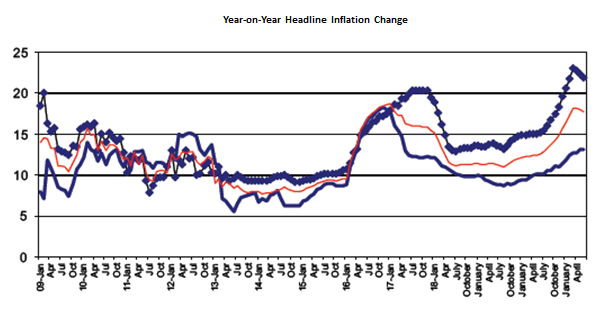
CONTRARY to experts’ views, Nigeria’s inflation has slowed down to 17.75 per cent year-on-year in June, from 17.95 per cent reported the preceding month. It was the third month the inflation rate would decelerate back-to-back.
In May, the inflation stood at 17.95 per cent, which was 0.18 percent points higher than the June figure as revealed by the consumer price index (CPI) released by the National Bureau of Statistics (NBS) released today.
According to the data, the food inflation rate also came down to 21.83 per cent year-on-year, from 22.28 per cent reported in May. Core inflation, other items less volatile food prices, slowed to 13.09 per cent, from 13.15 per cent reported in May.
The country’s headline inflation rate had accelerated consistently for over three years, hitting18.17 per cent in March, before a gradual retreat.
The data said the headline inflation increased by 1.06 per cent month-on-month in June as against 1.01 per cent recorded the preceding month.
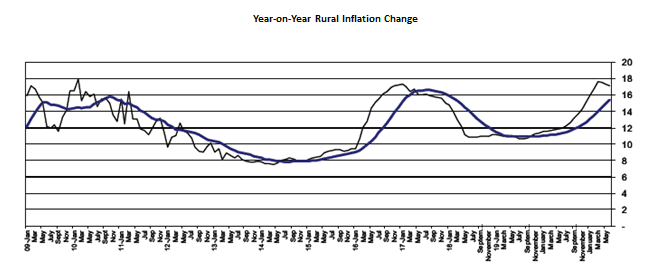
“The ‘all items less farm produce’ or core inflation, which excludes the prices of volatile agricultural produce stood at 13.09 per cent in June 2021, down by 0.06 per cent when compared with 13.15 per cent recorded in May 2021. The urban inflation rate increased by 18.35 per cent (year-on-year) in June 2021, from 18.51 per cent recorded in May 2021, while the rural inflation rate increased by 17.16 per cent in June 2021 from 17.36 per cent in May 2021,” the report stated.
On a year-on-year basis, the latest figure shows inflation was highest in Kogi State with a 23.7 per cent rate while Bauchi State followed with 20.67 per cent. Jigawa State came third with 19.81 per cent inflation rate.
On the flip, Cross River, Delta and Abuja recorded the slowest inflation rate of 15.53 per cent, 15.18 per cent and 15.15 per cent respectively.
Nigeria’s latest inflation data were published amid global concern over the rising cost of living and weakening purchasing power.
A few days ago, the Federal Reserve Chair, Jerome Powell, explained that the Americans might have to tolerate faster inflation in the coming months, suggesting that the growth is more than transitory as earlier assumed.
Globally, inflation surges test the nerves of citizens who are battling health challenges caused by re-surging COVID-19 pandemics.
In some countries, inflation statistics reeled out by institutions affiliated to governments are received with skepticism.
The Nigerian data are less perceived as incredible, and this predated March when the figure suggested an improved purchasing power. In different parts of the country, households borrow to supplement their meager income to survive as prices of essential commodities increase weekly.
A few upscale shops, which have policies of keeping their shelves filled up, are rationing sales of provisions whose supplies are less predictable, Naija Times learnt.
While high inflation in other climes is linked to fiscal expansion programmes rolled out to combat the economic challenges of Covid-19, Nigeria’s surging prices are linked to a currency crisis and poor local production capacity.
Dr. Abiodun Adedipe, a leading Nigerian economist, said currency devaluation in an economy that is import-dependent is near disaster.
At the FMDQ OTC Foreign Exchange Futures, which shows the perception of the market about the stability of Naira, the official exchange rate is expected to lose over 50 per cent of its current value in the next five years. Historical data have proved the future value estimation to be rather conservative.

