
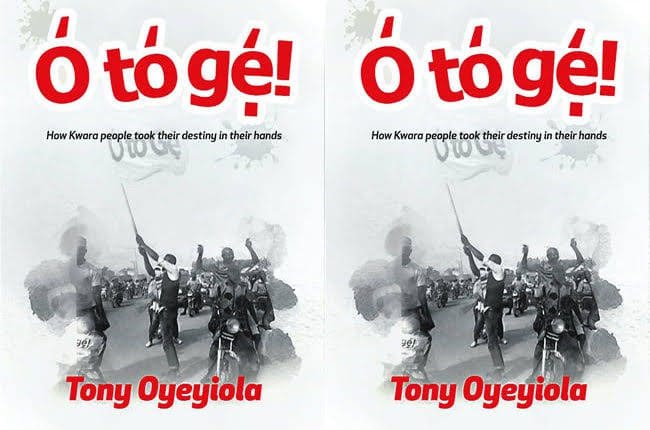

FULL TITLE: O tó gé: How Kwara People took their destiny in their hands
AUTHOR: Tony Oyeyiola
Pages: 212 pages
Cover: Paperback
ISBN: 9789789931439
THIS timely work is a product of the combination of extensive key informant interviews, participant observation, content analysis of news platforms, and painstaking observation of several historical and political developments that have shaped the State of Harmony in the last four decades. Perhaps, the biggest of them is the role of Sarakis. The readers are not left in doubt of the author’s background as a Political Scientist and his excellent narrative techniques which keep them glued to the book till the very end. The simplicity of the author’s presentation means the average reader will not need to have robust previous knowledge of Kwara politics to follow the thoughts about how a people did what was near mathematically impossible, and bloodlessly. Truly, it’s O tó gé (translated as “Enough is Enough” in English) to a political dynasty that has kept a people spell-bound (or subjugated) for over four decades.
In “The Thrust”, the author left no one in doubt as to the direction of the book. A “big elephant” – a sitting Senate President who moved around with a sense of invincibility – is about to be the first casualty of the 2019 elections. The author asked “How could the people celebrate the downfall of their ‘most illustrious son’?” (p.23). The clear sign that Bukola Saraki – the “inheritor” of the political estate of Olusola Saraki (or “Oloye”) could lose an election in a state that was almost like his extended family came to most of his admirers and supporters as a rude shock. If the National Leader of the People’s Democratic Party (PDP) and key actor could lose re-election into the Nigerian Senate, it’s clearly an ominous sign of what is to come. The author vividly captures the mood of everyone around the former Senate President from his polling unit, his immediate family members (his sister, Gbemisola), political associates, and the voters!
In Chapter One, “Kwara – From the Beginning” did the historicity delving into events that predate the creation of the state in 1967. The author vividly and fearlessly presented the formation of the Ilorin Emirate (with the story of the town’s formation by Afonja Enudunjuyo – the sixth “Are Ona Kakanfo” or Generalissimo of the Oyo Empire), Ibolo, Ekiti, Igbomina, Nupe, Baruba and the unique socio-linguistic characteristics of the state within the context of multiculturalism.
Chapter Two, “The Political Dynasty”, describes the origins, developments, and establishments of Saraki’s political dynasty in Kwara narrating its battles, victories, and eclipse in the last four decades. The Chapter lays the foundation of political dynasties in other climes such as the Bushes (America), Eyademas (Togo), Bongos (Gabon) etc which are not peculiar to Nigeria or Africa. The author beautifully describes – in picturesque form – the titanic electoral battles of 1979 and 1983 of the patriarch of the Saraki dynasty with formidable political foes like the strongman of Offa politics – Chief Josiah Olawoyin – and Alhaji A.G.F. AbulRazaq (SAN) the father of the current Governor. Oloye – as supporters of Olusola Saraki often describe him – sealed his political fortune after singularly ensuring Governor Adamu Attah of National Party of Nigeria (NPN) lost re-election in 1983 when the latter fell out with him (p.48). The Kwara strongman reportedly declared support for NPN’s bitter rival, the Unity Party of Nigeria (UPN) candidate, Chief Cornelius Adebayo, in 1983. Oloye will repeat this feat with Governor Muhammed Lawal two decades after this time fielding his biological son, Bukola, with little or no political experience, in 2003, in an election characterized by heavy bloodletting (p.50).
Chapter Three, “Key Political Battles – With Political Sons”, describes the major political battles the Sarakis had with their erring godsons from Adamu Attah (1983) to Muhammed Lawal (2003) to Oloye’s biological son, Bukola (2011) – when things apparently fell apart for the dynasty. With Oloye’s death in 2012, his son, Bukky, took over the dynasty. This chapter leaves a lot of gap with the significance of O tó gé whether it was against the entire Saraki dynasty or just activities directed at the former Senate President in 2019. For instance, Bukola’s sister, Gbemisola Saraki, stayed back in the All Progressive Congress (APC) – against her brother – was Gbemi (a prominent member of the Saraki dynasty) also participating in O tó gé against a dynasty she’s part of? Did the dynasty fall with Gbemi too even though she is currently Minister for State for Transport under the APC-led Federal Government? In the book, the author says “… for over 40 years, there were unsuccessful attempts to dethrone the Sarakis politically… The disgruntled voices grew in number, under the younger Saraki, as a result of alleged … arrogant leadership, aloofness, underdevelopment of the state, self-aggrandizement, etc” (p.23), this convinces the reader the O tó gé was about Bukola rather than the Sarakis or their dynasty.
Chapter Four “The Political Scion” describes the rise of Bukola Saraki to power and fame. The author vividly dangerous and politically mesmerizing manoeuvring techniques, his political adventures as a member of President Olusegun Obasanjo’s economic team, Kwara State Governor, Senator, his battle with his father during Oloye’s final years. There is a gap in this chapter which leaves the question on the mind of the reader: Can we say the Saraki dynasty ended when Bukky took it over because some Oloye’s lifelong fans could not cope with Bukky’s attitude of “supplanting his sister at the Senate and denying her a governorship seat” (p.92-93) in 2011?
Chapter Five “The Dark Cloud” describes Bukola’s political exploits – including the dare-devil ambition to become the Senate President in June 2015 against the powers of his party. The chapter describes the intrigues, power play, legal complications and political significance of his emergence as Senate President.
Chapter Six ‘The Beginning of the End” depicts the fast-changing Kwara political landscapes and the seemingly oblivious Bukola Saraki. The author describes the warning signs starting with the 2017 Local Government elections which went ignored.
Chapter Seven “The Defining Moments” presents the turning points for the main actors in the 2019 elections in Kwara. The huge factors that proved to be decisive here. According to the author, in one of them, the “stakes were high, but the tide was against the Saraki political dynasty” (p.120).
The crux of the matter – O tó gé – was described here. For reasons best known to the author, this chapter came a bit too late. This chapter – the longest in all – should have come much earlier as not too many readers would have the patience to wait this long to get the main gist.
Chapter Nine “The Big Factors” described the decisive factors that shaped the outcome of the Kwara 2019 elections. This appears to come to the reader as too much repetition as most of the events described here have been mentioned in previous chapters. This chapter should have been described as ‘recapitulation’ with many conveniences.
In the last chapter, the author present the lessons learnt for the future of the state and nation. The author set some policy agenda for the new Governor and how to positively impact the lives of the people.
The author used the phrases “political dynasty” and “political dynasties” about 31 times to give the impression that O tó gé was a battle against the Saraki family or dynasty instead of against Bukky. Also, the word “Sarakis” appeared 16 times in the book in relation to their political dynasty which leaves the critical reader wondering the author’s conception of the topic.
The reader suggests the following for the next edition: first, the author should dwell more on the repertoire of contention such as its heavy social media caption etc as is the case with socio-political movements in the scale of the O tó gé in Kwara. Second, the book’s technical formatting should include adequate page numbering. This edition started page numbering at 9. The Forewords, Acknowledgement, Dedication, etc should be numbered differently from the main body of the work. Third, there are so many typos and informal writing such as “Political Science Dept.,” (p.9), “dynasty3” (p.26), “Yar’Adaus” (p.41), “negative political sentiment…” (“N” should be in capital, p.121), “Dr, Bukola Saraki” (p.148), “much-neede” (p.191), “Gandis” (p.41) etc. Fourth, the next edition should be published by a noted publisher to improve its quality.
I strongly recommend the book to readers in social movements in Africa, Electoral Studies, History, and the general reader – both Kwarans and non-Kwarans alike – because it provides a rich resource on the socio-political implications O tó gé in the electoral history of Kwara state and the nation in general.
Olalekan W. Adigun, a political analyst and researcher, writes from Lagos, Nigeria. He can be followed on Twitter using @MrLekanAdigun or contacted by email: [email protected]

