

MOST checks on food products being shipped to, and remaining in, Northern Ireland from Great Britain will be scrapped under new proposals from the EU.
That is according to Irish Foreign Minister Simon Coveney, who said it was a “major effort” to address the post-Brexit trade rules between GB and Northern Ireland.
The UK says the rules impose too many barriers.
The proposals will be published later.
Mr Coveney said this was a “major intervention” by Brussels to deal with the concerns raised about the Northern Ireland Protocol.
“Meats, whether they’re chilled meats or other food stuffs, can come into Northern Ireland and if they’re staying in Northern Ireland then the checks that are currently required will not be required,” he said.
This would be dependent on proper sharing of data and proper labelling, he added.
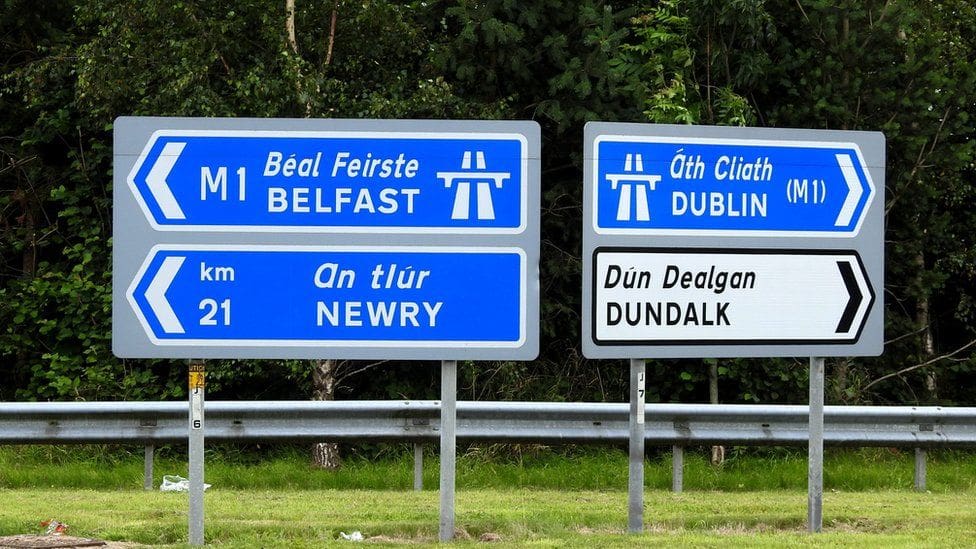
At the start of the year, the new post-Brexit arrangement – known as the Northern Ireland Protocol – was introduced to help prevent checks along the border between Northern Ireland and the Republic of Ireland.
It involves keeping Northern Ireland in the EU’s single market for goods – but this, in turn, creates a new trade border with Great Britain. Unionists say this undermines their place in the UK.
Both sides seems to agree – though to differing degrees – that the protocol is posing some difficulties for people and businesses in Northern Ireland.
Some firms in Northern Ireland affected by the protocol say supply chains are being disrupted, and while there may be opportunities, there are also some problems.
Eamon McKey, of County Down-based sandwich maker Deli Lites, said more people were now shopping locally, and Deli Lites had won accounts previously serviced by competitors in Great Britain.
But the sandwich maker had also lost some of its British suppliers, he added.
Talks between the EU and UK on the new proposals, likely to go on for several weeks, are the first step in trying to reach a better arrangement.
‘Major intervention’
Speaking on Irish broadcaster RTÉ, Mr Coveney said the EU will publish four papers focusing on the supply of medicines, trade in food products into Northern Ireland from Britain, customs, and governance and oversight.
“This is a major intervention by the European Commission and it is a very genuine and honest effort to try and resolve and provide answers for the concerns that many people in Northern Ireland had expressed as regards the protocol and its implementation,” he said.
On medicines, Mr Coveney said the EU wanted to make it “crystal clear” that there would be no barriers to medicines coming into Northern Ireland from elsewhere in the UK.
“The EU is effectively willing to change EU law to solve this problem,” the minister said.
European Commission Vice-President Maros Šefčovič has said the new proposals for the protocol would be “very far-reaching” and that he hoped they would be seen as such.

The EU is offering tweaks to the existing protocol and a relaxation of how it’s implemented.
That’s too little for Lord Frost who has tabled an alternative version which would strip out references to the continued application of EU law in Northern Ireland and eliminate the role of the European Court of Justice.
The problem is that’s too much for the EU to stomach.
The two sides will see if they can bridge the difference during a few weeks of intense negotiations. Which means the next crunch point is likely to be in mid-November.
If things go badly that could lead to the UK triggering a clause which allows each side to unilaterally suspend parts of it in an emergency.
That could lead to retaliation by the EU, potentially including new tariffs on British imports. Something you could describe as a trade war.
The protocol seems to be causing genuine problems for trade between Great Britain and Northern Ireland, and within Northern Ireland but the UK government also knows that standing up for the union against the EU is good politics.
On Tuesday, the UK’s Brexit minister Lord Frost proposed plans for an entirely new protocol to replace the existing one.
As part of these plans, the UK government wants to reverse its previous agreement on the oversight role of the European Court of Justice, which is the EU’s highest court.
The agreement states that the ECJ has jurisdiction to rule on matters of EU law in Northern Ireland – so for example, if there was a dispute around complying with applicable EU law, the EU could take the UK to the ECJ.
In a speech to diplomats in Portugal on Tuesday, Lord Frost described his new legal text as “a better way forward”.
He said his proposed text would amend the Northern Ireland Protocol and support the Good Friday Agreement.
Mr Coveney said very few people in Northern Ireland had raised the ECJ as being an issue.
“For whatever reason, the British government has decided to make the ECJ their central issue this week, in advance of Maros Šefčovič bringing forward these four papers,” the minister said.
The EU has repeatedly said the ECJ must have the final say on any matters of EU law in the protocol.
It is expected that the two sides will engage in intense talks during November.
On Wednesday, Lord Frost said the protocol was harming the peace process in Northern Ireland and that it undermined the Good Friday Agreement.
“The problem with the protocol at the moment is that EU law, with the European Court of Justice as the enforcer, is applied in Northern Ireland without any democratic process,” Lord Frost said.
“That has to change if we are to find governance arrangements people can live with.”
But Mr Coveney said he could not see how the ECJ could be removed as arbiter of the rules of the EU single market.
“All that’s being proposed is that the rules of the EU single market, as they apply in the protocol arrangements, that those rules are adjudicated by the ECJ, as adjudicator of last resort,” he said.
It comes as Ireland’s deputy prime minister, Leo Varadkar, warned governments doing trade deals with the UK that it is a nation that “doesn’t necessarily keep its word”.
He made the comment after Dominic Cummings suggested the UK had always intended to tear up the Brexit deal it signed with the EU in 2019.
A government spokesperson said the UK had “gone to great lengths to implement the protocol”.
“Despite this, severe disruption – economic, political and societal – has taken place,” the spokesperson said and added that without significant change “these problems will worsen.”
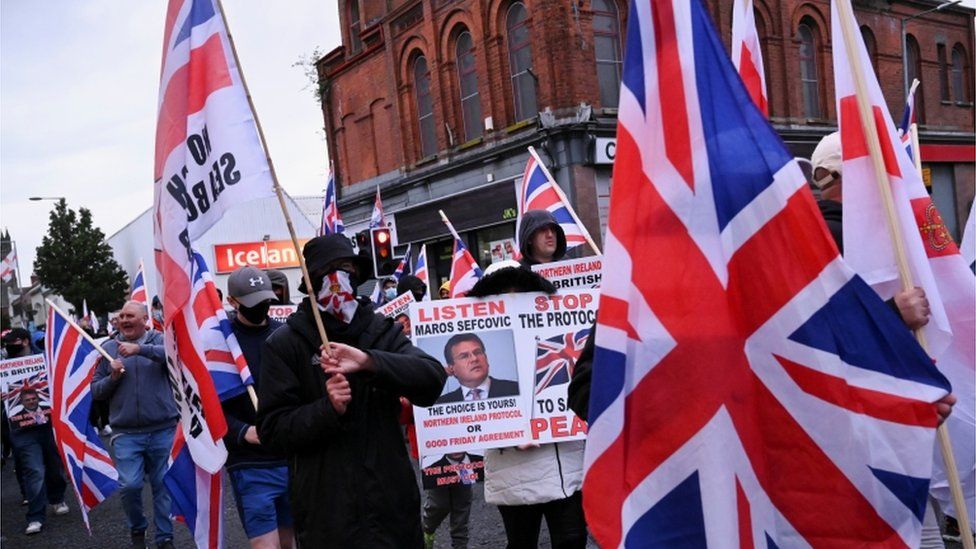
Sir Jeffrey Donaldson, leader of the Democratic Unionist Party – Northern Ireland’s largest unionist party – has warned that it may quit Stormont if its demands over the protocol are not met.
He has claimed pressure from unionists had led the EU to table its new proposals.
What are Northern Ireland politicians saying?
DUP MP Sammy Wilson said that central to any EU proposal was that “Northern Ireland is free from being part of the European single market” and that laws governing Northern Ireland should be made in the UK, rather than Brussels.
“The deal-breaker for us will be has sovereignty been fully restored? Are we fully part of the United Kingdom or are we half in the EU and half out of the United Kingdom when it comes to law making and the adjudication on those laws,” he said.
“That’s how we will judge this.”
Declan Kearney, one of Sinn Féin’s Northern Ireland assembly members, said the protocol must work and what was needed now was certainty and stability.
He said no local business leaders had raised issues about the ECJ during Mr Šefčovič’s recent visit to Northern Ireland.
“This is a red herring. It’s a distraction. What we need to do now is listen very carefully to the proposals coming forward from the European Commission,” he said.
Claire Hanna, MP with the Social Democratic and Labour Party (SDLP), said the EU intended to bring forward a “package of solutions that most people would be delighted” to see.
She said the EU had done what it had promised to do.
“They have listened to the concerns of businesses and people who were hurt by the symbolic dimension of borders and they have moved quite substantially,” added Ms Hanna.
Traditional Unionist Voice (TUV) leader Jim Allister said the issue was about sovereignty, and accused the EU of a “land grab” over Northern Ireland.
“They have annexed Northern Ireland under their ambit and removed us as an integral part of the United Kingdom,” he said.
https://www.bbc.com/news/uk-northern-ireland-58871221

