

BY AFRICA IN WORDS GUEST — SANYA OSHA

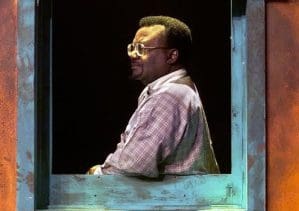
OLA Rotimi is a major Nigerian dramatist who passed away in 2000. Some of his major plays include, Our Husband Has Gone Mad Again, Kurunmi, Ovonramven Nobaisi, and the Gods Are Not to Blame which adapts the plot of Sophocles’s Oedipus Rex to meet local cultural specificities. Rotimi’s dramaturgy focuses on large moral dilemmas such as good versus evil and right versus wrong, among others.
Arguably, his theatre pedagogy has had a more lasting impact than most other Nigerian dramatists. Indeed, Rotimi formulated, alongside a few colleagues working with his seminal theatre collective, a concept of “total theatre” involving all the elements of conventional theatre-drama, music, song and dance – in addition to an interrogation of the performer/audience binary that continues to inspire and motivate products of his dramatic training, many of whom have become successful in their own right as alumni of the Ori Olokun theatre collective which Rotimi had established in Ile Ife, south-western Nigeria.
Ori Olokun sought to develop an indigenous theatrical tradition drawing largely from the knowledge base of south-western Nigeria since it was based in Ile-Ife, the famous university town in the region. Young theatre enthusiasts were selected and trained by experienced university-based academics and practitioners who taught them the various rudiments and disciplines of drama and performance.
Renewed interest in Rotimi’s work came in the form of a webinar hosted by the San Diego State University on April 30, 2021. At the event, which offered a reconsideration of his stature as a dramatist, the outpouring of affection and reverence for the late playwright was immense. Another webinar was held at Bowen University, Nigeria in 2020 in his honour. Niyi Coker, a professor of theatre arts, hosted the San Diego State University webinar titled, “Remembering the Ori Olokun Theatre Legacy”.
Present at the occasion were, Funso Aiyejina of the University of West Indies, Jimi Solanke, legendary fixture of modern Nigerian theatre, television and film, Chinyere Okafor of Wichita State University, Diedre Badejo, an American professor of African literatures, Peter Badejo M.B.E., internationally renowned award-winning dancer and choreographer, Bode Sowande, playwright and professor of drama and Bose Ayeni-Tsevende, drama lecturer and actress.
As a proponent of the concept of total theatre, Rotimi drew from indigenous traditions of drama, song, dance and mime. In addition, he sought to deconstruct the divide between audience and performer. He was perceived as a demanding teacher both inside the classroom and in the rehearsal hall. Having been trained in the Western theatrical tradition in the United States, Rotimi sought to unlearn the presuppositions of that tradition and instead aimed to connect with the cultural and artistic imperatives of home-grown practices which can be considered a form of cultural inversion.
Some of Rotimi’s innovations included subverting the divides between the professional performer and amateur, the ivory-tower and town, as well as toppling divisions between local theatre practices. In pursuing these theatrical categories, in this instance, between actor and singer, male and female, old and young, Rotimi’s plays explore the notion of community in its various ramifications and there is always an overarching ethos of inclusivity evident in them. In this manner, his dramaturgy – that is, most of his major plays – was conceived as a holistic and inclusive exercise; a way of interrogating the boundaries within and beyond cultures, not in order to subvert the limits of community but precisely to accentuate them.
Indeed Rotimi viewed theatre as a way of building community both within the theatrical confraternity and practice but also beyond them. In other words, theatre, as such, is not to be understood as a closed and artificial art form. Instead, it is essentially an avenue for constructing a community within a continuum that links past, present and future. The essence, by and large, of theatre, is community.
Theatre draws its power and cohesiveness as primarily a communal form and practice. But beyond being a tangible art form, it also serves as a treasured link to the wider community and ultimately, our common humanity. After the play has ended, after the curtains have fallen and the lights are out, the community beyond the stage continues to thrive and all performers, singers, actors and dancers included, have to return to it. However, they do not return to it empty-handed. They return instead supported with morals, ethics and a sense of social purpose and cohesion acquired during the course of a production. It is thus the duty of each member of a cast to uphold and spread these cherished ideals.
Without the strength and motivation of these ideals, theatre, it seems, becomes merely a sterile and counter-productive exercise. Thus Ori Olokun instilled within its members the belief that theatre is a community-building exercise, a project for engendering a sense of worthiness and belonging in each and every member of a production involving directors, performers, set designers, costumiers, and lighting technicians. The values of community are duly enshrined in every dramatic production, but as stressed, the cultivation and reinforcement of those values do not end after the curtains fall. They are instead carried forth into the wider community to create further dividends for society at large.
This conception of theatre provides a total contrast to the view offered by another great modernist, Samuel Beckett. Beginning with Waiting for Godot which is perhaps his most ground-breaking and also his most famous play, Beckett, horrified by the atomisation, despair, solitude and sterility caused by modernity, created some of the most powerful and striking parables of alienation in all of modern theatre. Other playwrights of the absurdist tradition such as Eugene Ionesco, Jean Genet, Harold Pinter and to a lesser extent, Joe Orton have further explored this trajectory of modern alienation in various ways. In a Nietzschean post-humanist world, the individual confronts a fate that is at once glaring, grim and relentless. There is no respite from this all engrossing post-nuclear dystopia. This is humankind’s seemingly immutable quandary in this age of (post)transhumanism and super-accelerated digitalisation.
By contrast, Rotimi’s theatre and dramatic pedagogy offer a different vista of humanity and community. It isn’t exactly the simplistic ideal of nature projected by Jean-Jacques Rousseau, the French enlightenment thinker and writer, although it might be slightly idyllic yet it is also practical and often realisable. As such, for Rotimi, theatre is community, and ultimately, community is everything. What is so endearing about Rotimi’s theatrical practice and vision is that they are based on his unfailingly infectious humanism. A humanism based on conviviality, reciprocity and human enlargement.
Instructively, Rotimi’s delectable humanism is not completely akin to Bertolt Brecht’s dramaturgy and searing socialist vision. The Brechtian corpus embodies a mix of modernism, socialism and Grecian overtones couched in the Western paradigm which, arguably, Rotimi was attempting to eschew. Instead, Rotimi’s vision is more easily compared with the Southern African concept of ubuntu or the Tanzanian ujaama. Ubuntu is defined by the credo; “I am because you are and therefore we are” which provides the fundamental basis of Southern African humanism and which is in stark contrast to the Cartesian ego, “I think therefore I exist”. Ujaama, on the other hand, is associated with the political project of African communalism promoted by Julius Nyerere when he was president of Tanzania. Nonetheless the Brechtian socialist vision, ubuntu and ujaama are all somewhat similar in the sense that the collective rather than the individual is viewed as the predominant vehicle of social transformation. And if Rotimi continues to exert an influence more than twenty years after his passing, it is simply because his sense of humanism was both genuine and pertinent.
*Osha is the author of several books including Postethnophilosophy (2011) and Dust, Spittle and Wind (2011), An Underground Colony of Summer Bees (2012) and Ken Saro-Wiwa’s Shadow (Expanded Edition) (2021) among other publications. He works at the Institute for Humanities in Africa (HUMA), University of Cape Town, South Africa.

