
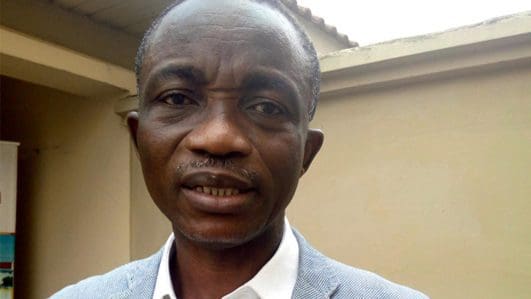

‘In this particular building, the structural engineer quit and officially disengaged from the project by writing to the client. The letter is now in the public domain. The immediate past president of the BCPG, Kunle Awobudu, knows the structural engineer; we know ourselves in the industry. When the building got to the fifth floor, the structural engineer said he could not guarantee the integrity of the building and he withdrew his services officially.That was a red flag‘
George Akinola is the President of the Building Collapse Prevention Guild (BCPG), an advocacy group made up of professionals with a focus on the building and construction industry since 2011. In this interview, he spoke on systemic failure as the bane of the industry and the society at large; what happened at 21-storey Gerrard Terrace in Ikoyi, Lagos, and the need for a change of mindset among professionals, especially in the public sector.
WHAT is BCPG all about?
BCPG is the acronym for Building Collapse Prevention Guild, an advocacy group made up of professionals with focus on the building and construction industry and we have been on this advocacy since 2011. What has been a systemic failure for over 100 years can’t be corrected in 10 years. We have been advocating for a lot of changes from mindset to loss, building procurement processes and other critical issues. It was our advocacy that gave birth to the Lagos State Building Control Agency (LASBCA).
It has been alleged that professionals in the construction industry behave unethically? Please respond.
There are a plethora of problems that do not start and end with professionals. Statistics have shown that not more than 20 percent of the buildings that you see standing out there are designed by professionals. For instance, if you go to the site of the 21-storey property that collapsed in Ikoyi on Monday, November 1, there is nothing to show who the professionals working there are. The law says for every construction, you must put up a board at the site that shows the professionals involved in the construction of the building. It is a list of the client, architects, structural engineers, quantity surveyors, etc. In the case of the collapsed building, there was no such display. What you will see there is the acronym, FMA and phone number. What is FMA? That is not the professional way to go about it. Laws are meant to be obeyed but once you have one big man somewhere, you can get away with anything.
What did your Guild do about it?
There are seven professional bodies that make up the Guild. These professional bodies include architects, town planners, etc. We are a private organisation engaged in oversight duties through advocacy and we file our reports which we send to the government. We don’t have coercive powers.
Was this particular building that collapsed reported?
Government officials were always there and as usual, we made our notes and submitted our report.
Are you saying your Guild did not report the absence of the board required by law?
No, the board issue was reported and on a daily basis on our platforms, we kept reporting our concerns to the supporting agencies including the Ministry of Housing, Ministry of Physical Planning, and Building Control (LASBCA).
Can it then be said that the relevant agencies of government ignored the concerns expressed by the Guild in respect of the collapsed building?
Not exactly … in Lagos State, there are over 10,000 buildings under construction; so we are unable to see all the errors and defects at once. We are in the 57th cell in the state and in other states. However, when we observe defects and errors, we inform the government and its agencies. We may miss one or two that we don’t know.
Including the collapsed 21-storey building in Ikoyi?
As I said before, there were government agents on site before construction started and even as it was ongoing until the unfortunate collapse. There is a document showing that approval was only given for 15 floors for the building but the developer took it to 21. This document was signed by government officials. However, the Guild did not have access to the document until the unfortunate collapse to actually see that 15 floors were approved and not 21. We have consistently told the government to involve professionals in two ways. First, this cell supervision, checking and whistle blowing that we keep doing should be made official. We have enough members of the Guild in Lagos and other states of the federation. Secondly, we should be allowed to participate in the procurement of the materials used. By this, I don’t mean we should buy the materials but to perform oversight responsibility.
The building that collapsed was on a massive construction site but the concerns raised by the Guild were not followed up strongly. What really happened?
From the signboard, it was very clear there was a contravention in the construction. Like I said, on the board you only see an acronym and then a phone number. That is not the way it ought to be. The name, address of the company and the phone numbers of the contacts handling the project should be clearly and boldly stated on the board. In the case of this collapsed building, that was not the case. Secondly, we don’t have coercive powers; we cannot enter into a building or construction site and stop work when we notice any defect. We only report to the appropriate authorities. We raised the alarm bell by making reports to the relevant agencies of government but they were ignored. Government officials are on the same platform because they are professionals like us, too.
When you say you report to the government, how often do you do that?
At intervals, we prepare reports, recommendations and process reviews and send to them to the government through the relevant agencies. I was with the Commissioner during his visit to the site after the incident and we talked about some of these issues. I told him we submitted reports and recommendations to them but he said they did not receive any of the report or recommendation from the Guild. Then I reminded him of the one I personally submitted.
Do you think there is need for improvement in the way things are done right, especially how reports should be presented and received by the state government on concerns noticed on a construction site?
Definitely there has to be improvement in the way we relate with the government. We are the last end of the chain. The important thing here is that most of these concerns come from systemic failure. We are all guilty; apart from the fact that most developers engage those who are not supposed to practice; people we call quacks who are not registered to practice. But you know what, they are practicing and nothing happens to them. Clients take up jobs that are not theirs; they should leave the job of the professionals to the professionals. A client’s job is just to provide funds, leave the rest of putting up the building, which is the job of the professionals. Of what essence are 500 laws without a single enforcement, and even when enforcement is implemented, they are frustrated by big powers. As we all know, LASBCA officials went to the site and implemented enforcement by stopping work but the developer kept working. He behaved as if he was above the law.
Don’t you think when professionals like you raise alarm or blow the whistle to expose where the integrity of a building has been compromised, it will change the way people do things, especially in the construction sector?
I agree with you and we have been making a lot of noise, blowing the whistle. Two years ago, we made a recommendation that professional bodies should have an oversight function on building constructions. Government does not have enough manpower to monitor and man the supervision that is required. Let us have professionals doing the oversight functions with coercive powers to enter into construction sites. By this, I mean there should be legislation to give the Guild the powers to enforce the laws of the land. That would help; we made that recommendation for two or three years now and nothing has been done.
Could this be the reason why professionals in your Guild close their eyes to the preventable collapse that happened?
No, we are also in pain; it hurts us too because it’s hurting our livelihood. So we shouldn’t do that and we are not doing that. Don’t forget, the people in the ministries and agencies are professionals and they are part of us. So those of us in the private sector and the public sector will continue to collaborate to improve on the process. The procurement process is an error.
It appears that there are a lot of gaps in the building and construction industry, and going by what you have said, some government officials are professionals just like those of you in the private sector. Where then is this gap coming from?
It is a systemic failure by all the parties and the connecting dots between all the points on the process line. It could be the problem of how the client procured the approval, maybe through underhand deals. It could be the problem of the approving officer that did not study the document properly before making the recommendation; it could be the problem of the person (the professional outside) that prepared the drawings and designs. It could be a problem of materials on-site and some of these materials are seriously compromised. For example, a 12mm iron rod is longer than a gauge, it has been reduced drastically; it is more or less now like a 10mm or 10.5mm and the length has been shortened. These are some of the things that the Standards Organisation of Nigeria (SON) should check. So it’s a complete systemic failure. The only way we can get out of this problem is to continue to address them even before they arise. I repeat, a 100-year-old problem cannot be solved in a day or even 10 years; it will take a while.
Building and construction is a highly regulated industry just like the medical profession and others. It is believed that professionals like you are not going far enough to ensure compliance and make strong cases for sanctions. But this is not the case. What’s going on?
If we look at the state of buildings today and the ones that collapsed, professionals are not to blame. They are not carried along. Not more than 20 percent of the buildings that are constructed were designed or materials actually procured by professionals. Secondly, the clients, apart from providing the money, take over the process and ignore professionals. And this is where the government has to be blamed because they as regulators should ensure the right professionals are on-site at every given point in time during construction. But in most cases, professionals are not engaged and they are not on site. For example, in this particular building, the structural engineer quit and officially disengaged from the project by writing to the client. The letter is now in the public domain. The immediate past president of the BCPG, Kunle Awobudu, knows the structural engineer; we know ourselves in the industry. When the building got to the fifth floor, the structural engineer said he cannot guarantee the integrity of the building and he withdrew his services officially. That was a red flag.
There has been a call for the assessment of the buildings along the road where the ill-fated 21-storey collapsed. Is there a possibility of carrying out integrity tests on buildings to ascertain the impact of the collapse on them?
For an integrity test to be carried, out you need between two weeks and a month before the result can come out. Integrity tests on buildings above five floors are good and very necessary. But buildings can come down at any time if they are not properly engineered; it does not matter whether it is up to five floors. As we mourn those that lost their lives, I think this is the time to reflect deeply and conduct integrity tests regularly on buildings, especially those planned to go above three floors. The facilities are available. For instance, there are three materials testing laboratories available in Lagos, one belonging to the state government and the two private labs belonging to the University of Lagos and Yaba College of Technology. Now, do we have enough manpower and facilities to carry out the governor’s mandate on buildings above five floors? That is a heavy question. So, maybe the government needs to increase the capabilities of the materials testing laboratory or encourage more private laboratories to come up to be able to do this. It will be a step in the right direction.
How will this unfortunate incident impact investors’ confidence in the building construction industry?
Completely negative; to bolster investors’ and residents’ confidence, there should be random if not total integrity tests on buildings to ascertain their conditions, especially those that are already occupied. I was on a project some time ago and at a point, I felt the need to conduct an integrity test on the building. The test gives you the confidence that you are on the right part and everything including materials being used are okay. We should encourage integrity tests and adopt it as policy. It will save lives from avoidable building collapse.
What in your view are the implications of this massive collapse? Would there be a shift in the way things are done at building construction sites?
The implications are multifarious. For example, from our records, this was the tallest in Nigeria to ever collapse. In most buildings of this magnitude and height like the Cocoa House in Ibadan, NITEL building on Broad Street, Marina, in Lagos, you cannot see such collapse because the procurement processes were properly handled by the professionals. About 10 years ago, I went to conduct an investigation on Cocoa House and I was amazed at the size and quality of the concrete slab, floors and structural members. That building has been standing since 1965 till now and it is still standing strong. We have to address the all-round systemic failure; it is a big problem. Corruption has a way of fighting back, no matter how hard you try to ensure things are done properly.
In tackling this systemic failure, how can whistleblowers reach your Guild in the event of any distress?
They can reach us through our email address: [email protected]

