

NIGERIA has three levels of government – Federal, State and Local. But in real functional terms there are only two levels – Federal and State. In terms of interrogation, the focus of attention seems to be only on the federal government, leaving the state at the mercy of those governing them.
It is commonplace to see critics lampoon the federal government on a daily basis for irresponsibility, inefficiency, corruption, sloppiness etc., but the same scrutiny is not extended to sub-regional governments. And because attention is not often focused on state governments, leaders at that level push their failures to the central government.
The questions to be asked are: What is the responsibility of the state governments? Who measures their performance? What is the performance index? What are they really doing with the money they receive from the Federation Account and internally generated revenues (IGR)? Unfortunately, these questions are not being asked by those who are supposed to ask them. And since questions are not being asked, it has become business as usual in the states.
It is sad to note that not much is going on at that level of governance despite the amount of money collected monthly from the federation account and from internal revenue sources. There is no match between the amount of money collected and generated over time and development indicators on the ground; even though some make bogus claims of achievements that cannot be substantiated in real terms.
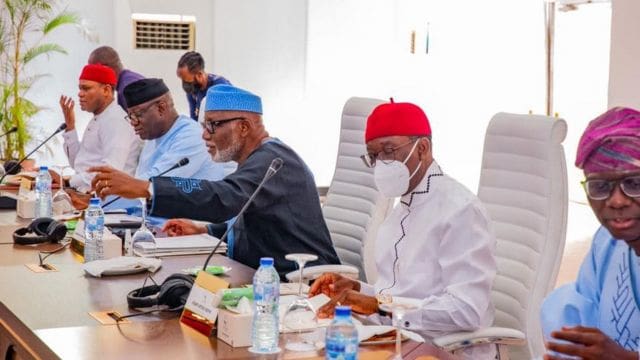
State governors have become too powerful to be interrogated or probed by those who are constitutionally obligated to carry out the responsibility; so they do whatever they like and get away with it. The local governments that should have provided another level of services to the people and the state legislature which should be interrogating the actions of the executive have been annexed; and have become an integral part of an empire where the governor reigns supreme.
Those in charge of these institutions have been incapacitated because they owe both their positions and allegiance to the state governor who must have decreed their position into existence and could bring them down if challenged. The governor determines and decides whatever happens at the state level and is above interrogation and sanction. There is no difference between the state and the governor because the governor is the state.
It is common knowledge that state governors collect revenues from both federal and local sources and share them according to their whims. The local governments get whatever the state governors allocate to them, which in most cases is barely enough to cover workers’ salaries and cost of running basic services.. Council chairmen are thus not committed to their responsibilities and also not prone to sanctions as long as they bear true allegiance to the governor. If the governor is misfiring, what else would be expected of the local government chairmen?
The unfortunate situation in the country now is that there is a general lack of performance among the states and so there are no good examples to emulate. The local governments blame the states and the state governments point accusing fingers at the federal government. The various levels of government keep shifting responsibilities. The people who should have arrested the blame game by holding each level to account seem to be more engaged in sentimental pursuits that fail to place responsibilities where they belong, as clearly spelt out in the constitution.
It could be recalled that in the 1970s, there used to be good examples of performance even among the states. Bendel State under Dr Samuel Ogbemudia used to be a yardstick to measure what the states can achieve. Was it in the area of education, good roads, health facilities, rural electrification, agriculture, sports, just name it, Bendel State was a model. The sad situation today is that apart from very few states that are struggling with cosmetic and self-serving developments, there seem to be no reference point in real terms.
The fact clearly is that we have lost the power of a good example and there is rottenness all over the place. You can barely point to any significant thing that the state governors are doing that are directly beneficial to the people. . You can only point to bad examples; it has become a performance issue. Today, you are likely to hear more of ‘how bad is your governor’ rather than ‘how good is your governor.’
States are just doing whatever they like. Governors have a clever way of pushing blames to the Federal Government and never admit their own failures or irresponsibility. They are adept at diverting attention of their people from their own failures; and never accept that the challenges faced by the people stem from their deliberate acts of irresponsibility and arrogance. Most of them spend huge amount of money on vainglorious publicity, rather than concentrate on beneficial programmes. The truth is that the states are not performing and the governors are the major culprits.
Unfortunately, the governors derive impetus for all these from the people themselves who have lost the power of interrogation and have allowed their leaders at the sub-national levels to run riot. They are afraid to call their leaders to order but concentrate on criticising the central government even on matters that are purely under the coverage and responsibility of state and local governments. They no longer make distinctions regarding responsibilities of the different tiers of governments.
Even when efforts are made by the Federal Government to ensure that critical institutions are allowed the independence accorded them by the constitution, the governors resist and subvert them. Typical examples are the executive orders granting autonomy to the local government, state legislature and judiciary. These institutions have been crippled in the states because they are funded by the state governments who have defied every attempt at direct authority and allocation of funds to them.
Since no critical attention is focused on the activities of state governments, governors convert states into empires and become emperors, determining and deciding every conceivable matter of state, including who runs for, or hold strategic offices. And this is usually the beginning of the subservience which characterise the major institutions that would have put some checks on the governor.
If we are desirous of inclusive growth and development, critical attention must be focused on the activities of state governments. State governors must be made to account for every of their actions, including how they spend monies accruing to the states. The national economy cannot grow if the sub-national economies are not growing. The country cannot develop if its sub-national entities are not developing. The failure of the states can have a disastrous effect on the national economy; and consequently national development.
State legislatures must be alive to their responsibilities, especially in their oversight functions; and state governors must be interrogated and held to account. Appropriate laws must be activated to allow for the financial autonomy of local governments and the judiciary at the state level.
Necessary electoral laws should be put in place to curb the influence of state governors in determining the electoral fortunes of elected political office holders. There is an urgent need for constitutional reforms to tighten the belts around state and local governments if they are to work for the benefit of the people and for the overall economic development and prosperity of the country.

