
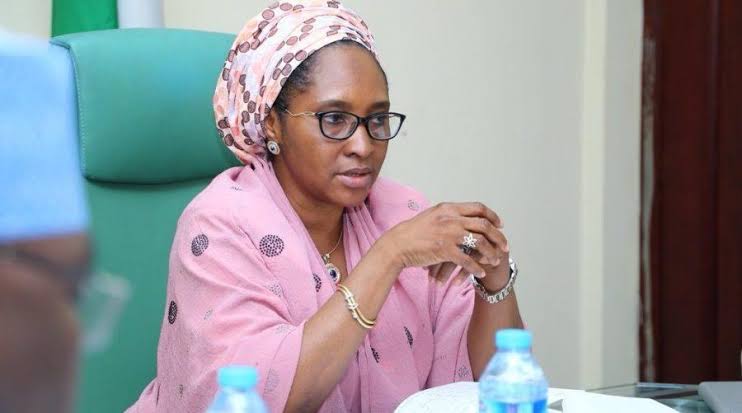

THE Minister of Finance, Budget, Mrs. Zainab Ahmed, and National Planning, stated at Abuja at a Town Hall Meeting on the government’s infrastructure development achievements that Infrastructure and human capital development will be funded by the Federal Government at a cost of N3.53 trillion.
Ahmed noted that the government expected to spend N1.42 trillion on infrastructure and N2.11 trillion on human capital development this year alone.
She explained that the administration will spend such a large sum because it wants to prioritize infrastructure and human capital investments in order to promote rapid economic development.
The implementation of the Appropriation Act, notably the capital budget, has made tremendous progress, according to Ahmed.
According to her, N12.56 trillion (or 94.1 percent) of the N13.57 trillion pro rata budget had been spent by November last year. The GOEs’ expenditure estimates are included in this performance, but Project-Tied Loans are not.
The finance minister also stated that at the start of the administration that N200 billion had been paid for stranded power to service liabilities.
“Contract terms in power purchase agreements (PPAs) were changed from ‘Take or Pay’ to ‘Take and Pay’.
“Also, DISCOs were made to use banks for bill collections – prior to this, TCN was getting only 50 percent of proceeds. Now, TCN is financially viable and can invest in its own infrastructure,” she said.
On the government’s infrastructure provision, Ahmed stated that over N78 billion in tax credits had been provided to investors under the Road Infrastructure Development and Refurbishment Investment Tax Credit Scheme in the last three years (RITCS). The Nigerian National Petroleum Corporation (NNPC) would also fund the development of 21 roads throughout the country.
She added that the RITCS plan was created to relieve the government of the burden of subsidizing large capital outlays on road construction.
She went on to say that the RITCS used tax expenditures in the form of tax credits to fund the construction of critical road and bridge infrastructure projects, as well as an innovative Public-Private Participation (PPP) mechanism aimed at encouraging private sector participation and capital investments.
She stated that the government, through the Nigerian Sovereign Investment Authority (NSIA) and the Nigeria Infrastructure Fund (NIF), completed 13 projects in seven critical sectors, including healthcare, education, agriculture, financial services, and housing, over a seven-year period (2015-2021).
The AFAM III Fast Power project, for example, is a N10.4 billion investment in the acquisition and local assembly of Solar Home Systems as part of the FGN’s solar ambition to electrify five million households.
Ahmed stated that the Federal Government had completed three infrastructure projects totaling $22.5 million in the healthcare sector.
The NSIA-LUTH Oncology Centre, which has served over 4,000 patients, is one of them. The NSIA-FMCU and NSIA-AKTH Diagnostic Centres are also two cutting-edge facilities in Abia and Kano, respectively where nearly 47,000 people have been served by both diagnostic centers.

