
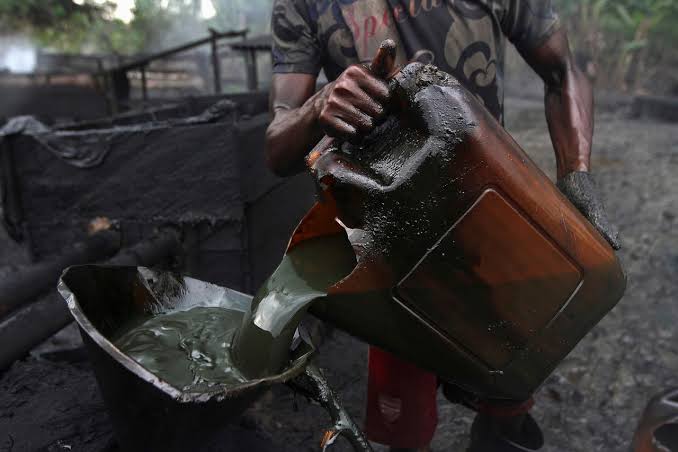

TO combat crude oil theft in Nigeria, the Nigerian Upstream Petroleum Resources Commission (NUPRC) is considering collaborating with key government institutions.
According to the Nigeria Extractive Industries Transparency Initiative (NEITI), Nigeria lost 42.25 million barrels of crude oil to theft in 2019. The product is estimated to be worth $2.77 billion.
While the country is also battling to maintain oil prices low per barrel, the commission, which replaced the former Department of Petroleum Resources, insisted that technology is being used to keep costs down.
Gbenga Komolafe, the Chief Executive Officer of the NUPRC, said the Energy Summit in Abuja yesterday that the commission is working with other relevant agencies to enhance and deploy technology to combat crude oil theft in Nigeria.
According to him, the NUPRC has incorporated technological advancements into its work processes, and the company’s Technological Adaptation Unit, which is part of the Engineering and Standards Department, engages service providers on new technologies that could be used in the Nigerian Petroleum Industry.
We are, without a doubt, living in the era of big data in practically every facet of human endeavor. In tandem, the oil and gas industry has made great progress in acquiring big data in order to explore, capture, develop, and produce hydrocarbons, as well as monitor reservoir performance and surveillance in real time.
“A good example of big data use is in 4D seismic surveillance, using nodal seismic technology where real-time seismic data is collected at periodic intervals to interpret for the reservoir effect as a result of injection-production in a reservoir. This process helps in reducing cycle time in decision-making on reservoir performance,” he said.
With great capacity for continuous data gathering, Komolafe stated the development will assure higher operational efficiency, reduced downtime, decreased HSE risk, and lower environmental impact.
He stated that using data to estimate injector/producer connectivity between wells in a producing field is still an important technique.
“It is noteworthy that the upstream industry is facing challenges that require the need for mass data in high-precision reservoir modelling and surveillance. Consequently, superb computing power, high-performance storage capacity, powerful and integrated mapping applications are required to be able to turn big data into barrels and value for money,” Komolafe said.
The key challenge for service providers in the oil and gas industry, he said, is demonstrating the value that obtaining additional data would bring to the asset.
The main problem, according to him, is to use big data to satisfy Nigeria’s energy needs and expand proven reserves by guaranteeing that the country’s oil and gas resources are not left in the ground without being helpful to the country in a timely manner.
Komolafe said: “National Data Repository (NDR) within the NUPRC serves as the data warehouse for Nigeria’s oil and gas industry. The Value of Information (VOI) is for the purpose of oil and gas investment decisions. For example, NDR facilitates data for bid rounds in line with the statutory mandates of the NUPRC under the PIA to prospective investors, thus enabling informed investment decisions and shortening upstream business lifecycles.
Another application of mass data to barrel in NUPRC can be found in the National Production Monitoring System (NPMS), an electronic system that is deployed to monitor oil and gas production in Nigeria. This ensures accurate and reliable reporting of crude oil production.“

