
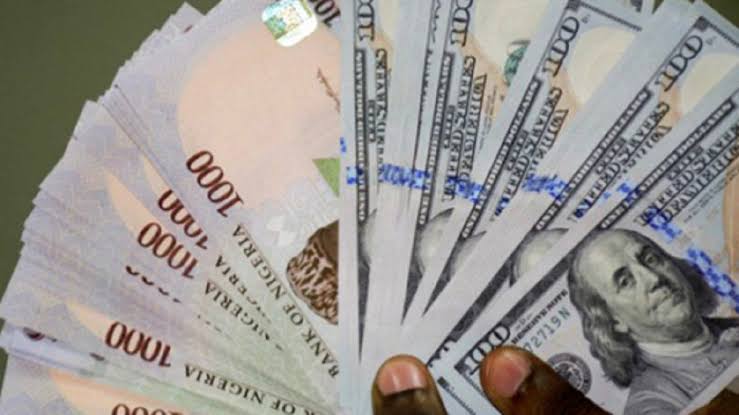

DUE to growing demand and lesser supply, the Nigerian naira traded weak at N419 to the US dollar at the Investors and Exporters foreign currency (FX) window on Friday, creating a disequilibrium position at the official window.
According to data from the FMDQ Currency website, the exchange rate declined against the dollar by 0.2 percent to N419, reversing the previous days’ gains due to market pressures brought on by increased import bill payments.
Despite relatively high oil prices on the world market, inflows into the foreign reserves remained sluggish.
Nigeria’s crude oil production, on the other hand, has been falling short of the limit set by the Organization of Petroleum Exporting Countries (OPEC) and its allies.
According to OPEC+ numbers reviewed by Reuters, the group pumped 1.45 million barrels per day (bpd) less than its target in March, accounting for 1.5 percent of global production.
Angola was responsible for about 300,000 bpd of the OPEC+ supply shortfall, according to the statistics, while Nigeria was pumping nearly 400,000 bpd below target.
Also based on data from the Central Bank of Nigeria (CBN), the country’s external reserve fell by $152.55 million to $39.43 billion last week, owing to low accretion and increased import payment bills. This is taking place as international portfolio investors leave the country’s financial markets.
With CBN capital control measures in place to prevent the local currency from plunging too much, the FX backlog remains high. N65 incentives for exporters who transacted through the investors and exporters’ FX window were also implemented by the apex bank.
Despite this, the value of the naira continues to decline.
On Thursday, total turnover in the Investors and Exporters FX window fell by 57.1 percent from the start of the week to $379.18 million. Cordros Capital traders said in a report that deals were completed between N410.00 to N453.15 per dollar.
According to traders’ notes, the Naira dropped by 19.00 percent versus the dollar on the parallel market, closing at N592.00.
Cowry Asset Management’s weekly market report also revealed that the Interbank Foreign Exchange market closed unchanged at N430.00 to a dollar, despite the CBN’s weekly injections of $210 million.
$100 million was allotted to Wholesale Secondary Market Intervention Sales (SMIS), $55 million to Small and Medium Scale Enterprises, and $55 million was sold for Invisibles out of the total pumped into the FX market.
In a note, Cowry Asset observed that the currency rate moved in a variety of directions throughout the foreign exchange forward contracts.
According to the investing firm, two-month, three-month, and 12-month contracts gained 0.05 percent, 0.05 percent, and 0.18 percent, respectively, to settle at N420.92, N423.80, and N448.02. While according to the World Bank, Nigeria’s per capita income has fallen to 1981 levels.
Analysts noticed that the 1 month and 6 month contracts, respectively, lost 00.11 percent and 0.01 percent to settle at N418.46 and N432.66.
“In the new week, we expect some level of pressure on the Naira against the dollar due to anticipated pressure on foreign exchange amid electioneering activity coupled with weak petrodollar earnings, “Cowry Asset said.

