
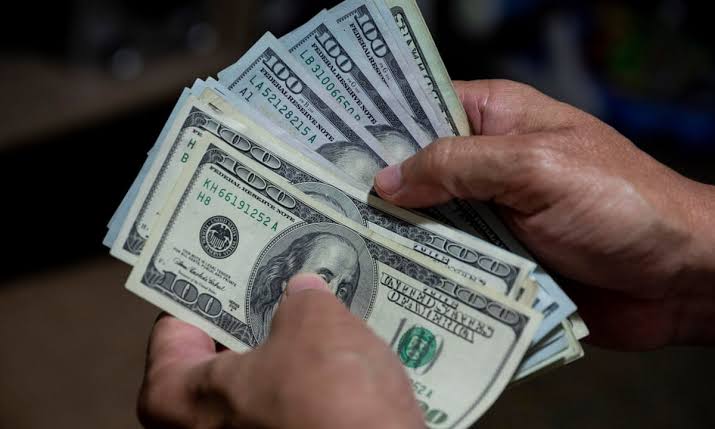

ACCORDING to statistics from policymakers, the Nigerian local currency, the Naira, faces a dismal future as foreign reserves plummet and foreign currencies or dollar inflows into the domestic economy suffer.
On Friday, the official window sold Naira for N419.75. Despite demand pressures in the parallel market subsiding, the local currency was trading at N606 per dollar on Friday, down from N610 the week before.
Despite increasing global crude oil prices, data from Nigeria’s Central Bank showed that the country’s external reserves fell even more last week, falling below $40 billion.
Africa’s greatest economy misses out on the oil windfall, due to inadequate investment in oil infrastructure and theft – a considerable percentage of crude oil is stolen, according to government authority. These continue to have an impact on market supply, especially considering the fact that the Organization of Petroleum Exporting Countries (OPEC) has consistently failed to achieve its quotas.
Rising imports continue to put a strain on external reserves, which export receipts have been unable to meet, exposing the country to foreign currency scarcity. The National Bureau of Statistics (NBS) revealed that, despite rising import expenses, capital importation into the economy slowed significantly in the first quarter of 2022.
The naira depreciates to N419.75 per US dollar in the Investors and Exporters FX window, owing to demand pressures following pre-election spending. The naira’s declining value continues to fuel currency market fears of devaluation. A spate of analysts retain the notion that the local currency is overvalued in their respective market notes.
Foreign investors’ interest in the local economy has declined dramatically as a result of the multi-tiered exchange rates. According to the most recent report, foreign investor involvement in the stock market fell even further in May 2022 and based on NBS report, capital inflows into Nigeria fell by 28% in the first quarter of 2022, from $2.19 billion in the fourth quarter of 2021, to $1.57 billion in the first quarter of 2022.
When contrasted year over year, the record of dollar inflows into Nigeria from foreign investors, which stood at $1.905 billion in the first quarter of 2021, fell by 17.46 percent to $1.57 billion in the second quarter of 2022. Due to unpriced risks in the Nigerian market, foreign investors have stayed away, reducing foreign exchange inflows.
According to Nigerian investment banking specialists, foreign investors’ reluctance to repatriate US cash has been a drawback to investment flows into Nigeria’s financial industry.
Also Cowry Asset Management analysts in a market analysis revealed that foreign investors appeared to be concerned that the Naira was not fairly valued against the dollar.
Meanwhile, demand for foreign currencies has risen in anticipation of election spending in 2023. Despite minimal inflows, the central bank continues to support the local currency in the foreign exchange market.
Despite having a reasonably substantial cushion of roughly $39 billion, the local currency has been hit by one of the worst periods in its history, with a sustained fall in the official window. The CBN’s N65 exporter rebates appear to have had no impact on the exchange rate, as the local currency hasn’t performed any better at the Investors and Exporters FX market.
According to data from the apex bank’s website, Nigeria’s foreign reserve fell for the fifth week in a row, falling to its lowest level since October 8, 2021.
At the end of May 2022, the reserves had fallen by $58.90 million week on week to $38.48 billion.
According to Cordros analysts, total turnover or dollar volume traded in the Investors and Exporters FX window climbed by 115.3 percent to $1.15 billion on Thursday, with deals completed within the N410.00 – N453.55 per dollar zone.
On the stock market, the 1-month rate was unchanged at N419.70 per dollar. In addition, the three-month contract cost N426.63. The 6-month contract’s exchange rate fell 0.1 percent to N438.05 per dollar, while the 1-year contract down 0.2 percent to N459.74.
The currency rate in the Interbank Foreign Exchange market remained unchanged at N430.00 per dollar, despite the Central Bank of Nigeria’s (CBN) weekly injections of $210 million. A total of $100 million was set aside for Wholesale Secondary Market Intervention Sales (SMIS), $55 million for Small and Medium Scale Enterprises, and $55 million for Invisibles.
Analysts foresee modest pressure on the Naira against the dollar due to expected pressure on foreign exchange amid electioneering activity and lackluster petrodollar revenues.

