
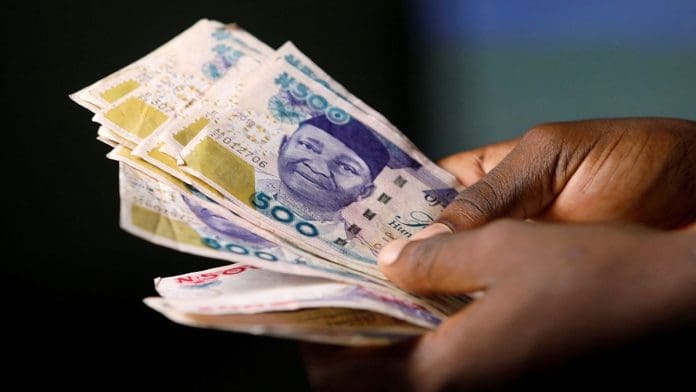

WHILE naira, the local currency of Nigeria, declines, the average yield on fixed income securities finished mixed midweek on the secondary market.
Also at the Investors and Exporters foreign exchange window, the naira lost 0.1 percent of its value to N420.50 per US dollar.
Despite N65 rebates granted to exporters, the official window has nevertheless been under strain because of low dollar inflows.
According to data from FMDQ Exchange, the money market saw a small increase in short-term rates despite a liquidity crunch in the financial sector. According to Cordros Capital’s market report, the overnight lending rate increased by 13 basis points to 14.1 percent as a result of withdrawals for the N226.13 billion FGN bond auction.
In spite of a high headline inflation rate, the secondary market for Nigerian Treasury bills traded with pessimistic emotion today as the average yield increased by 3 basis points to 4.7 percent.
Investors traded exits on Treasury bonds as yield repricing appears to be slowing down following a 150 basis point hike in the benchmark interest rate to 13 percent.
As players sold off the 64-day to maturity (+26bps) and 115-day to maturity (+15bps) bills, respectively, traders reported in the note that the average yield increased at the short (+4bps) and mid (+4bps) segments across the curve.
However, the long end’s yield was unchanged. In the open market operations (OMO bills) category, the average yield increased by 12 basis points to 5.2 percent.
While trading in the secondary market for bonds came to a favorable conclusion. According to Cordros Capital, the midweek average yield fell by 6 basis points to 11.1 percent.
Following buying activity on the MAR-2024 (-15bps), APR-2032 (-7bps), and MAR-2050 (-13bps) bonds, respectively, traders stated the average yield contracted at the short (-6bps), mid (-4bps), and long (-7bps) segments across the benchmark curve.

