
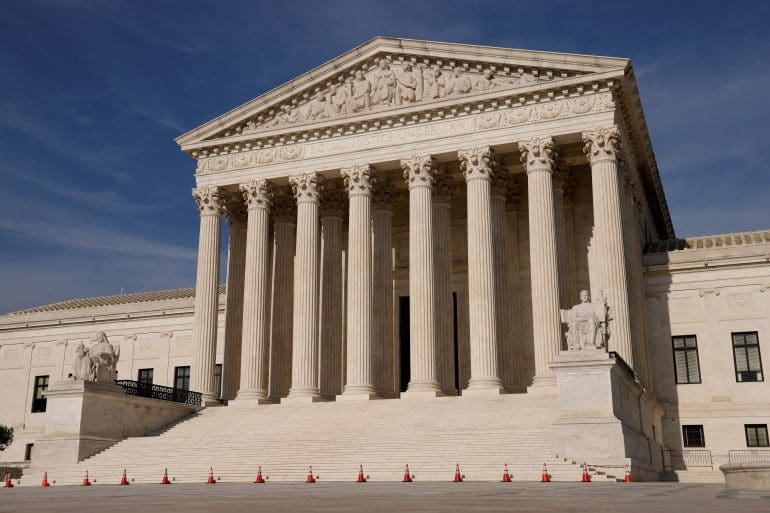

On Friday, the US Supreme Court curtailed the right of American women to abortion. President Joe Biden and Secretary of State Antony Blinken have condemned the decision, which had weeks ago been leaked to the press. Sadiq Yishau reports that some days before the judgment, the Washington Foreign Press Centre held an edition of its “Understanding America” series, where Georgetown University Law School Professor Susan Low Bloch, dissected the American apex court. Her submissions put the court in perspective and help understand its move against abortion among other issues. Excerpts:
The court
The Supreme Court has considerable discretion over its docket. It – it only agrees to hear the cases that it thinks are important. It takes four justices, four of the nine, to vote to take a case. In the jargon, the – we talk about the court granting certiorari.
Once the court – once four justices or more vote to grant a case, the case then gets scheduled for oral argument, the parties write their briefs, and they make their argument. Right after the argument – immediately after the argument – the Supreme Court meets in conference that week and decides the cases tentatively. They each vote on how they will vote on the case, whether to affirm it or to reverse it, and on the basis of that tentative vote they decide who’s going to write the majority opinion and, if there’s a dissent, who will write the dissent. And then the justices go off and start writing.
Nothing is final, nothing is published until every justice has joined an opinion and formalized his or her vote, and that generally takes three to four months. I can go into more detail on that, but as Jean mentioned, I clerked for Thurgood Marshall, so I had an inside view of all this. But it’s very interesting, and there has never been a leak until this year. There even – I mean, there hasn’t even been a leak of how the court has voted, but there’s never been a leak about giving the actual draft of the opinion. I can talk more about that later.
Let me tell you something about the docket that the court has for this term. Obviously, the big blockbuster is what will happen with Roe v. Wade, and there are – the big case is the Mississippi case. There’s also a Texas case, but all eyes are on the Mississippi case. Mississippi prohibits an abortion after the 15th week of pregnancy. Roe v. Wade and the cases that have built on Roe say that there can’t be a ban on abortions – in other words, abortions must be legal – before viability, before the fetus could live on its own outside the womb. And that’s usually thought to be around 24 weeks. So the Mississippi ban that takes – that bans abortions after 15 weeks clearly conflicts with Roe, and Mississippi is asking the Supreme Court to overturn Roe.
Case was argued on December 1st, and we expect an opinion any minute. The draft opinion that got leaked – and by the way, there has never been a leak of a draft opinion in the court’s history – suggests that the court is ready to overturn Roe, and that would be quite a seismic shift. I’ll talk more about that in a few minutes.
Let me just tell you couple of the other big (inaudible) that are on the docket. There’s also a Texas case that bans abortion after there’s a heartbeat, and that – the court will just – all eyes are on the Mississippi case. On the – actually (inaudible) about the draft opinion – it looks like the court is about to overturn Roe. There have been three conservative justices appointed by Trump, and Trump said that he wanted justices who would overturn Roe; and then there’s Alito and Thomas, who are – have been on the court, but they had been opposed to Roe for a long time.
Trump appointees
The significance of the Trump appointees is that it has made what Chief Justice Roberts does basically irrelevant. He was – he had been, before the Trump appointees, especially the one who took Ruth Ginsburg’s place – before that, the chief justice had a – he could have been – he was always the fifth vote and essential. He’s no longer essential. The conservatives now have five solid votes, and it doesn’t really matter what Chief Justice Roberts does. He – Justice Roberts – does not like overturning precedents.
He was – he had been, before the Trump appointees, especially the one who took Ruth Ginsburg’s place – before that, the chief justice had a – he could have been – he was always the fifth vote and essential. He’s no longer essential. The conservatives now have five solid votes, and it doesn’t really matter what Chief Justice Roberts does. He – Justice Roberts – does not like overturning precedents. He was the – sort of the stalwart vote that kept the court from overturning Roe. Now, with six – with five conservatives without Roberts, it looks like the court is going to overturn Roe, and we can talk more about the significance of that.
Other cases to watch
Let me just tell you a little more about some of the other cases on the docket. There’s a big Second Amendment gun case coming out of New York. The court has not had a big Second Amendment case since 2008. In 2008, in Heller v. the District of Columbia, the conservatives on the court voted and succeeded in saying that the Second Amendment protects an individual right to own guns. Now the question is: how far does that extend? New York has a law talking about carrying guns outside the home, and the court has to decide how far the Second Amendment protection extends on – and we should be hearing about that in the next few days.
There’s another really big religion case coming out of the state of Maine that the court literally just decided and announced half an hour ago. Maine has an – the state of Maine has an interesting state law that says if a community doesn’t provide local public schools, then there will be state money given to individual families to use to pay for private education of their children. So if a city or a community doesn’t have a public school, the parents are given state money to use for tuition for private schools, but the Maine law said you – parents could not use it to pay for religious schools.
Several parents challenged that. They would like to use the state money for religious schools, and the court just announced that Maine must allow that. They struck down the Maine law that prohibited parents from using the money for parochial schools, religious schools. Six to three, the court has just decided that no, Maine must allow – or states, not just Maine but all states, if they have such a program – must allow parents to use the money if they wish for religious schools. Otherwise, said the six in the majority of the court, that violates the parents’ religious rights. It’s not really a surprise. This decision is not really a surprise, but it’s certainly not the way the Warren court would have decided it back in the ’70s – ’60s and ’70s.
There are also a couple of interesting death penalty cases on the docket. One involved the guy who did the Boston Marathon bombing, the Tsarnaev brothers. One of the brothers died in their effort to escape the police, but the other brother, but the other brother, Dzhokhar Tsarnaev, was tried and found guilty and sentenced to death. The Court of Appeals found some errors in the sentencing and reversed the death penalty. The case went up to the Supreme Court. The Supreme Court agreed with the federal government, said the errors – there were no significant errors, and they reinstated the death penalty for Dzhokhar Tsarnaev. So he is back on death row.
The other interesting death penalty case involves an inmate, Mr. Ramirez, who would like the state of Texas to allow his pastor, his religious minister, to hold his hand and to pray with him aloud while the death sentence is being administered. Texas says that a minister can be with the death penalty inmate, the person who is about to be executed, but had – Texas had imposed rules that prevented the clergyman from praying out loud and prevented him from touching the inmate. The inmate brought the case to the Supreme Court. The Supreme Court has said that there must – the state must allow the religious person in there. The court just now decided – well, decided in March that the Constitution does require that the state allow a death row prisoner to have his pastor in with him, allow the pastor to touch him, and allow the pastor to pray out loud with him. Because Texas did not give Mr. Ramirez this opportunity, it was violating Mr. Ramirez’s religious liberty, and therefore the state of Texas must comply. That vote was 8-1 with only Justice Thomas dissenting.
I want to mention one more religious case and that’s a football coach who customarily prays at the end of every game. He would pray on the 50-yard line and thank God for the game. His name is Joseph Kennedy. And he was fired because he would engage in this practice. He would – at the end of every game, he would kneel at the 50-yard line and give a prayer of thanks at the end of every game. He claims that being – his firing violated his First Amendment rights of free speech and freedom of religion. The court heard the case back in March and seemed somewhat sympathetic to the coach, but it’s hard to predict what the court will do. That is a case that we’re still waiting for. The issue, of course, is the question of the coach’s First Amendment free speech rights versus the school’s concern that it might be establishing religion and hurting the students’ free religious rights. So as with all religion cases, it’s complicated because there are religious rights on both sides, and we’ll have to wait to see what the court does.
And no matter what happens, this is a really interesting docket this year full of interesting cases and potentially some real explosions as the abortion leakage suggests.
Packing the court
Let me just end my prepared remarks with a short discussion about, quote, “packing the court.” I’ll tell you what that means, for those of you who don’t – aren’t with this jargon. The question is: Is the court too conservative and should Congress pass a law adding more seats to the court? If they added more seats to the court, then Biden would have the opportunity to nominate the justices to fill those seats. The Senate would have to confirm, but it would give Biden the opportunity to add more – presumably somewhat more – liberal justices.
Right now, the court is very conservative. There are five very conservative justices, three more liberal justices, and the chief justice, who is conservative but not as conservative as the most conservative. And as I mentioned earlier, he used to be the critical fifth vote, but with the addition of Amy Coney Barrett, the chief justice has less significance. His vote has less significance, because the conservatives have the five votes that they need to make a majority in any decision.
Number of judges
The Constitution does not specify how many judges are on the Supreme Court. The Constitution requires that there be a Supreme Court and that the president nominate and the Senate confirm the judges on the court, but it does not specify how many. And oddly enough, when the court was first created in 1789, there were – Congress provided that there be six judges, which I’ve always found very striking. They obviously didn’t contemplate dissents, because otherwise I think they would have put an odd number, not an even number on the court.
In any event, the number has fluctuated from that six. By the time of the Civil War, it was nine and it has remained nine. So nine is sort of the magic number, although as I say, there is nothing in the Constitution that specifies nine and nothing in the Constitution that says Congress can’t add more or take away.
The last time the court – that Congress seriously considered adding more and, quote, “packing the court” was during Franklin Delano Roosevelt’s administration when Roosevelt was trying to get the Congress to pass laws to help us get out of the Depression, and Congress obliged, passed a number of different laws to try and deal with the Depression, and a very conservative Supreme Court struck them down frequently. That led to a discussion about letting FDR – well, letting Congress create more seats and then letting FDR – President Roosevelt – nominate justices to those seats. The proposal at the time was that they would add more seats, but as justices left the court by dying or retiring, the court would eventually get back to nine. So it wasn’t a permanent enlargement of the court.
But even that proposal the Congress decided not to do, in part because they thought it was probably too political, it might damage the reputation of the court, and in part because natural attrition meant that a number of the justices died or otherwise left the court, so ultimately in not too many years FDR got to appoint new, more liberal judges.
In any event, the proposal today is back that Congress add more seats and Biden nominate and the Senate confirm and thereby give more liberal voices on the court. I actually don’t – personally don’t think it’s a good idea, but that is what is being discussed.
Public confidence
Personally, I would say that the Supreme Court has lost – the public has lost some confidence in the court. I think – I mean, Chief Justice Roberts is very concerned with the reputation of the court and trying to keep politics out of the court. Lately, I think the fact that Justice Thomas’ wife has been so overtly in the Trump camp has hurt the court. I think that that – there has been that leak is going to hurt the court. It’s – the court has over the 200-something years has maintained a really, I think, very admirable position, highly thought of. I don’t want to say revered; that’s a little too much. But – and Justice Roberts, Chief Justice Roberts is just enormously adamant about maintaining that, but I do believe that the court has looked more political. And the more political the court looks, the less respect I think people have for it. And I think it’s a real tragedy.

