
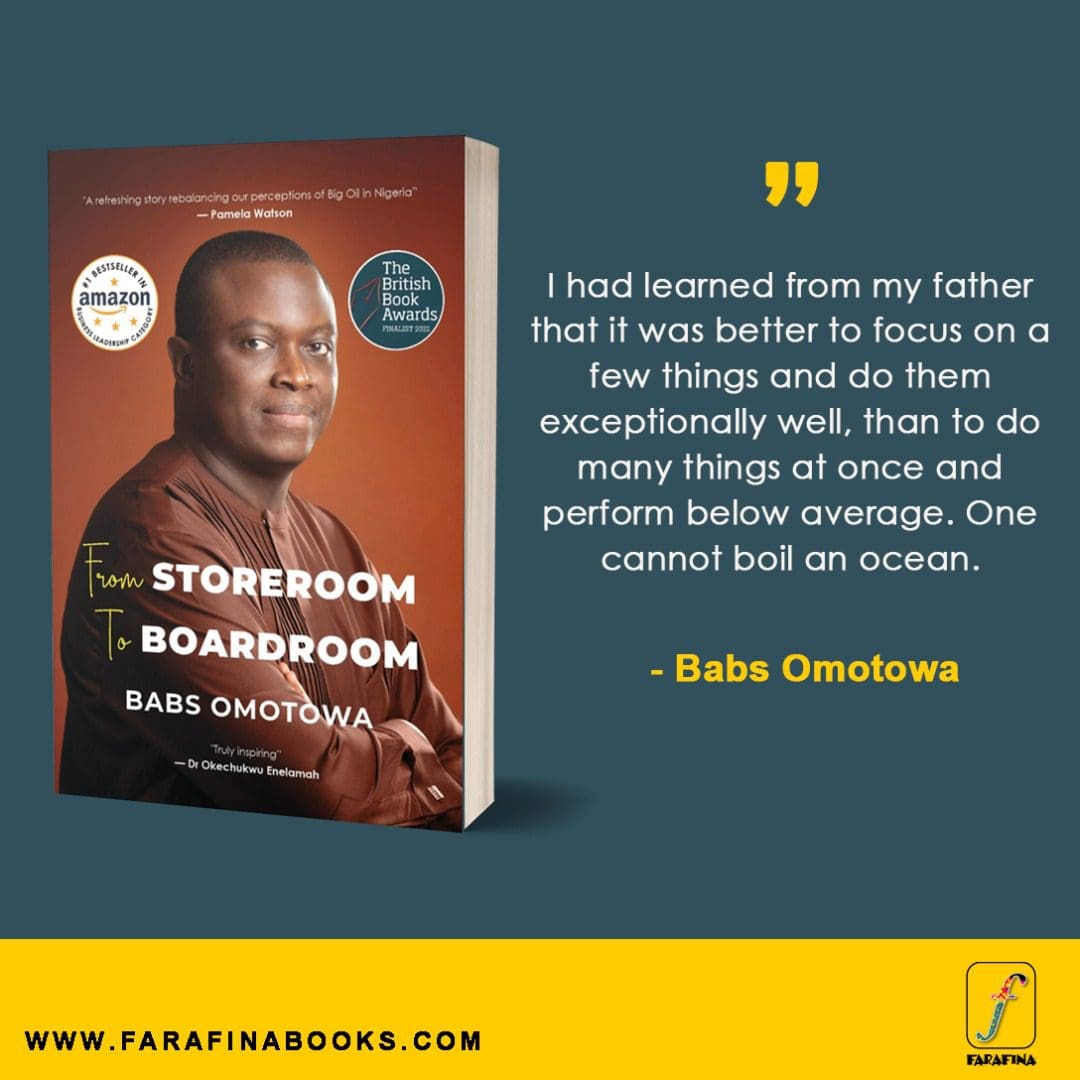

(Being the review of From Storeroom to Boardroom, by Babs Omotowa, presented at the Inaugural Reading of the Leadership Book Series on August 1, 2022 at the Civic Centre, Victoria Island, Lagos)
Opening Comments
DR. Babs Omotowa (or “Babs” as we fondly call him) has written a great book. The book is both engaging and illuminating – truly inspiring! For instance, Babs provides a rich context to help his readers put his story in a proper perspective (he provides background information on the themes and subjects covered in the book – so his readers do not necessarily need to be familiar with the subject matter or Nigeria etc. to enjoy the book).
The book is an easy read because so much has been done to make it readable and easy to follow.
As a result, the book is well positioned to attract both international and local readers.
In fact, the book is already a #1 bestseller on Amazon (Business leadership category)!
Before going through my review of the book, let me speak briefly on how Babs and I met and connected as it is somewhat relevant.
Babs and I met in 2015 when we were both serving in our respective official positions (Babs was CEO, NLNG and I was serving as Minister responsible for the Industry, Trade and Investment portfolio in President Buhari’s first term from 2015 – 2019).
Most times, we are tempted to skip the Acknowledgements of a book and get into the meat of the book. However, in scanning the Acknowledgements, something Babs said struck me because it captures the spirit and essence of Babs Omotowa and the book: “my enormous gratitude goes to those who have packed my parachutes over the years and provided everything that made it possible for me to make it through. Thank you for letting me stand on your giant shoulders!”
Odein Ajumogobia in the Foreword provides what is akin to a pithy summary of the book. Here again is a quote: “He went from managing the Storeroom in the materials department of the SPDC’s outpost in Warri to the global executive suite at The Hague, in less than two decades.” This is of course where we get the title of the Book: “From Storeroom to Boardroom”.
Purpose of Book: Babs introduces the book thus: “I would be content, simply, with writing a book about my failures, challenges and successes; episodes from my life; and the lessons I learned during my career.” I believe Babs does a great job in fulfilling this objective and more in the book. For example, the book has many leadership principles and principles to guide our younger colleagues in managing their careers.
Chapter 1 – BEGINNINGS
Here is a quote from the chapter on Beginnings:
“My parents were the lodestars (serving as inspiration and guides) that helped me navigate life. I owe much of my start in life, as well as my career to their efforts. Not just for the financial stability they provided but the values they passed on to me. They are the giants on whose should I stand.”
Babs shares several intriguing (and at times hair-raising) stories from his background – like when he almost got killed or maimed by some unruly students who were expelled from the secondary school where he taught during his NYSC. It was indeed a narrow escape! Only by the grace of God and a good Samaritan family that hid Babs in the roof of their house did he escape death!
Babs returns to the significance of this “near death experience” in a moving piece in the Epilogue of the book
Chapter 2 – DETERMINATION
As I read this chapter, I reflected on what it would take for a young graduate to land a Shell job today versus when Babs got his unlikely offer to join Shell. Recently, I was contacted by a friend whose son desperately wants to land a Shell job he has applied for. I will send him a copy of Babs’ book – Determination is key! Even if he doesn’t land the Shell job, I hope applying the principle of determination and hard work, God willing, he will land a great job.
Here is a quote from the Book: “Determination is the making up of one’s mind about something and pursuing it to a logical conclusion without letting anything stop you”
“To be successful and achieve a goal, one has to prioritize the goal, provide time and effort towards achieving it.”
Here is another greater quote from Chapter 2 on Determination:
Focus on a few things and do them exceptionally well.” “One cannot boil an ocean.”
Chapter 3 – AMBITION
One key principle from this chapter is that Babs prioritized learning and personal development and was willing to make sacrifices and pay for his personal growth and development. When SPDC cut costs, including the budget for Training and Conferences in 1998, Babs went ahead and paid for his CIPS (Chartered Institute of Procurement and Supply) conference fees, flights and accommodation. This reminds me of a popular quote from King David in the Bible: “No, I insist on paying for it. I will not sacrifice to the Lord my God burnt offerings that cost me nothing.”
Many of us underestimate the power of sacrifice – and being willing to pay in money, time, and determination to achieve our goals and ambition.
Here is a quote: “I went ahead and paid for my CIPS conference fees, flight and accommodation. This would not be the only time I had to do this for myself when oil prices fell. In each instance, I was happy to invest in my own continued learning.”
One quote from this section that is quite intriguing– (this was in connection with Babs’ speaking engagements, including at Harvard University): “I spoke about Nigeria’s resources (human and mineral) that make its emergence as a major market economy inevitable. I told the audience that my country’s path to transforming itself from a developing to developed nation requires dreamers of a certain kind who have the belief and drive to make a difference in their areas of influence.”
Another interesting quote from Babs in this section: “To change others, start from yourself.” I think it was Jim Rohn, who said; For things to change, you have to change. For things to get better, you have to get better. For things to improve, you have to improve.”
Chapter 4 – MAKING IMPACT
Here is a quote from Babs on making impact – “To achieve a successful career, one has to take risks to make an impact within and beyond their area of influence. Impact is about making a difference, being a trail blazer, breaking new grounds and spearheading new ideas. It means being a step ahead, proactiveness and thinking of tomorrow’s solutions today.”
Babs goes on to share 2 case studies:
1. How he revolutionized the leasing of helicopters; and
2. how they turned the SPDC bases in Port Harcourt and Warri from cost centres to revenue centres.
5. Chapter 5 – DEVELOPING COMMUNITIES
“Dubai’s transformation from plain desert to global tourist destination took less than thirty years. This shows what is possible in a generation and lifetime with vision, purpose and determination.”
Dick Kramer (my former mentor and boss) used to tell us that a Spanish Managing Partner of Arthur Andersen in Europe (EMEA) during his tour of duty there in 1970’s often told them: “it takes only one committed generation to transform a nation.”
Under Babs’ leadership, NLNG worked with Bonny to develop a 25 years master plan for the development of Bonny Kingdom. Bonny Kingdom Development Foundation was registered as vehicle for the execution of the master plan.
Chapter 6 – VISION
On Culture:
“Addressing a firm’s work culture is the foundation for success, and involving staff in the process is key.”
A popular saying by management guru, Peter Drucker goes this way: “Culture eats strategy for breakfast.”
On Organisation Structure:
“There is no perfect structure. The key is to design a more efficient structure for the phase a company is at to meet its goals.”
On the challenge of managing setbacks: “I had learned from my experience working on the Farm not to back down due to setbacks. If we did not achieve a good harvest in one year, we went back the next year with the same crop but with improvements in our farming methods or manuring.”
On Cost Optimisation – Babs said they adopted a “Cadence” approach. “Cadence is a disciplined improvement method centred on analysing and understanding opportunities, followed by listening to conversations on solution options, agreement on actions and periodic updates by the team members responsible for this – all stitched together with effective communication with all stakeholders.”
On Employee Costs – Babs shares how they anticipated headwinds that were coming because of the economic downturn that happened in 2015. This meant that NLNG avoided the staff layoffs that other LNG projects suffered in 2015.
Here is a great quote from this chapter on vision: “A cowardly leader will ask, “is it expedient?” An expedient leader will check, “is it political?” A vain leader will ask, “is it popular?” A great leader will ask, “is it right?” A great leader takes a position, not because it is safe, political or popular, but because it is right.”
This is a great take-away for students of leadership.
Chapter 7 – INTEGRITY
Here is a great quote : “Integrity is the consistency of character and virtue even when no one is watching.”
After a fraud investigation in which he was exonerated, Babs observed: “One’s integrity remains their best defence.”
On Corruption and Nigeria:
“Corruption has led to high poverty levels in Nigeria, with the UN poverty index reporting poverty rate as over 80% in Northern Nigeria.” “It is responsible for the poor infrastructure.”
I couldn’t agree more with the author on this key point. Babs personal and professional integrity; and his leadership by example, I believe, in part, is what propelled him to the peak of his career.
This was also a point of connection from which our relationship developed and took off – Babs and I met when I became Minister of Federal Ministry of Industry, Trade and Investment, while he was still serving as CEO of NLNG in 2015/2016.
8. Chapter 8 – COURAGE
“Leading a company in a high-risk developing country is challenging. A leader will be confronted with situations that would confound international management gurus. They must however, refuse to let the company be extorted. They must be ready to protect and put up a rigorous defence of the company even against popular opinion, especially in a country where corruption is rife.”
Case study – NLNG vs. NIMASA and the $140 million extortion.
The courts eventually exonerated NLNG! Although NIMASA subsequently appealed, and the case is still in court.
In another case, where the NOC sought Babs’ removal because he was not co-operating to pay NLNG taxes that were not yet due in advance, Babs said: “I was not bothered, losing my job was a price I was prepared to pay for doing what was legally, ethically and morally right. “ This is of course a display of COURAGE!
Chapter 9 – RELATIONSHIPS
Here is a quote from this chapter:
“Building relationships is key to achieving results. It is important to build them before they are needed. In building a relationship, one must first give. One should first find out what is important to the other person, or what they are working on, and contribute to it or support them towards achieving their goals. Enabling others first, draws a person’s goodwill which they can then leverage on, if necessary, in the future.”
Case studies:
1. NLNG Train 7 finally got approval during President Buhari’s first tenure; and
2. Babs leveraged various relationships to ensure NLNG Act was not amended.
Chapter 10 – REFLECTIONS
Babs makes the following observation in this section:
“I don’t think a company leader should be in a role for more than five years,”
It will be interesting for other companies and Private Public Partnerships (PPPs) to study and adapt the NLNG model to increase the likelihood of success of these projects and initiatives.
On Motivating others
“Through my journey from storeroom to boardroom, one of the most important personal transitions was the shift from focusing on my own individual performance to focusing on enabling others perform.”
Here are some more quotes from Babs:
“Coaching focuses on a specific problem, a here-and-now issue.”
“Mentoring is focused on long-term career guidance from a leader to a junior colleague.”
On Nigeria
“There are no silver bullets or short-term fixes for Nigeria’s historical missteps. Nigeria will have to be built sector by sector. The country needs transformation built on a long-term (10 – 25 years) transition plan, EXECUTED WITH DISCIPLINE!!!”
His Personal Reflection:
“Integrity and courage were key differentiator values that helped me stand out in the crowd through out my career journey from storeroom to boardroom.”
“Core values are a lighthouse for when tough decisions are required and no one choice is clearly the better one. If one compromises on their core values, then one goes nowhere.”
Chapter 11 – EPILOGUE
Here is the lead-in to this section that puts Babs’ faith in God into perspective.
“God is preserving me for future impact.”
This sums up how Babs saw his near-death experience and how God delivered him and eventually propelled him to the great heights and impact he has made.
WOW! Congratulations Babs!
What an inspiring book!
I recommend “From Storeroom to Boardroom” by Babs Omotowa highly!
* Enelamah, Nigeria’s Minister for Industry, Trade and Investment, 2015 – 2019.

