
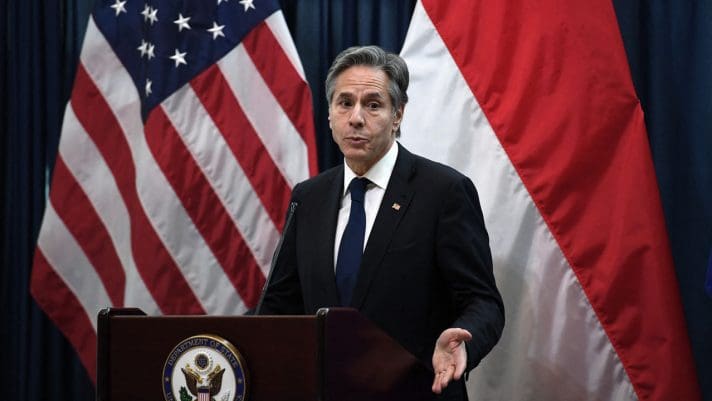

THE United States Secretary of State, Antony J Blinken, has said more than 55 million Africans have been driven into poverty by the Corona virus pandemic.
He added that this has set back decades of hard-earned progress.
Blinken spoke on Monday in Pretoria, according to a statement by his Spokesperson.
He promised that the U.S. would work together with Africa to recover from the devastation wrought by COVID-19 and lay the foundation for broad-based, sustainable economic opportunity to improve the lives of our people.
“We know the pandemic has dealt a devastating blow to Africa – lives lost, livelihoods shattered. More than 55 million Africans have been driven into poverty by the pandemic, setting back decades of hard-earned progress. The economic pain has been deepened by Russia’s unprovoked war on Ukraine,” he said.
In a speech titled ‘Vital Partners, Shared Priorities: The Biden Administration’s Sub-Saharan Africa Strategy’, Blinken said the future depends on young people.
“Our future depends on young people like the scholars and practitioners who come here to study. And, as you’ve heard, by 2050, one in four people on the planet we share will be African. They will shape the destiny not only of this continent but of the world.
“It’s also fitting because South Africa’s struggle for freedom, and the courage and sacrifices of those who led it, continues to inspire people around the world. We know that in your nation, like ours, the long walk to freedom is unfinished. Yet the remarkable progress you’ve made is all around us,” he said.
Blinken added that sub-Saharan Africa is a major geopolitical force that will shape the future.
“It’s a strategy that reflects the region’s complexity – its diversity, its power and influence – and one that focuses on what we will do with African nations and peoples, not for African nations and peoples.
“Put simply, the United States and African nations can’t achieve any of our shared priorities, whether that’s recovering from the pandemic, creating broad-based economic opportunity, addressing the climate crisis, expanding energy access, revitalizing democracies, strengthening the free and open international order – we can’t do any of that if we don’t work together as equal partners.”
He said the U.S. would foster openness because it allows for the free flow of ideas, information, investment, which in the 21st century requires digital connectivity.
He said: “So the United States is partnering with African governments, businesses, entrepreneurs to build and adapt the infrastructure that enables that connectivity – an open, reliable, interoperable, secure internet; data centers; cloud computing.”
According to him, African citizens want democracy and would always receive America’s support to strengthen it.
“The question – the question is whether African governments can make democracy deliver by improving the lives of their citizens in tangible ways. That is a challenge that is not unique to Africa. It’s one facing democracies in every part of the world, including the United States. And it’s a problem that won’t be fixed by maintaining the same approach.
“So here’s what we’ll do differently. We won’t treat democracy as an area where Africa has problems and the United States has solutions. We recognize that our democracies face common challenges, which we need to tackle together, as equals, alongside other governments, civil society, and citizens, ” Blinken said.

