
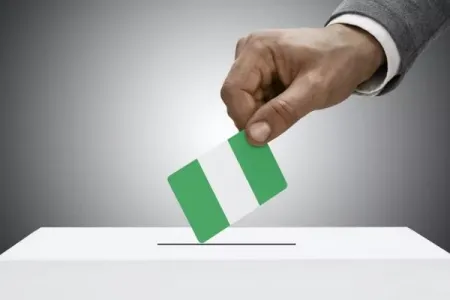

WITH 197 days to the 2023 general elections, the dream of Nigerians living abroad to participate in the electoral process is still a mere hope, even though the Presidency and the Independent National Electoral Commission (INEC) have agreed to work on the technical areas of developing a policy when the legal encumbrances are eventually removed.
The INEC Chairman, Professor Mahmood Yakubu, on Thursday, August 4, received the Senior Special Assistant to the President on Foreign Affairs and Diaspora Matters, Dr. Abike Dabiri-Erewa, who also doubles as the Chairman of the Nigerian Diaspora Commission (NIDCOM) at the INEC headquarters in Abuja.
Prof Mahmood during the meeting stated that the Commission had long begun the process of developing guidelines, regulations, and policy in anticipation of an amendment to the legal framework to enable people living in the Diaspora vote.
Diaspora vote: More rivers to cross
He, however, regretted that the issue of Diaspora voting was not included in the recent constitutional amendments by the National Assembly. “The problem basically is the legal environment, election is a legal process but we made submissions to the National Assembly for constitutional and legal amendments to make Diaspora voting happen. Unfortunately, it’s not part of what the NASS submitted in the case of Constitution amendment to the states for concurrence.”
According to Dabiri-Erewa, Nigerians living outside the country seek to be included in the electoral process. “Everywhere we go, it’s about Diaspora voting. Nigerians in Diaspora are very eager to vote. We are talking about a group of people who this year alone, remitted US$22billion to the Nigerian economy. We are talking about a group of professionals who wherever they go, are contributing to the development and progress of Nigeria.”
Between the 1990s and 2010s, participatory politics grew, as the percentage of African countries holding democratic elections increased from seven to 40 percent. Since 1990 to date, the number of countries on the African continent holding democratic elections have remarkably increased but less discussed is the democratic franchise to its citizens in the diaspora.
Prior to this period, no African country extended the right to vote to any of its citizens living abroad. Today, a full two-thirds of the continent’s 54 countries allow for some form of external voting. Observably missing from this list of countries is Nigeria, which is regarded as the giant of Africa or the big brother, given its economic size, population, and development role.
Liberia, Kenya lead in diaspora voting
Nigeria, along with Liberia, remains one of just two countries in the West Africa sub-region that is without any form of, or legal provision for external (Diasporas) voting. Many African countries today like Kenya are increasingly including provisions in their constitutions that extend voting rights to their citizens in the Diaspora to vote in national elections while living in foreign countries. This is premised on an emerging consensus that they hold great potential to contribute to the development of those nations.
As evidently seen from emerging economies with appropriate policy frameworks, the Diaspora community can be an effective force in the development process. Beyond remittances to support relatives, diaspora citizens contribute through investment in productive activities that support economic growth and job creation and can be tapped to contribute to policy dialogue as well as the transfer of knowledge and skills.
Beyond simple economic support and given the immense contribution to their home countries, some countries include the Diaspora in commissions and management boards of state institutions. Therefore, it is quite justified that members of the Diaspora have the right to participate in electoral processes.
For a number of countries, the debate has progressed beyond whether they should vote but to the logistics of implementing voting. For some countries, the Diaspora vote could tip electoral outcomes. This right to vote essentially means those citizens abroad have a voice in how their home countries are governed.
Social media and remittances as tonic
Social media and communication technology have accelerated these trends globally, providing diasporas easier connections to the politics and communities of their home countries, and giving governments interested in expatriate enfranchisement one more way to make it happen.
In the case of Nigeria, the Diaspora population remittance has hit US$60billion in three years, thus boosting economic activities and the nation’s external reserves. This is according to data from the World Bank and Budget Office of the Federation.
The World Bank in 2019 revealed that Diaspora remittances into Nigeria were estimated at $23.81billion, while the Federal Ministry of Finance, Budget and National Planning in its 2023 – 2025 Medium Term Expenditure Framework (MTEF) and Fiscal Strategy Paper released in 2021, disclosed that Diaspora remittances were $17.21billion in 2020 and $19.2billion.
Prior to 2020, the nation’s remittance inflows had only fallen below $ 20 billion once, when it fell to $19.7billion in 2016. According to the budget office, Diaspora remittances were among the top sources of non-oil foreign exchange for the nation. It explained that a string of policies from the Central Bank of Nigeria (CBN) was responsible for increased inflows of Diaspora remittances into the country in 2021.
It stated that the nation was banking on improved Diaspora remittances in 2022 to reverse the decline in its foreign reserves and strengthen its current account balance. The office clarified that the continuous decline in the nation’s external reserves level was because the CBN was intervening in the official market in a bid to stabilise the exchange rate.
Nigeria’s Diaspora remittance inflow is expected to increase by 7.1 percent in 2022. This is because of higher food prices and the continued adoption of official bank channels. According to the World Bank, diaspora citizens will likely send more money to their home countries like Nigeria, where the prices of staples are extraordinarily high.
The Challenges
Given their contributions to the economy, the yearning of Nigerians residing abroad to be able to participate in the choice of leaders in their home country during elections is one that will not go away as soon as it is legitimate.
However legitimate these yearnings may seem, they are not without some challenges. While some of the challenges have been tied to logistic failure (including lack of a database of people in the diaspora, non-preparedness of the INEC), there remains a moral question that is tugging at the fabric of this laudable and seemingly progressive initiative.
For instance, under the Nigerian 1999 Constitution (Amended), voting rights, or the right to register as a voter, were extended to all citizens of Nigeria who resided in Nigeria at the time of voter registration.
Section 117 (2) of the Constitution clearly states that: “Every citizen of Nigeria, who has attained the age of eighteen years residing in Nigeria at the time of the registration of voters for purposes of election to any legislative house, shall be entitled to be registered as a voter for that election.”
Also, the new Nigerian Electoral Act, 2022 (Amended) states in Part III, Section 12 (1) that: “A person shall be qualified to be registered as a voter if such a person — (a) is a citizen of Nigeria; (b) has attained the age of 18 years.”
Furthermore, paragraph (c) states that such a person: “is ordinarily resident, works in, originates from the Local Government, Area Council or Ward covered by the registration centre; (d) presents himself to the registration officers of the Commission for registration as a voter; and
(e) is not subject to any legal incapacity to vote under any law, rule or regulations in force in Nigeria.”
Another challenge that seems to inhibit this demand is the validity of the results, as most election results in Nigeria are usually fiercely contested in courts several months after the ballots have been counted and the due (and even sometimes undue) winner of the election returned.
Therefore, going by this electoral law provision, and ascertaining the validity of election results in Nigeria, the desire of Nigerians in the Diaspora to participate in the electoral process will remain a mirage.
Recall that members of the National Assembly overwhelmingly voted against the Bill for an Act to alter the provisions of the Constitution to provide for Diaspora Voting, and for Related Matters at the Tuesday, March 1, 2022, plenary.
NaijaTimes checks revealed that out of 469 federal lawmakers, only 390 were present during plenary. While 87 votes were counted in support of Diaspora voting, a majority of 269 votes countered the bill, causing it to fail.
Figures released by the National Assembly showed that 29 Senators and 58 members of the House of Representatives voted in support of the bill which sought to allow Nigerians abroad, to register and vote in their country of residence during elections. 62 Senators and 240 Representatives voted against the bill.
There were high expectations that the Diaspora Voting Bill, if it has been allowed to sail through, would have amended Section 77 and 117 of the Nigerian Constitution, thus allowing Nigerians in the Diaspora to participate in the electoral process. This was why NIDCOM threw its weight behind it.
Following a global trend
The United Nations Department of Economic and Social Affairs in its June 2020 report estimated Nigeria’s Diaspora population to be 1.7 million but the federal government’s records say the country has about 17 million citizens in the Diaspora.
INEC’s Chairperson had argued that Diaspora voting is a global trend; hence Nigerian citizens living outside the country should be allowed to participate in the nation’s electoral process as it was consistent with global best practices. He added that the Diaspora Nigerians make considerable contributions to the economy through Diaspora remittances.
“INEC is committed to providing Nigerians living outside the country the opportunity to have a say in who become our leaders at various levels. I hope that the legal and constitutional obstacles to voting by Nigerians in the Diaspora will soon be removed so that Nigerians, irrespective of where they live around the world, would have the opportunity to vote in future elections,” Mahmood had said.
Throwing his weight behind diaspora voting in Nigeria, former President Olusegun Obasanjo, on Tuesday, August 9, said he sees no reason why the National Assembly cannot amend the relevant laws to make it possible for Nigerians in Diaspora to vote.
Obasanjo disclosed this when Chairman/CEO of NIDCOM, Dr. Abike Dabiri-Erewa, and some staff of the Commission, paid him a courtesy visit in Abeokuta, the Ogun State capital.
Recall that 20 years ago, the former president during his eight years term in office came up with the initiative to get Nigerians to co-ordinate their activities under a Non-Governmental Organisation (NGO) code name Nigerians in Diaspora Organisations (NIDO), which today has transformed to NIDCOM.
This engagement process has led to investment by Nigerians in the Diaspora in critical sectors of the economy such as health, agriculture, hospitality, tourism, and housing, among others.
Corruption in the High Commissions
Notwithstanding the enormity of the contributions to the economy, Nigerians living abroad have continued to accuse the country’s officials in foreign missions of corruption, ineptitude, and negligence, which they believe are unnecessarily causing a delay in the issuance and renewal of the Nigerian passport.
There was viral footage of a distressed Nigerian lady, Oluwakemi Ola, lamenting her frustration at getting her Nigerian passport renewed at the Nigeria High Commission in Canada. A resident of London Ontario, Ola had gone to the Nigeria High Commission in Ottawa to renew her Nigerian passport, only to find out on arrival that the Commission did not open for business that day without prior notice.
By implication, Ola would have spent about $300 making the trip to get her said passport renewed. This according to her was much higher than what her father realises monthly back home in Nigeria.
“I am not Canadian yet, but the moment I become Canadian, I am burning this (Nigerian) passport. I will burn it and I will never, never in my life get a Nigerian passport,” she said out of frustration.
Another video that went viral was that of an unnamed Nigerian of Igbo extraction who had visited the Nigerian embassy in Bern, Switzerland, in relation to his effort at procuring a new passport.
In the video, the man was heard saying he had to drive for two hours from his base in Schaffhausen to the Swiss capital after officials at the Nigerian embassy had failed to acknowledge all his correspondence.
At the Nigerian embassy, the doors were locked with no one to attend to him, despite his claim that some officials were inside, going by the fact that the cars on the premises were neat, clean, and uncovered by the falling snow.
“Nigerian government, bikonu (please), I use God to beg you, it is better we close the embassy here because the embassy has no simple feelings about Nigerians in Switzerland. You would book an appointment at the embassy, call them, and register for the passport. Calling the embassy from Day One, nobody will pick up your call. Write an email to the embassy, the embassy will never reply to your email,” he lamented.
Olalekan Osoleye’s case is not different either, as he claimed that he drove to Washington DC, which is six hours away from his Ohio base. “On getting there, I had a lot of nasty experiences. They told me the embassy didn’t open for business and it was stated on the website that they were open for business that day.
“So that means I had to travel back home for another six hours. The website is not functional, no adequate information. You call them, nobody picks up the call. I wish the Nigerian government will do something about it urgently,” he said.
For Adeolu Adeyemi, a Nigerian resident in Spain, officials of the Nigerian embassy in Madrid, treat visitors to the embassy with laxity, “turning themselves into ‘tin gods’ as if they own everywhere. Their arrogance is an open display of their laziness and inefficiency combined.”
Amid all these complaints, will diaspora voting be effectively manned when eventually passed? Will the usual Nigerian laxity not kill the initiative?

