
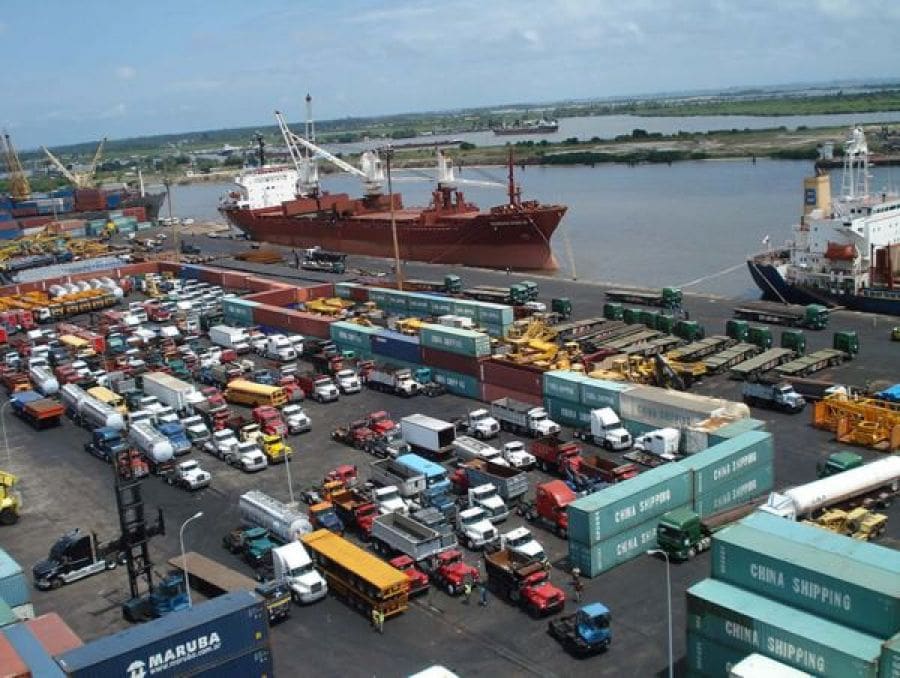

DESPITE the efforts by past and present administrations to end the traffic bottlenecks and articulated vehicles parking on Lagos ports access roads, the challenge still remains with dire consequences for individuals and businesses within the corridor.
At the peak of the crisis, there were claims that as much as N18.2b allegedly exchange hands, yearly, as bribes and sundry kickbacks on access roads to Lagos ports. No thanks to the activities at the various checkpoints and roadblocks on access roads to the ports. It was gathered that then an articulated vehicle driver could pay as much as N150,000 on a trip at the different points leading to the ports. Although the number of collection points had reduced, there are still multiple other points.
It was also learnt that not less than 500 trucks enter the ports daily through the road. This bribe collection galore happens daily except on national public holidays when activities at the ports are sort of grounded. It was not surprising that those who were benefiting from the rot coined the slogan ‘Apapa pass yahoo’.
Speaking on the issue, the Chairman of the Association of Maritime Truck Owners (AMATO), Chief Remi Ogungbemi, maintained that the challenge is a product of inadequate parks for trucks, noting that if there are sufficient parks, trucks would not be parking on roadsides, bridges and un-authorised places within the city and ports access roads.
“I was part of those who did the visibility study of Asiwaju Bola Ahmed Tinubu (ABAT) park at Orile, but when the terminal was completed, it was dedicated to only petroleum tankers. Recently, a part of it has been assigned to serve as a pre-bay for trucks going into the ports, especially those with empty containers. Initially, it was meant to be a truck park. During the tenure of Akinwunmi Ambode, he flagged off the construction of the remaining portion of the park with the contractor sand-filling the section but before Ambode completed his tenure, the contractor stopped work.
“The present administration is working towards getting a place that would serve as a truck terminal because trucks must come from somewhere. It is not in the interest of the drivers that they park haphazardly across the state. It is because of the unavailability of befitting and modern truck terminals. The places we were using before when the ports were constructed had been taken over by other business activities and trucks must surely come from somewhere.
“As of now, truck drivers are just managing to see where they can park. That is why some of the trucks are parked under bridges and other places. The fact remains that trucks must come from somewhere. Even the aircraft that are coming into the country, there is a place inside the airport, where there is a hangar, where the aircraft always park.
“Somehow, some people in authority believed that those that own the trucks should look for a place to park their trucks before they buy their trucks. I want to say that every truck coming from other states to Lagos has a place they park their trucks in their originating state, but it is not possible to bring their truck parks into the ports or Lagos.
“For example, we have eateries where people go to eat or buy food and they park their cars before they patronise the eateries. Will the eateries or hotel managers say they are not concerned about wherever the would-be customers park their cars, as they are only interested in customers patronising them? Having a parking space is part of the provision by which they can establish such a restaurant or hotel.
“There must be a parking space for customers, likewise ports cannot operate without the trucks. And the trucks must come from somewhere. Thank God we are not fighting a war in Lagos. There are so many barracks in Lagos; some of the barracks can be converted to a modern truck terminal so that trucks will not be parked in unauthorised places.”
Ogungbemi observed that though the Electronic Call-Up System popularly called ETO is functioning and the managers are trying their possible best, their effort is not enough.
“Anything you are doing, there is always room for improvement. I am expecting those behind ETO to improve on what they are doing. I want a situation where before a truck leaves anywhere it is parked, the truck driver would have been informed that it is his turn to move out of wherever he is parked.
“But there are some individuals that are sabotaging the system. They are circumventing the system for their personal interest, but when we say something is electronic, it is something you cannot bribe.
“For instance, if you load a recharge card, and you throw away the paper, if someone picks it and tries reloading the card again, can it load? No. That is technology. But the fact is that people are still manoeuvring and circumventing the ETO system. This shows that the system needs to improve and not working as expected. The system should work to the extent that no one can bribe or circumvent it.
“If any truck is booked to enter the port, there should be a barrier at the port that is programmed against each truck, so that the barrier will not give access to any truck that is not approved.
“Just like we have in offices where staff thumbprints are programmed and anyone who is not a staff, no matter the number of times he puts his finger on the system, it will not give him access. So, I am expecting ETO to work to that stage.”
Containing the gridlock
That a lot of work still needs to be done was why, some weeks back, the Lagos State government re-constituted and inaugurated Apapa Special Traffic Management Team to effectively tackle gridlock in Mile 2/Tincan axis, claiming it is aimed at consolidating on the gains of improved traffic flow being witnessed in Apapa axis.
The Special Adviser to the Governor on Transportation, who is also the Chairman of the team, Sola Giwa, explained that the focus of the team is to solely eliminate gridlock on the Mile 2/Tincan axis to sustain the 80 per cent success recorded on Apapa traffic reduction, in line with the governor’s promise to resolve traffic challenges in Apapa and its environs.
Giwa further stated that the task must be carried out with utmost integrity as the Governor, Mr. Babajide Sanwo-Olu, aims to replicate the success recorded at the Apapa axis by focusing more on the Mile 2/Tincan corridor to ensure improved traffic flow in the affected areas. He added that the team is poised to achieve the onerous assignment with the full cooperation of the State Traffic Management Authority (LASTMA).
The Special Adviser also revealed that the team would work in line with its mapped-out Modus Operandi to address the gridlock challenge on the aforementioned corridor through strategic planning and operations.
Responding, the General Manager of State Traffic Management Authority (LASTMA), Bolaji Oreagba, on behalf of other committee members assured the state that the team would consolidate on its previous achievements in Apapa, saying that they will execute their tasks diligently.
The reconstituted Apapa Special Traffic Management Team includes; the Special Adviser to the Governor on Transportation, Sola Giwa as Chairman, the Senior Special Assistant to the Governor on Special Intelligence, Mr. Ayo Laurent as Vice Chairman, General Manager LASTMA, Mr. Bolaji Oreagba. Others are Mr Monsuru Akerele, Mr Adekoya Joseph, Mr Hassan Waheed and Mr Hassan Oladeinde.
Surprisingly, just as the special team was being inaugurated to ease the menace on the Mile 2/Tincan axis, tankers and trucks were seen parked on Ijora and Marine Beach bridges, waiting and heading towards Apapa.
With the different interventions by past and present administrations, some of the checkpoints, especially those manned by security officers and State Traffic Management Authority (LASTMA) officers had been dismantled, but those manned by transport unions are still in place, with new collection points springing up along the Mile 2 corridor on the Apapa-Oshodi Expressway, Lagos-Badagry Expressway and the Ijora corridor.
The Apapa crisis has been on now for over a decade and each government had taken steps to remove the menace around Apapa ports, but most times yielding positive result for a few days and a return to the vomit days after, with commuters and motorists spending hours in traffic connecting or leaving Apapa.
Prohibitive transport cost
This aside many businesses also suffer, as the cost of transporting goods out and into Apapa became doubled.
All these are in spite of former governors of Lagos State, Babatunde Fashola, Akinwunmi Ambode, and the present governor, Babajide Sanwo-Olu had taken different steps and efforts aimed at ending the chaos, but no clear headway yet. Though there had been some form of improvement overall compared to the past, there is a huge more work to be done as accessing the ports whether by articulated vehicles or other road users is still not a smooth ride.
When Fashola was governor, he tried to sanitise that corridor of the state, but there was little or no improvement till he left office. Then, he blamed the Federal Government for not giving the right support to bring the problem to an end.
With the All Progressives Congress (APC) winning the election at the federal level and in Lagos State, the general notion was that the Apapa disorder would be resolved quickly. And when he ended his tenure, luckily, Fashola was appointed Minister of Works, Housing, and Power, and the party at the federal was also the party at the state. But the first four years of APC at the state and federal levels ended, but the crisis did not cease. This was in spite of the joint efforts by the federal and state governments to collectively and individually end the bedlam.
Before the presidential committee by President Muhammadu Buhari, the state under Akinwunmi Ambode had set up a joint task force involving security agencies and stakeholders in the maritime sector to remove all containerised trucks and tankers parked along the Oshodi-Apapa expressway and other access routes to the Apapa and Tincan seaports.
Tagged ‘Operation Restore Sanity On Lagos Roads,’ the state government had set up the task force involving 2,271 personnel drawn from the police, Lagos State Traffic Management Authority (LASTMA), Lagos State Emergency Management Agency (LASEMA), Nigerian Security and Civil Defence Corps (NSCDC), Federal Road Safety Corps (FRSC), and Nigerian military including the army, air force, and the navy. Yet the issue was not resolved with articulated vehicles still parking on roads to the ports.
Owing to the concern of the Federal Government to end the lingering crisis, the Vice President, Prof. Yemi Osinbajo, accompanied by the Minister of Transportation, Rotimi Amaechi visited Lagos then. The delegation was conducted around the Apapa-Oshodi Expressway by chopper for the assessment of the menace of the drivers along the axis. At the end of the visit, the Vice President directed the police boss to clear the gridlock within 72 hours.
As a result of the order by the Vice President, personnel for the operations were deployed to the locations for the evacuation of the over 20,000 petroleum tankers and flat belt trucks causing gridlock from the service lanes and expressway to the six holding bays at Ijora, Isolo, Amuwo Odofin, Orile, and Apapa. This effort only yielded fruit for two weeks, after which the trucks returned.
Under Sanwo-Olu, the best leg put forward by his administration to resolve the crisis was the introduction of the Electronic Call-Up System (ETO), hoping that technology will be the answer. At the introduction, there was excitement that the new strategy would be the last straw that would break Carmel’s back of gridlock around Apapa and its corridor and the parking of trucks and tankers on roads to the ports. This was more so that stakeholders jointly agreed on the new move, which they also felt was a good step going forward. As part of ETO, the government and the stakeholders agreed that only trucks at the approved holding bay for trucks at Ojota, Obanikoro, Oregun, Olowotedo-Ibafo, Amuwo-Odofin, Orile-Iganmu, Okorisan-Lekki/Epe, would have access to the ports.
But surprisingly, weeks after the new strategy kicked off, that is the e-call-up system, trucks returned to the road, with its attendant consequences. To see the impact of the new effort, Sanwo-Olu, who took a tour of the Apapa corridor must be alarmed that the new effort did not yield the needed fruits. And he expressed his frustration at an event hours after he monitored the area when he said the state government will name and shame all the people undermining the state government’s efforts to ensure sanity returns to the area. Lagosians are still waiting for this to be done.

