
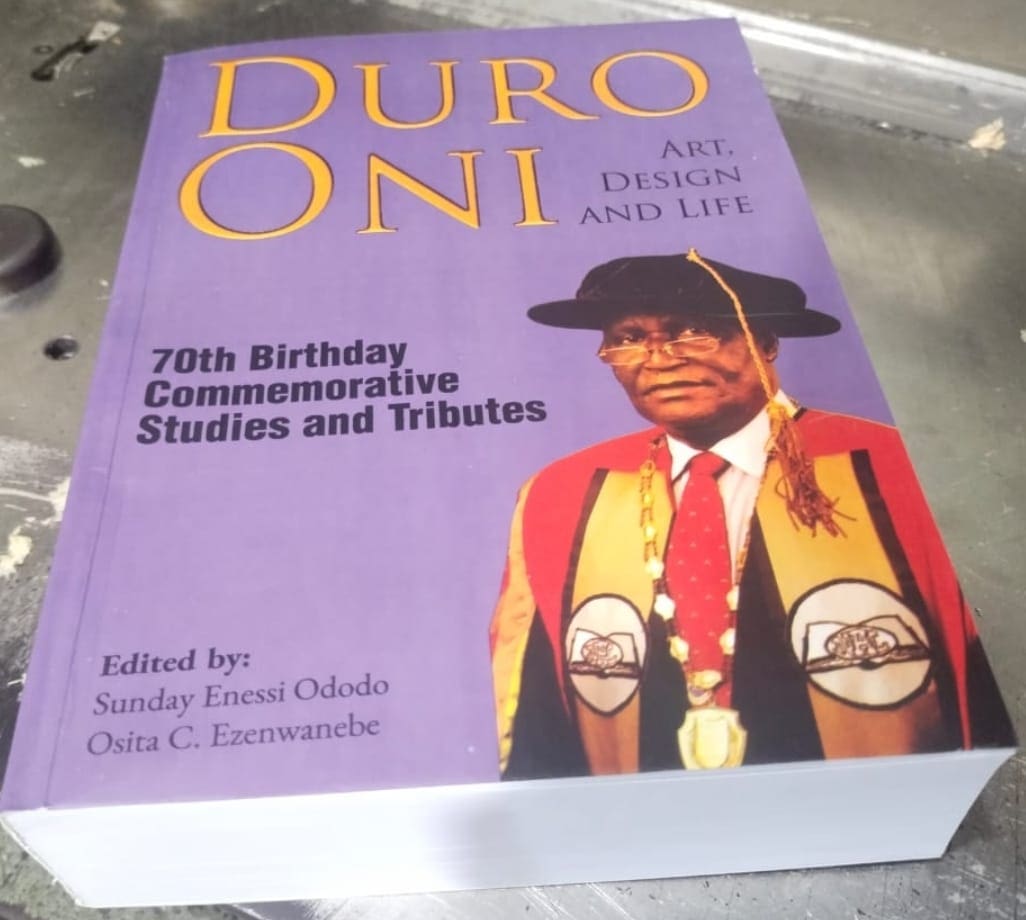

(Duro Oni: Art, Design and Life – 70th Birthday Commemorative Studies and Tributes; ed. Sunday Enessi Ododo and Osita C. Ezenwanebe; pub. National Theatre, Iganmu Lagos, Nigeria in conjunction with Alpha Crownes Publishing Ltd, Rochester, United Kingdom; 2022)
Review by Dr. Solomon Omatsola Azumurana
‘Duro Oni is not a scholar who is disconnected from the social realities of his society. As an astute administrator and cultural activist, his commitment to the quality of his aesthetic output and his vision of the development of human power and institutions are pointers to his commitment to the development of his society’
TO begin with, I will like to state first and foremost that I am here on a professional level. I am here to review a book. Second, today’s event is a complex one and does not fit just into a single categorization. It is as much a birthday celebration as it is a valedictory ceremony. And from the Derridean Deconstructionist perspective, there is a sense in which it can be argued that the privileged item in the binary opposition is the valedictory component. We are here today not so much because it is the 70th Birthday celebration of Duro Oni, but more because of Duro Oni’s 46 years meritorious service to the University of Lagos, to Nigeria, and to humanity in general.
It is against this background that I begin my review of the book – Duro Oni: Art, Design and Life – 70th Birthday Commemorative Studies and Tributes.
There is no equivocation that Duro Oni has distinguished himself as a leading light in academics, administration, and light design aesthetics and theory. In fact, given Duro Oni’s vast experience in light design and aesthetics, and his contribution to same in both theory and practice, it is neither an exaggeration nor is it out of place to conclude that Duro Oni is one of the greatest aesthetic luminaries to have walked the turf of the earth, especially from the standpoint of theatre practice in Nigeria. No wonder, at seventy, his influence, impacts, and footprints loom larger than life.
But of what use is success without a successor? Duro Oni has successfully reproduced himself countless times as there are countless persons who are already trailing his footsteps. This accounts for the profusion of accolades, tributes, and praise, and the eagerness with which people are ready to reverentially cast themselves at Duro Oni’s feet. Duro Oni: Art, Design and Life – 70th Birthday Commemorative Studies and Tributes is a testament to the deep sense of appreciation that creative arts aficionados, literary critics, students, and peers reserve for the contribution of Duro Oni to the field of lighting and design specifically, and to theatre practice in Nigeria generally.
The book under review is, however, divided into six parts:
- Art, Design & Theatre Technology;
- Culture, Film, & Entertainment;
- Literature, Music, Communication and Society;
- Book Review;
- Interviews;
- Tributes – of forty-one (41) critical essays, some with data sources drawn from different linguistic and ethnic orientations, and a review of collected essays in honour of Duro Oni published a decade ago, an interview and a little less than fifty tributes from family, friends, colleagues, and well-wishers.
This review will follow the organizational structure of the book in terms of its divisions/topical classifications.
The first part of the book, “Art, Design & Theatre Technology” is a conflation of 16 critical essays. Of the sixteen (16) essays, thirteen (13) focus on the importance of lighting and design to the overall development of the message of dance and drama. The kernel of the argument of these contributors to this first section is that neither the stories enacted on the stage nor the dance steps possess intrinsic capacity to lend perspectives to the nuances of meaning they express without the aid of technology such as lighting and design. Simply put, they all seem to argue that it is the application of technology for aesthetic purposes that add tenor, texture, and meaning to the performances on stage. This position, taken by 13 of the 16 contributors to the first section, undoubtedly amplifies Duro Oni’s contribution, not only to the development of creative arts in Nigeria but also to the interpretive possibilities of works of art through lighting and design.
This position taken by the 13 contributors is very remarkable and revolutionary taking into account what Aristotle had postulated in his revered and venerated Poetics. After highlighting that there are six elements that determine the quality of a tragic play, Aristotle emphatically argues that the spectacle such as lighting and design, although having an emotional attraction of its own, is the least artistic, and concerned least with the art of poetry. In his words, “the power of tragedy, we may be sure, is felt even apart from representation and actors.” In effect, what Aristotle is saying is that the element of spectacles such as lighting and design does not add or subtract anything to/from the meaning-making of performances on stage. It is this viewpoint of Aristotle that 13 of the 16 contributors to the first section overturns. In different ways, but in the same breath, they all demonstrate how the spectacle of lighting and design contribute to the hermeneutics of performances on stage.
Regrettably, it is only three essays in the first section and one other essay from part two of the book that specifically examine the contribution of Duro Oni to scenography and national development, his general philosophical approach to all aspects of theatrical production, his vision of humanism as manifested in his theatrical practices, and his commitment to the “unearthing of the problem bedeviling theatre practice and offering a recipe for revamping same as well as a look at his enigmatic and charismatic frame as a prodigious aesthetician” (214). Given the immense contribution of Duro Oni in terms of scholarly output and aesthetic praxes, it would have been deserving for a complete section to be created and dedicated to discussing his work and personality. This observation, however, does not by any means undermine the merits of the book.
What is more? Duro Oni is not a scholar who is disconnected from the social realities of his society. As an astute administrator and cultural activist, his commitment to the quality of his aesthetic output and his vision of the development of human power and institutions are pointers to his commitment to the development of his society. While the essays in the second part of the book do not set out to explicate these aspects of Duro Oni’s life, they are essentially hinged on the economic, religious, and sociocultural values of arts to the society – a position Duro Oni has harped upon and advocated for more than 46 years. It is pertinent to stress that most of the contributors to this section are Duro Oni’s creative and critical progenies who understand his passion and commitment, and have decided to honour his decades of hard work with their essays reflecting his vision. Put succinctly, the contemporary nature of the issues discussed in this section highlights the currency of the researchers as well as their understanding of the commitment of Duro Oni to the transformation of Nigerian society through arts.
Much more than the previous parts of the book, the third part is renowned for its topical diversity. From gender issues through semiotics, gang, and gangsterism, codes for musical interpretation, aesthetic functions of music, language, and language use, to the nexus between arts and leadership, it is clear that part three of the book is richly diverse in ideas. Symbolically, the section and the eclectic collection of the book itself speak volumes of the versatility of Duro Oni, his diversity of interest and expertise in all of them.
The fourth part of the book features a review of Fireworks for a Lighting Aesthetician: Essays in Honour of Duro Oni at Sixty, a book of collected essays edited by Sunday Ododo Enesi in honour of Duro Oni’s 60th birthday. Featuring critical essays, interviews and tributes, the book foreshadows the current book. A cursory look at the book reveals that if anything has changed about Duro Oni in the past ten years, it is that he has grown bigger in influence and in his service to the nation and humanity.
The fifth part of the book features an interview granted by Duro Oni on his journey to and through the University of Lagos and the centrality of his role in founding and establishing the Department of Creative Arts of the university. As has been noted elsewhere, the staff and students of the Department of Creative Arts, University of Lagos exist today because of the vision and foresight of Duro Oni. But at the heart of the interview is the revelation that humanity is the major driving force in all that Duro Oni does. This is why it is easy for him to have drawn over forty lengthy tributes from friends, family, colleagues, and well-wishers. Noteworthy also in this section is the character of those who pay tribute to Duro Oni. The section is populated with the high and mighty in the literary and academic world. But one thing that is certain from all the tributes is that Duro Oni through his selfless service to humanity, commitment to the greater good of society and his scholarly and practical contribution to arts in Nigeria and beyond deservedly earned all the accolades he received.
Going through the tributes and knowing the face behind the mask, there is no doubt that we will all miss Duro Oni so dearly. We will all miss what has been aptly described as his “inimitable push power,” his love, compassion, kindness, graciousness, generosity, magnanimity, sociability, warmth and cheerfulness, his devil-may-care attitude, his humble disposition, his mellifluous voice and laugh, and his bespectacled visual contact that keeps us at ease even when we know and are well aware that we are sitting or standing before a giant and a masquerade of some sort.
In conclusion, the book attempts to do too much in its all-inclusiveness. For example, the title of the book, Duro Oni: Art, Design and Life – 70th Birthday Commemorative Studies and Tributes suggests that the central focus of the work should be on Duro Oni’s scholarship and practice, his theatrical and managerial experiences, his contributions to arts and design, and his aesthetic inventions and interventions. However, only four essays examine the life and works of Duro Oni. This is far from sufficient. Here might be the major weakness of the book to the uninitiated. It is worthy to note, however, that the said weakness does not stem from the less-than-expected scholarship or inefficiency of the authors or the editors. On the contrary, most of the essays are well-researched and thoroughly edited; their seeming offence lies in their digressive stance.
Yet, in writing about theatre practice in Nigeria from whatever perspective, are the contributors not in fact writing about Duro Oni. Is Duro Oni not synonymous with theatre practice in Nigeria as theatre practice is synonymous with Duro Oni? The perceived weakness of the book, therefore, transforms itself at once into its strength. Though fundamentally collected to celebrate a prodigious and a leading light in academics, administration, and light design-aesthetics and theory, by the very nature of the digressive and all-inclusive posture of the book; teachers, students, critics, theatre goers, and theatre practitioners and administrators will find the book to be a very useful compendium and companion.
Thank you.
*Dr. Azumurana is of Department of English, Faculty of Arts, University of Lagos, Akoka.

