
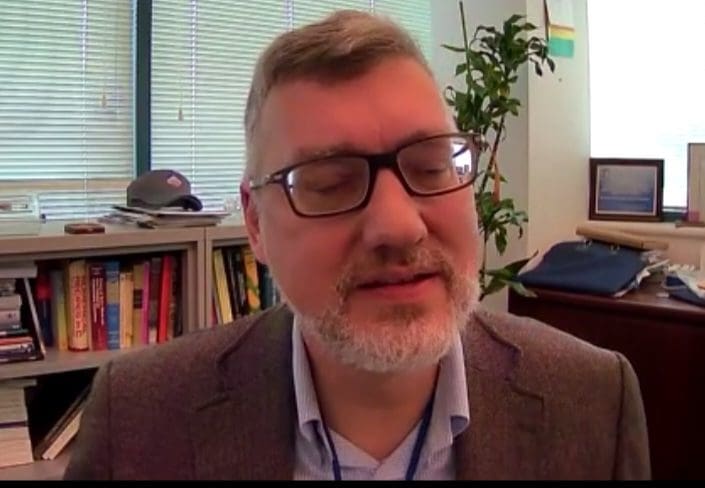

THE Programme Director for the Weapon Physics and Design (WPD) Programme at America’s Lawrence Livermore National Laboratory (LLNL), Mark Herrmann, has said the country’s power plants generate one trillion watts of electricity.
Herrmann spoke at a briefing organised by the Department of State Foreign Press Center in Washington DC.
The briefing was on a scientific breakthrough, which could be a potential path to a fusion power energy plant with 500 trillion watts capacity.
Herrmann, who leads LLNL’s weapon science research and development, said: “The amount of energy that was released by fusion was greater than the amount of energy we put in, demonstrating that fusion is – in the laboratory is a possibility for generating very extreme environments and potentially someday generating more energy out than goes in, and a potential path to a fusion power energy plant.
“So you’re used to power in terms of 100 watt lightbulb, or we can talk about the electrical generating capacity of the United States. It’s about 1 trillion watts. So at any point in time, all the electricity from all the power plants in the U.S. is about 1 trillion watts. So this laser generates 500 times that and deposits it into that little tiny target, but it only does it for a very short amount of time – four billionths of a second.
“And when the laser goes into that target, it heats it up to a few million degrees. But that’s not extreme enough to create the fusion conditions. In fact, we have to squeeze that fusion fuel up and reach temperatures – in this experiment, we reached temperatures as high as 130 million degrees, so very, very high temperatures. The plasma gets very small. It’s about the size of a human hair at the most extreme conditions. And when we – in this experiment, the fusion reactions took place in about one-tenth of a billionth of a second. So – and the power that was generated, the fusion power that was generated, is greater than 30,000 trillion watts. So much more than the power that was generated by the laser, very extreme.”
This breakthrough, according to him, has a potential to be a carbon-free baseload energy source for humanity.
On the side effects of this breakthrough, Herrmann said: “When this blast is taking place, people have to be far away. We have a – we have a facility and we have the doors and things like that that we have to close, and we keep people out of it, and we have to wait for a period of time before we go back into it. So we’re very careful about that. Safety is a very important consideration.
“People have looked at fusion and the potential it may have for proliferation. We think that the concerns associated with that, that’s something that was studied before we built the National Ignition Facility to make sure that any concerns along the lines of proliferation were manageable. I mean, the main concern is that fusion neutrons are very energetic and so they could be used to convert uranium into plutonium. And so, but that would be managed if you had a fusion energy economy, and that’s something that the IAEA and other agencies are thinking about.
“I think – I’ve seen – again, we’re many decades away from putting power on the grid with this approach, but if you did have a lot more energy available to you, that could be good because we think that the biggest determination of how – the more energy that – there’s a strong correlation between energy usage and GDP per capita and people’s standards of living, so that’s a good thing if we could generate more energy. But having unlimited energy may not be a great thing in terms of what the implications would be for the environment and things like that. Again, I’d say we’re a long way away from that, but it’s something that people are thinking about as they work to develop fusion as an energy system.”

