
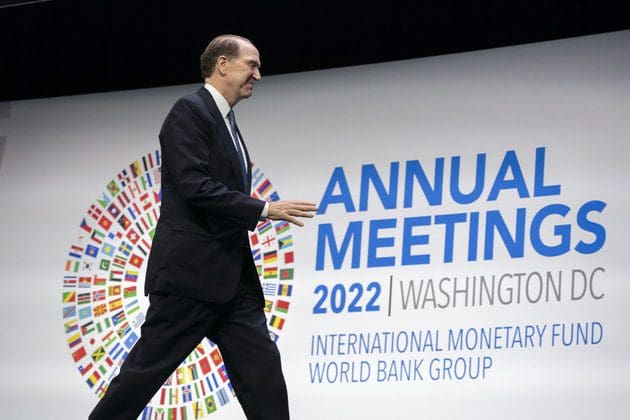

OUTGOING World Bank President, David Malpass, has said Covid-19 threatened to wipe out decades of progress in human capital.
He spoke today while launching a new report, ‘Collapse and Recovery: How Covid-19 Eroded Human Capital and What to Do About It’.
“The pandemic and school closures threatened to wipe out decades of progress in building human capital. Targeted policies to reverse the losses in foundational learning, health, and skills are critical to avoid jeopardizing the development of multiple generations,” he said.
The World Bank Group President urged countries to chart a new course for greater human capital investments to help citizens become more resilient to the overlapping threats of health shocks, conflict, slow growth and climate change.
The lead author of the report, Norbert Schady, who is Chief Economist for Human Development at the World Bank, said: “People under the age of 25 today—that is, those most affected by the erosion of human capital—will make up more than 90% of the prime-age workforce in 2050. Reversing the pandemic’s impact on them and investing in their future should be a top priority for governments. Otherwise, these cohorts will represent not just a lost generation but rather multiple lost generations.”
The report said COVID-19 pandemic caused a massive collapse in human capital at critical moments in the life cycle.
It shows that millions of children and young people in low- and middle-income countries are worse hit.
According to the report, today’s students could lose up to 10% of their future earnings due to COVID-19-induced education shocks. It added that the cognitive deficit in today’s toddlers could translate into a 25% decline in earnings when these children are adults.
“Human capital—the knowledge, skills, and health that people accumulate over their lives—is key to unlocking a child’s potential and enabling countries to achieve a resilient recovery and strong future growth. Yet the pandemic shuttered schools and places of employment and disrupted other key services that protect and promote human capital, such as maternal and child health care and job training.
“Due to the pandemic, preschool-age children in multiple countries have lost more than 34% of learning in early language and literacy and more than 29% of learning in math, compared to pre-pandemic cohorts. In many countries, even after schools had reopened, preschool enrollment had not recovered by the end of 2021; it was down by more than 10 percentage points in multiple countries. Children also faced greater food insecurity during the pandemic.
“Among school-age children, on average, for every 30 days of school closures, students lost about 32 days of learning. This is because school closures and ineffective remote learning measures caused students to miss out on learning and also forget what they had already learned. In low- and middle-income countries, nearly 1 billion children missed out on at least a full year of in-person schooling due to school closures, and more than 700 million missed one and a half years. As a result, learning poverty—already 57% before the pandemic—has increased further in these countries, with an estimated 70% of 10-year-olds unable to understand a basic written text,” the report said.
It said forty million people who would have had a job in the absence of the pandemic did not have one at the end of 2021, worsening youth unemployment. “Youth earnings contracted by 15% in 2020 and 12% in 2021. New entrants with lower education will have 13% less earnings during their first decade in the labor market. Evidence from Brazil, Ethiopia, Mexico, Pakistan, South Africa, and Vietnam showed that 25% of all young people were neither in education, employment nor training in 2021.
“The window for addressing setbacks in human capital accumulation is small, as gaps in early stages of the life cycle tend to widen over time. Without urgent action, the pandemic also threatens to deepen poverty and inequality. This report highlights evidence-based policy options to recover from current losses and forestall future ones. It also provides an approach to help countries prioritize among different crisis recovery policy options.
“In the short term, for young children, countries should support targeted campaigns for vaccinations and nutritional supplementation; increase access to pre-primary education; and expand coverage of cash transfers for vulnerable families. For school-age children, governments need to keep schools open and increase instructional time; assess learning and match instruction to students’ learning levels; and streamline the curriculum to focus on foundational learning. For youth, support for adapted training, job intermediation, entrepreneurship programs, and new workforce-oriented initiatives are crucial,” said the report.
The report urged countries to build agile, resilient, and adaptive health, education, and social protection systems.

