
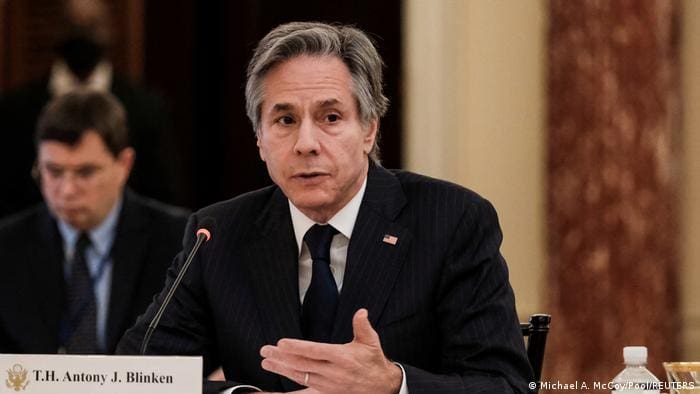

United States Secretary of State Antony J. Blinken has identified synthetic opioids as the number one killer of Americans between the ages of 18 to 49.
Blinken spoke during a tour of the Centers for Disease Control and Prevention in Atlanta, Georgia.
According to him, last year the government seized enough fentanyl to kill every single American citizen. “So the State Department is working aggressively to build an international coalition to help more effectively deal with the fentanyl challenge because it’s by definition a global challenge, an international problem. The precursors that go into making fentanyl often are manufactured somewhere else in the world. They wind up coming toward us, turned into a synthetic opioid, and then they wind up on our streets and kill Americans. So we need global collaboration, global cooperation, as part of dealing with this challenge,” he said.
He added that CDC is a critical partner in dealing with things like fentanyl, synthetic opioids, which he described as one of the worst scourges the United States faces as a country.
“So in these areas and so many more, this partnership, this collaboration, is an essential part of our national security. It’s an essential part of our foreign policy. And to have the opportunity to come here today to be with the leaders of the CDC, to learn from them, and to look at how we’re going to pursue this partnership going forward is a very important part of my agenda. So I’m grateful to our colleagues here, grateful for the collaboration, and very much looking forward to the work ahead,” he said.
The CDC, he said, has experts in more than 60 of American embassies around the world, as the front-line defense for the United States in terms of detecting and then dealing with the outbreak of infectious disease.
Blinken said: “And we all know – we’ve all experienced over the last few years – just how something that starts halfway around the world can have the most profound impact imaginable right here in the United States. So that front line of defense, that collaboration with the CDC in country after country, is making a huge difference. It’s making a difference in spotting something as it emerges. It’s making a big difference in helping build the capacity of partner countries to better detect, prevent, deal with the emergence of disease.
“That remains a vital collaboration. But there is so much more that we’ve been doing together for many years, working together, particularly on HIV/AIDS around the world through the PEPFAR program initiated by former President Bush, where as a result of that program we have helped save well more 20 million lives. And we’re determined to see that it’s reauthorized and to make sure that we complete the mission, because we’re very close to getting that done, eradicating HIV/AIDS around the world as a killer.
“We’re dealing now together with Marburg and an outbreak that we’ve seen in Equatorial Guinea and Tanzania, where again the CDC and the State Department are joined at the hip in working with the host governments in dealing with that outbreak and trying to make sure that it doesn’t go any further than it’s already gone.”
He went on: “And more broadly, we are working together to try to build up genuine global health security in a sustainable way. The thing that we’ve learned powerfully in recent years is that health security is national security. We know that when health security breaks down, it’s almost inevitably going to have an impact on our national security. As disease outbreaks that go uncontrolled and unmanaged, we have everything from, potentially, societal breakdowns to mass migrations, all of which have a profound impact on national security

