

THE Central Bank of Nigeria (CBN) said that a total of N144 billion has been disbursed to the exporters of semi and finished commodities as rebates in the life of the RT200 Programme.
According to apex bank, last quarter alone, the exporters were paid a total of N25.04 billion or about an eightfold year-on-year increase.
The non-oil rebate scheme, a major pillar of the RT200, took off in the first quarter of last year with exporters receiving a total incentives of N3.23 billion.
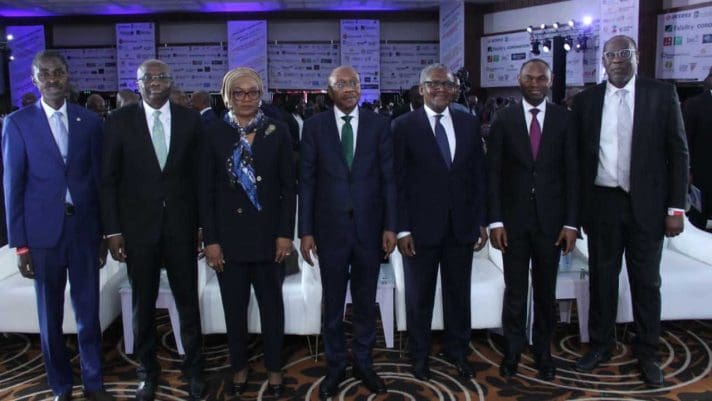
CBN Governor, Godwin Emefiele, who disclosed this yesterday at another leg of the programme held in Lagos yesterday, described the scheme as a phenomenal success story in the effort to raise the performance of the critical sector.
He stated that for a dollar repatriated and sold at the Investors’ and Exporters’ (I&E) window for third-party utilisation, exporters are given N65, and foreign exchange (FX) repatriated for own use through the official window attracts N35 per dollar.
The CBN helmsman told the gathering that a total of $1.7 billion has been repatriated this year so far, whereas 46.5 per cent of the value ($790 million) was sold at the I&E window. The balance, he said, is retained in the exporters’ domiciliary accounts.
“Please note that proceeds that are not sold at the I&E window cannot and will not be eligible for the rebate. So, we encourage holding their export proceeds in their domiciliary accounts to take advantage of the rebate by selling at the I&E Window,” he pleaded.
It need be noted thst previously, export proceeds were sold at the parallel market where exporters earn a premium. The CBN had lamented about the consequences of the linkage for the country’s FX management.
Speaking further at the summit, Emefiele said the CBN would continue to engage other critical stakeholders such as the Nigeria Customs Service (NCS), the Nigerian Ports Authority (NPA) and the Nigerian Export Promotion Council (NEPC) to increase the volume of non-oil export – the most sustainable source of FX to any country.
“For exporters, flying the flag of Nigeria in the international market, the Bankers’ Committee and the CBN stand ready to partner with you to achieve your goals. You can benefit from the many financial programmes introduced by the CBN through your banks and as such grow your business exponentially,” the CBN chief said.
To raise the bar of transparency of the scheme, the CBN governor said the regulator started publishing the identities of the beneficiaries in January this year, promising that the Bankers’ Committee would continue to work with other stakeholders to find solutions to the challenges faced by exporters.
Emefiele noted that with “countries all over the world turning to export earnings and proceeds repatriation as a veritable means of bolstering foreign reserves, maintaining a robust balance of payments position and a stable source of FX inflows, Nigeria must explore all options to raise the contribution of oil-oil exports to the economy.”
The CBN governor expressed excitement and optimism that Nigeria would soon transition from an importer of refined petroleum products to a net exporter with the completion of Dangote Refinery whose promoter, Aliko Dangote, joined the summit to relate with entrepreneurs and bankers on how to address the challenges.
Lagos state governor, Babajide Sanwo-Olu, who was represented by his Commissioner for Economic Planning and Budget, Samuel Egube, charged the country to support a robust external sector to build a resilient economy.
Other talking points at the summit were achieving a public-private partnership (PPP) that works, looking beyond RT200 and addressing critical infrastructure challenges.

