
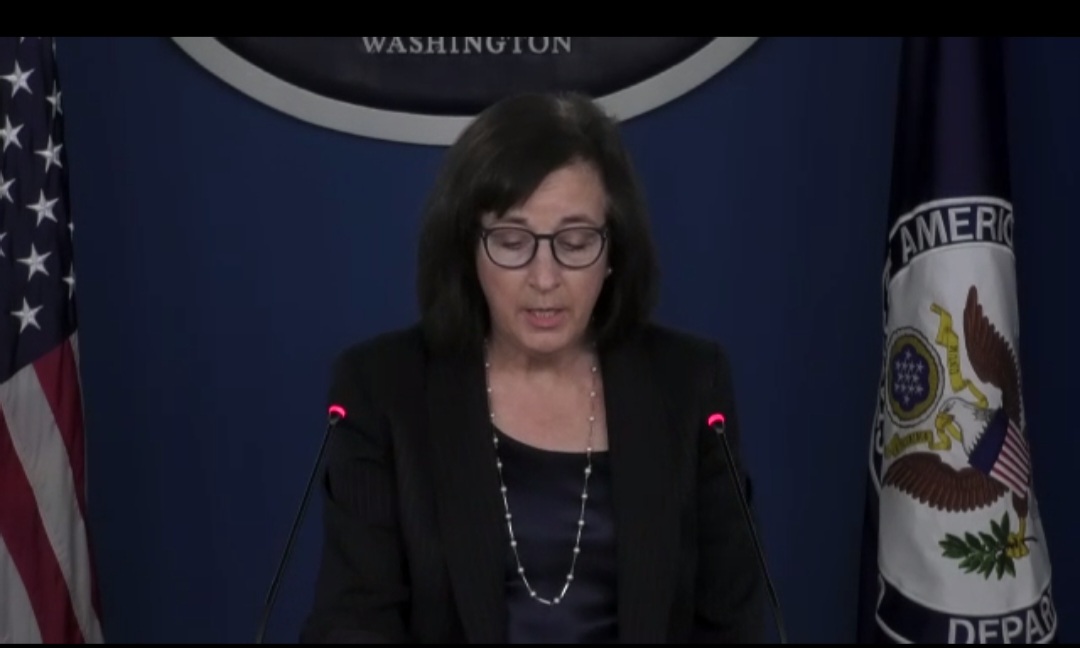

Marta Costanzo Youth is the Principal Deputy Assistant Secretary, Bureau of Population, Refugees, and Migration, U.S. Department of State. In this briefing, she speaks about migration and related issues. Excerpts:
Forced displacement
Forced displacement in the Western Hemisphere has reached historic highs. One hundred million people are forcibly displaced globally; of those, 20 million are in the Western Hemisphere. Migration impacts on every country in the region, and no one country can provide solutions for millions of displaced people on their own.
Addressing the challenges of irregular migration, providing protection to refugees and asylum seekers, and offering legal migration pathways are key priorities for this administration. We’ve been working on safe, orderly, and humane migration management from day one of the administration. We’ve brought countries together at the Summit of the Americas, where 21 countries endorsed the Los Angeles Declaration on Migration and Protection. Countries are stepping up to do things that they weren’t doing before, but in coordination to help all of us respond to the challenges around migration in the hemisphere. What we are seeing now is that people are making use of lawful pathways – parole processes, family reunification, existing labor pathways. We’ve led the expansion of legal pathways, and now we are establishing new rules to direct people to use those pathways instead of making the dangerous journey to try to enter irregularly.
Measures to combat the challenge
One of the several innovative measures the U.S. Government has announced is Regional Processing Centers. These will provide easier access to protection and other lawful pathways. Once they are operational, these centers will make it easier for migrants to access lawful pathways from where they are and avoid putting them – their lives and their life savings into the hands of criminal actors.
So on May 11th, our international partners launched the website – it’s called movilidadsegura.org. We can circulate that. It’s available in English, Spanish, and Creole. This is an important step towards operationalizing the Regional Processing Centers initiative. The website contains information on processes that will be available and will be updated regularly as new pathways come online and the initiative rolls out. Migrants will be – soon be able to use the site to also request appointments for pre-screening at regional centers. This site will also eventually be updated to provide information on regular pathways to Spain and to Canada that will be accessible in the future. It’s important to note that the site and the services provided through the initiative are free, and this is really important in the region, where criminal actors sometimes get between legal, free options and insert themselves. So again, the website is movilidadsegura.org.
The United States has committed to considering thousands of additional individuals per month from the Western Hemisphere for resettlement through the U.S. Refugee Admissions Program. We welcomed six times as many refugees from Latin American and the Caribbean in 2022 as during the previous year, and we’re on track to more than double those arrivals in Fiscal Year ’23. We’re currently processing refugee admissions cases in 19 countries in the region, and we’re doing it – refugee resettlement – faster through innovative, streamlined approaches.
Humanitarian assistance
We are the largest provider of humanitarian assistance worldwide, and that stands in the Western Hemisphere. In the last two years, the United States provided more than $2.4 billion in humanitarian assistance across the Western Hemisphere and 2.1 billion in development, economic, and health assistance.
But no one country can provide solutions for millions of displaced people on its own, as I said at the top, so we really work closely with governments, civil society, international organizations, multilateral development banks, the private sector, and other partners to help provide protection and options to people fleeing persecution or torture, to address the root causes of irregular migration and forced displacement, and to manage migration humanely. Our efforts complement the generous efforts of host countries throughout this region who are offering refuge to those in need.
Regional Processing Centers
We are in the process of having discussions with the two countries as well as the host countries of the Regional Processing Centers. Essentially when we rolled out this concept and had discussions with partner nations, they – I think partner nations were intrigued by this. And part of this is that getting people to – incentivizing migrants and refugees to utilize legal pathways has been part of our challenge, right. Because there’s nothing sadder than knowing that somebody has taken a perilous journey – as you know, people are moving through the Darien as well in the region on the way north, and so many people have put themselves in really very life-threatening situations. And what we would like to do, and the whole point of these processing centers, is to make sure that people understand what the legal path – the lawful pathways are, what the options are for them. And if that is a protection pathway, like refugee processing, to have them be able to access that closer to home, closer to where they are, rather than to take this perilous, perilous journey to the border.
In terms of numbers with Canada or with Spain, I don’t have those specifics, and we’re really not there. I think those two governments were very intrigued by the processing center idea, the idea that people will be incentivized to access lawful pathways, that they will be incentivized to find information closer to home, and have actual – these are international organizations who will be running these processing centers. And so to have a reputable voice who can explain, specialists who can explain to them how to access pathways. In some instances I think people – that space has been ceded to coyotes and smugglers. And so this is a way to get information and to expand the access so that people can be able to move safely and know early on what their possibilities are.

