

The eyesight for an eagle is what thought is to a man – Dejan Stojanovic
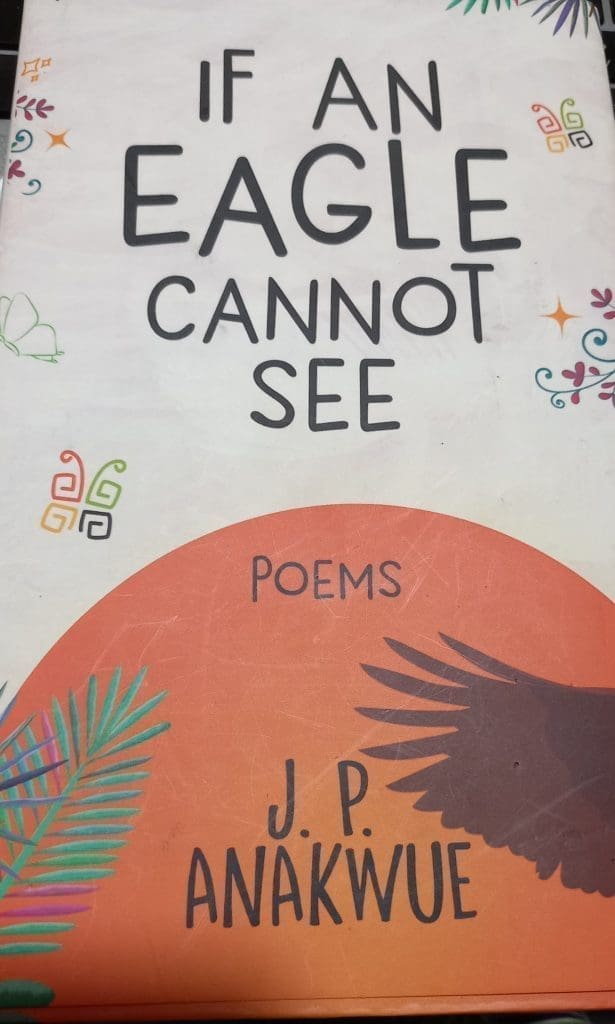
(A review of If An Eagle Cannot See, J. P. Anakwue, Agbalumo Editing Services, Lagos, 2023)
POETRY is one of literature’s grand genres that is deep, touching and intriguing. It is the genre which most writers if not all, begin their writing career from. Show me a writer who has not tried his/her hand at poetry and I would show you a struggling writer. However, because all writers, successful or otherwise, kick off their writing career with poetry does not mean it is the easiest to write. Don’t be deceived. Many writing careers have been stunted because they write “bad verses”. Remember Cinna the poet in Shakespeare’s Julius Caesar!
William Faulkner, one of the 20th century’s most enduring novelists confessed, “I am a failed poet. Maybe every novelist wants to write poetry first, finds he can’t, and then tries short story, which is the most demanding form after poetry. And failing at that only then does take up novel writing.” Poetry is king, and as we say in the lingo of the street, it is not meme!! If Faulkner can confess that he failed in poetry and turned to novel writing. Then you know write poems is not for the faint-hearted!
Anakwue’s If An Eagle Cannot See is a collection of forty-four poems of varied tones and standards. It is broadly divided into two parts. The first part is under the theme of Visions and Symbols, while the second is a clarion call to our beloved country with the title Wake Up Nigeria.
Through poetic lines in Herbal Prayer, the poet pays homage to nature and paints a picture of life suffused in a natural environment without artificial pinning. He writes about “sacred herbs” mentioning such plants as green pawpaw, brine, garlic, onion, pepper ginger, ginseng roots, lemon grass, bitter aloes, and so on. A lover of nature would find a home in this poem which is the opening shot in this collection. The next poet simply titled ‘The Road’ reminds me of the Nobel laureate Prof Wole Soyinka’s play of the same title. It is a poem though short but is powerful in the message conveyed. We all travel through or on some roads every day and what we see on these roads are mind-boggling. For anyone who leaves and commute in Lagos, you would entirely appreciate that we “zigzag up the road” through “upon rocks-arrows”. I agree with him that “Some have fallen in wrath/Some trapped in webs”. You know how many roads rage you witness every day on Lagos roads. How danfo drivers and conductors display their wrath and unruliness on Lagos roads. We are all “trapped in the webs” of Lagos traffic and anger on the roads.
In Passages, he writes:
Life is rising, falling
Into this gloom stream of think-not
To wake with three morn cock-crows
Or as guava grows/Upon the green of rot.
A deep reflection shows that Anakwue is here talking about the going and coming which life is all about. As some are being born, some are dying, we are all like plants, growing and withering at different times and hours.
The closing poem in part one titled The Writer is a salute to the men and women of words who labour through thick and thin to capture our world in living words for posterity to know that some people once passed this path.
He writes:
In words, I paint that which is revealed.
O words! Potent words! Friendly words!
Words are not words
Words are images seen, interpreted
Heavens-music hums in my inner ears.
By the rhythm, I live, I move.
The writers who in “solitude stand on the electrodes” to interpret our dreams and put our aspirations before us in flowing words and make us realise our dreams. It is a fine tribute to the scribblers of our memories.
The second part as the theme shows Wake Up Nigeria is a clarion call to citizens to come to the realisation that the country needs an awakening and no one would do that but the citizens themselves. In his preface to this section, Anakwue writes, “Responsible citizens develop a country’s civic awareness that can lead to a political, social and economic revolution. You cannot continue abusing the environment. You cannot continue abusing resources. You cannot continue feigning ignorance to the floundering economy…If citizens fail to perform their responsibilities, then the country will eventually disintegrate.” (p42). It is a challenge to the citizens to re-examine themselves and turn a new leaf to see how we can all make our country better.
In Lockdown, the poet as a seer is unveiled. This poem is about the Covid-19 pandemic and he goes ahead to predict what he thinks would happen after the pandemic. Some have come to pass. Take for instance this:
Though businesses be shut,
They shall re-open with technology.
Has this not happened?
Are we not holding meetings, conferences, and seminars online through Zoom, Facebook etc? Today we even have a new language, seminars have become webinars!
He writes:
Though temples be closed
Worshippers shall worship in spirit & truth
We are already holding church services across borders, oceans, boundaries and territories online. The world has become more than a global village as envisioned by Marsal McLuhan one of the grandfathers of communication.
The irresponsibility of the government and the issue of neglect of the majority of the populace during the Covid-19 lockdown is handled in the poem titled Isolation.
The poet bemoans:
The roads are deserted
The markets are decongested
The poor are in anger
Where are the billions of donations?
How many did we feed?
Where are the palliatives?
Leaders have become a virus
Sucking the blood of the masses. (p51)
This poem, for me, sums up the whole testament of this slim volume. Anakwue has in this collection been able to lend his voice to the cry of citizens for a better country where people are treated as human beings and not mere objects. In Isolation, he takes a stand with the downtrodden and the poor who are voiceless and on whose behalf many decisions are taken but end up not benefitting a jot from such. During the Covid-19 lockdown, roads, markets, churches, streets and so on were deserted. The rich and the poor were all indoors and hungry walked the streets with many unable to feed. Millions were said to have been donated but those in need never got a wad of naira, food items were locked up in barns, yes, barns, while millions were wallowing in poverty.
If An Eagle Cannot See is a collection that a reader would find some interesting poems to read. Although some of them read like reflections that does not take away the essence of the message. The publisher however needs to take another look at their printing; which does not seem to be able to recognise an apostrophe thus putting wide gaps between letters with an apostrophe.
The eagle as a bird signifies strength and power. It has a sharp eye and thus when it is said that “one takes an eagle eye to look at something” means strong and critical. But in Anakwue’s world, the eagle cannot see. So, what happens? Which eagle is he referring to? The one on the Nigeria coat of arms? Or which? The answer is there in the wind…

