
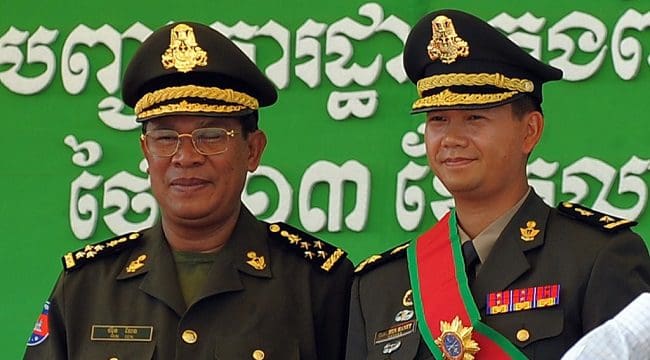

AFTER nearly four decades as Cambodian leader, Hun Sen goes into elections this weekend certain of victory and vowing to eventually hand power to his eldest son.
But the 70-year-old has given no timeframe for his dynastic succession and signalled he will continue to wield influence even after standing down.
Sunday’s vote is widely deemed a sham thanks to the near-total absence of genuine opposition parties, and critics say that more than 30 years after UN-brokered peace accords ended decades of bloody conflict, Cambodian democracy is in a sorry state.
“Nobody can block the steps forward of Hun Sen or Hun Manet,” the prime minister told voters in June.
“After Hun Sen, it will be Hun Manet.”
While no fixed date has been given for a transfer of power, Hun Manet, 45, has taken on a number of his father’s campaign duties this year.
In a highly symbolic gesture at a rally for the ruling Cambodian People’s Party (CPP) this month, Hun Sen passed the party flag to Hun Manet, who led a crowd of supporters on a march through Phnom Penh.
Hun Manet has also travelled around the country to preside over ceremonies and meet soldiers, workers and CPP members, repeating his father’s campaign mantras of peace and development.
“As long as the CPP continues to lead the country, can keep the peace and can keep balance, we all live with happiness,” he said in a clip posted to Telegram this month.
– ‘Like North Korea’ –
Phil Robertson of Human Rights Watch told AFP that the prospect of a dynastic handover “makes Cambodia look more like North Korea than a genuine democracy”.
Hun Sen has five children and has carved out political roles for all three of his sons, with the most senior responsibilities entrusted to his eldest.
Hun Manet, already a member of the CPP’s powerful permanent committee, will contest a parliamentary seat this weekend for the first time.
He has served as commander of the Royal Cambodian Army since 2018 and met with foreign dignitaries and world leaders including President Xi Jinping of China — Cambodia’s main ally and benefactor.
Hun Sen’s politics are shaped by his experiences of revolution and war as a young man during the genocidal Khmer Rouge regime.
Those privations moulded him into one of the most effective — and most ruthless — politicians of his generation and thrust him into the prime ministership in 1985, aged just 32.
He has since consolidated his power by co-opting, jailing, sidelining or effectively exiling any opponents.
By contrast, his son was raised in luxury and educated abroad, including at the US military academy West Point.
But a Western education is no guarantee of a more liberal approach, exiled politician Sam Rainsy, a longstanding foe of the prime minister, told AFP — pointing to Syria’s brutal Assad dynasty.
“Syria’s Bashar al-Assad is more educated than Hafez al-Assad, but the son is politically worse than the father,” he said.
Sebastian Strangio, author of a book about Hun Sen’s rule, told AFP that so far Hun Manet had shown “little evidence that he will introduce anything more than cosmetic reforms to the current political system”.

