
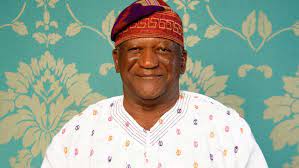

I am writing this article from the Nelson Mandela Gardens here in Asaba, Delta State, where the FADE team and I, in partnership with the South African Consulate in Lagos, and the Delta State government, have just concluded the two-day Nelson Mandela centenary celebration. We decided to take time out of our busy schedules to come together and honour such a great man. In addition, we thought it would be a great idea to educate the younger generation on what an icon Madiba was, this is why we also invited students from secondary schools to partake in the activity.
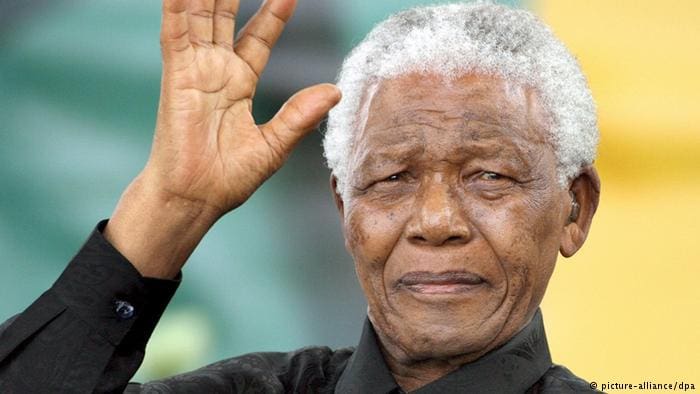
“A new world will be won not by those who stand at a distance with their arms folded, but by those who are in the arena, whose garments are torn by storms and whose bodies are maimed in the course of the contest.” — From a letter to Winnie Mandela, written on Robben Island, June 23, 1969
AS Africa and the entire global community begin the celebration of Nelson Rolihlahla Mandela to climax on July 18, 2018, we must look north and south, east and west to find another Madiba because, if only a very small percentage of Africa can be like Madiba, the world and our continent would be a better place.
In my culture, we believe that a king or queen never dies, instead they go on a journey to the unknown and they will never get to their destination until a new replacement is found. We must keep reminding ourselves in searching for a replacement that Madiba was a selfless warrior who spent 67 years
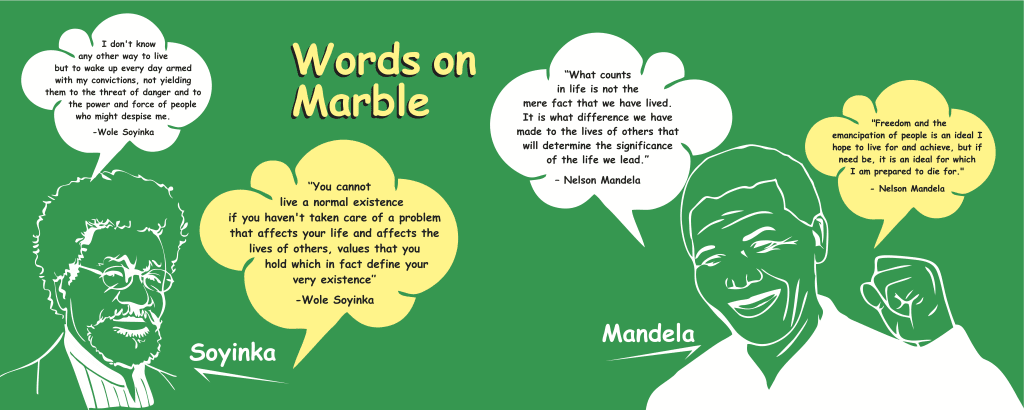
of his 95 years on earth fighting for the emancipation of his people. In his words, “to go to prison because of your convictions, and be prepared to suffer for what you believe in, is something worthwhile. It is an achievement for a man to do his duty on earth irrespective of the consequences.”
He served his time, paid his dues came out of prison and, on April 2, 1990, he was elected Deputy President of the ANC (African National Congress). He served in this position for two years until 1992 when he was elected President of the ANC. In 1994, the ANC won 62 per cent of the votes in the election and Mandela as leader of the ANC was inaugurated on May 10, 1994, as South Africa’s first black President. He did all that with nothing in his pockets, very unlike what is experienced now when everyone feels they need billions to make a difference.
Mandela did not attempt to have the constitution amended to remove the two-term limit – a move that many might have supported wholeheartedly; instead he only had the intention of serving one term, which he did and left office on June 14, 1999, with nothing again. On June 1, 2004, Mandela announced that he was bowing out of public life to lead a quieter life, issuing the now famous statement: “Don’t call me, I’ll call You,” to those who would require his presence at their functions.
Described as an activist, a hero, a man of peace, Nelson Mandela was a distinguished humanist whose selfless fight for the emancipation of his people landed him in prison in 1962 for 27 years. Any ordinary man would come out of that ordeal with bitterness, anger and a taste for revenge but not Nelson Mandela; he walked out of prison with his shoulders high and a heart ready to forgive. In his own words, “I am working now with the same people who threw me into jail, persecuted my wife, hounded my children from one school to the other… and I am one of those who are saying, ‘Let us forget the past, and think of the present.’”
Nelson Mandela was the epitome of bravery, the embodiment of courage, a great man that will be missed severely by the country he fought for, friends, family and well-wishers. “I learned that courage was not the absence of fear, but the triumph over it. The brave man is not he who does not feel afraid, but he who conquers that fear.”
If there is anything Nigerians can take away from the life Nelson Mandela lived, it was in the way he focused on his mission to emancipate his people and didn’t stop until he successfully achieved that goal. There are many among us who have a coherent vision for Nigeria but are stifled by a lack of courage. Madiba was a man who started with virtually no one behind him and preached his gospel until he had a congregation of followers echoing his words wherever they could. Start where you are, and if your objectives are in the interest of the people, I have no doubt that you can have a movement as great as Mandela.
With his centenary fast approaching, we are reminded of the difference a man like Mandela made in the world and not just in his home country, South Africa. This difference or impact is something the world can do with in times like this. In celebrating and reminiscing on his legacy, we are challenged to intensify the search for another Madiba so that we can find him or her before another 100 years. We owe him that because of what he gave to us and so Madiba the King can arrive his destination safely.
He taught us forgiveness, he even forgave his prosecutors, he taught us humility, he taught us endurance, he taught us transparency and good governance, he taught us unity by unifying a nation of races from all over the world.
He left office with nothing but was never in want of anything. This unique, incorruptible man from Africa who was a gift to the world changed his nation for better and thus the world; we must be in a hurry to replace him before he is taken from us forever by the plethora of unremarkably corrupt leaders.
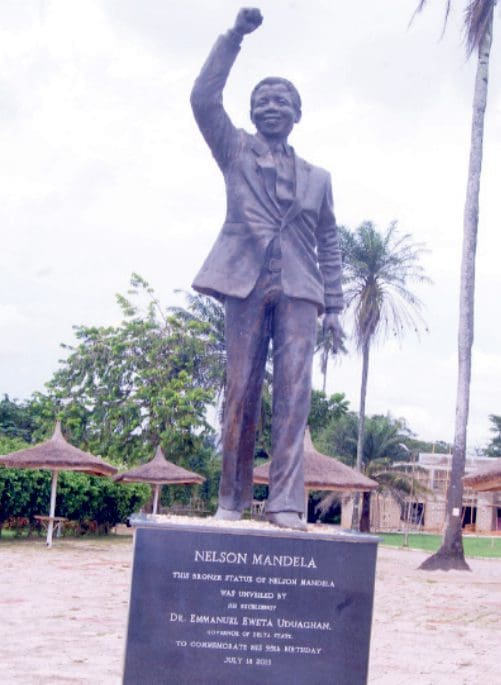
In keeping with Madiba’s humble way of doing things, there will be a low key ceremony to commemorate the centenary with music, dance, poetry and tree planting at the Mandela Garden of 95 trees in Asaba International Airport, Delta State.
The South African Embassy, representatives of Delta State Government, two secondary schools and myself will each plant a tree to bring the number of trees in the garden from 95 to 100 trees. The Nelson Mandela Garden of 95 Trees is a world-class nature resort, established in honour of Nelson Mandela, which offers both tourism and educational provisions to the general public. It is located within the Asaba International Airport in Delta State, Nigeria, and is designed in the shape of the map of Africa, using 95 trees to represent the 95 years of Nelson Mandela’s life on earth.
As we look forward to July 18 with excitement, I am reminded by this quote that, until a man is ready to die for what he believes in, he isn’t truly ready to stand for what he believes in. “I was prepared for the death penalty. To be truly prepared for something, one must actually expect it. One cannot be prepared for something while secretly believing it will not happen. We were all prepared, not because we were brave but because we were realistic.” – Mandela, Long Walk to Freedom, 1994
*******
…In search of another Mandela in Africa: A mirage or possibility?
This week, I have decided to write a follow-up to last week’s article on Nelson Mandela. Yesterday, July 18, marked the centenary anniversary of Mandela; if he were alive today, he would have been 100 years old. It was a bitter-sweet moment for me as I celebrated an ideal that once was even as I fear that such may never again be…
IN today’s article, I will shed more light on why it is important to have characters that emulate Madiba in our society, especially in leadership.
Using Nigeria as a relatable example, our past leaders have moral compasses pointing in the complete opposite direction of that of Mandela. If we have made it this far with questionable and selfish leaders, imagine how much farther in the right direction we could go with leaders who possess half of the character traits of Mandela.
I will try as much as possible to be objective in this article. Some people might not agree with my train of thoughts but, as someone who has been around for decades and successfully navigated my way to a peak position in one of Nigeria’s top corporations, I dare say I have more than enough facts to back my theory that we lack good leaders in our society.
Inasmuch as a lot of damage has already been done, we still have a chance to right our wrongs and steer this country towards prosperity. Before we can achieve this, we as the Nigerian people have to re-evaluate our priorities, our character, and what we stand for in general. As the great Malcolm X once said, “A man who stands for nothing will fall for anything.”
With that being said, can we all agree that we need to make some changes? Luckily for us, we don’t have to look too far outside our continent to find a great leader to emulate.
I have decided to highlight some key leadership qualities of Mandela, in hopes that our next generation of leaders can match or surpass them.
• An acute level of focus: Nelson Mandela, who was born Rohilala Mandela to a royal family in 1918, was always a man of peace. He became an activist in the university when he aligned with both black and white activists who were also involved in the fight against racial discrimination. He joined the African National Congress (ANC) in 1944 and it was when apartheid was introduced in 1948 that his alliance with the ANC grew stronger. Apartheid was a time when blacks were segregated from whites and Mandela was one of the people who was at the forefront of the fight against this. It was during this fight against apartheid that he was convicted of treason and sentenced to life imprisonment. During his time in prison, his popularity grew around the world and, upon release in 1990, he immediately began negotiations to end apartheid in South Africa. The negotiations went on till 1993 and, in 1994, for the first time, a black man was allowed to run for the office of the President of the Republic of South Africa. Mandela, backed by the ANC, won the election and continued to fight for his people. Mandela’s fight against apartheid lasted 42 years. Such a level of focus is rare and is one of Madiba’s finest qualities worth emulating.
• A will to forgive: When I was a younger man, I was quite stubborn. Very opinionated and headstrong. It was due to this strong will that I unfortunately landed in jail for a few hours. I remember how upset I felt due to this ordeal and after I was exonerated by the court, I remember thinking of blaming the policemen who arrested me and making them pay. Although I did not see this through, the thought lingered in my mind. The point of this preamble is to tell you that prison time does evoke some malicious thoughts in the heart of a man. Even worse when you are arrested for a crime you didn’t commit.
Mandela was incarcerated for 27 years for treason – a crime so vague, they just needed an excuse to put him behind bars. He went in with dark hair and by the time he was released his hair was grey. He was separated from family, friends and the comfort of his home for so many years. By the time he was out, some of his children had already started families of their own; 27 years behind bars is a long time for a man to come out and not be spiteful. Mandela’s will to forgive was one of his most enviable character traits. Mandela knew that what was best for his people was racial harmony. That meant forgiving without forgetting, and sharing power.
“We have to surprise (the white minority) with restraint and generosity,” he said. A master of symbolism, Mandela invited his prison guards to the presidential swearing-in ceremony.
• A desire to serve: Many ask why we celebrate Mandela the way do when he did nothing for Nigeria. Others say why only him, when so many others fought and died in the same battle for freedom? Some point out that we idolise him like a god when he was just as flawed as the next man. The man in question would be among this last set of people as he clearly said in an interview, “My first task when I came out was to destroy that myth that I was something other than an ordinary human being.” I do not deny his humanity, instead, I am inspired by it. Man can be ultimately a leader who puts the needs and interests of those he leads first. This is one of the many reasons why Mandela remains a celebrated hero. After being elected South Africa’s first black President, Mandela announced he would serve only one term, though two were permissible. He understood that rallying the country and bridging diverse interests meant making room for others.
The philosopher Lao Tzu said the following: “A leader is best when people barely know he exists, when his work is done, his aim fulfilled, they will say: we did it ourselves.”
We are burdened with too many leaders wanting and demanding accolades they believe they deserve.
Every year, the Mandela celebration is marked by people donating 67 minutes in a day usually the 18th, doing something good for the community. It could be planting trees like in the picture above or cleaning your environment. The act should affect other people positively.
So, I would like to encourage everyone reading this article to invest 67 minutes of their 24 hours for the good of humanity.
*First published in July 2018
https://sunnewsonline.com/search-another-mandela-africa-mirage-possibility/

