

To know anything, you have to know everything, or so I tell myself – no doubt to justify my gluttonous appetite for books – Robert Gottlieb
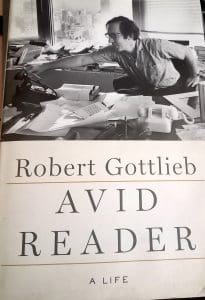
THERE are some books you purchase on the spur of the moment. You may never have heard of the writer’s name nor read any book written by him or her. The book Avid Reader: A Life by Robert Gottlieb was one of such. It has become a habit, anytime I travel abroad, especially to the United States of America, I always visit bookshops, especially those that sell second-hand books. For those who don’t know, a second-hand book bought in America is not like the one you buy on the roadside in Ikeja, Ojuelegba and all those joints here where such books are sold.
A second-hand book bought there is like new. Many buy books and after reading decide to sell to such bookshops at pawn prices. So, such are now sold at very reduced prices, most times at rock bottom prices. When I bought Gottlieb’s memoir a few years back, it was only when I got to my host’s residence that I took the pain to read the blurb. I was only attracted by the title Avid Reader. I consider myself one, so I bought it without reading the blurb. More so, the price was friendly. It was at home after reading the blurb that I knew the writer was one of the leading book editors who had worked with most of the foremost publishing houses in America.
Recently, when I gave myself the task of reading some of the memoirs and biographies in my collection, I decided to take a dive into it. Gottlieb, an experienced and influential book editor had worked with the big publishing firms in America. In the line of duty, he had worked with Simon and Schuster, Alfred A. Knoff, Knoff Redux and The New Yorker (magazine). These are the big publishing firms in America today.
Before this encounter with Gottlieb, I had read memoirs of leading American editors and journalists such as Ben Bradlee’s 1995 memoir A Good Life: Newspapering and Other Adventures, a chronicle of his life and job as editor of The Washington Post, as well as that of Walter Cronkite (A Reporter’s Life) and that of others. I never read or came across the memoir of a book editor until I happened on Gottlieb’s.
In reading this memoir, I can safely say that the life of a newspaper editor and that of a book editor may look the same but they are different as day is from night. A newspaper editor meets everyday people from reporters to politicians, technocrats, dunderheads and so on, while a book editor deals with men and women who are rational and at times tempestuous.
The newspaper editor deals with these everyday people and can say and write much about them just as a book editor meets with these special breeds of society and can pass judgment on their craft and competence. A few people do not know that no great writer, no matter how talented, does not have an editor! No writer can escape the scalpel of an editor. There must be an editor to preside and look over what has been written; his or her job is to chisel the writer’s imagination into shape or give possible direction into which a book could branch for maximum effects, and these and other more Gottlieb did with the books he edited.
In this vantage position, he is able to give verdicts on some of the leading authors he worked with in his life-long career. He edited John Cheever, one of America’s greatest novelists and short story writers, whom he describes as “One of the finest American writers of fiction in the twentieth century,” noting that “his talent didn’t stretch to punctuation and spelling.” Imagine what it would have looked like to publish Cheever’s books with inappropriate punctuation and spelling errors. On the Nobel laureate Doris Lessing, he writes, “People who didn’t know Doris Lessing assumed that she was in person as severe and uncompromising as her work was. And she was those things. But she was also warm, funny and domestic.”
Of course, Gottlieb confirmed what many people had said or felt about another Nobel laureate VS Naipaul. Agreeing that he was a superb writer who hardly needed an editor, he has this to say about him, “We maintained a professional relationship – occasional diners in London or New York which I found strained: I sensed a streak of narcissism in him, and too much (barely) represented anger. He was also a snob. But was a superb writer.” And Salman Rushdie? According to him, he had a fairly testy relationship with him and after the publication of the novel Midnight Children, which won the Booker Prize, the writer became a new person. He writes that Rushdie became a changed person after winning the Booker, “But something had changed Salman. From the moment he won the Booker, he seemed more demanding and less cordial. His old associates were dismayed.” Shall we say the success has gone into his head? Perhaps. However, he had a different editing experience with the publisher of The Washington Post Katharine Graham. He worked with her on her memoir Personal History. In fact, he confessed that working with her was “One of the most agreeable and satisfying associations of my working life.”
He was also the editor of President Bill Clinton’s highly successful memoir My Life. He writes about how cordial their working together was and how the former president never allowed his ego as the once most powerful man in the world to interfere with their work. He writes, “Bill was bashed but good-natured as I slashed and burned, although he fought back and even won some clashes. By this time, I had realized that he was a complete professional- that neither ego nor sloth would get in the way of his making his book as good as it could be.”
For a man who edited award-winning authors like Rushdie, Joseph Heller (Catch- 22), Tony Morison, and a host of others he no doubt led a wonderful life.
He was also at one-time editor of The New Yorker magazine. He found the work of a book editor different from that of an editor of a magazine and he writes, “In book publishing, it’s the writer who has the final authority, and properly so: It’s his or her book, not yours. But if it’s the writer’s book, it is the editor’s magazine. As I was to discover at The New Yorker, it’s the editor who is in charge, and the writer who’s there at the editor’s pleasure. In other words, writers had to please me, not the other way around, which is what I was used to. I was perfectly comfortable being the boss of a staff, but I didn’t enjoy being the boss of writers.”
In a way, I find the story and life of Gottlieb very interesting because it reads familiar, a life spent reading and editing stories and books. It is a book many who love reading will find compulsive and engrossing. Gottlieb lived a life of satisfaction because he found fulfillment in his job, he did what he enjoyed, and found someone ready to pay him for what he considered a pleasure!

