
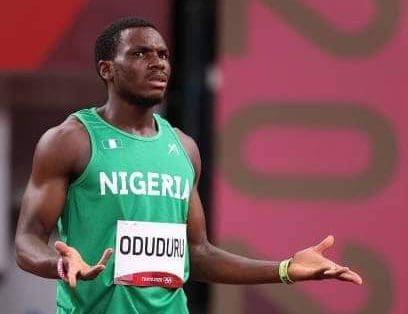

NIGERIAN sprinter Divine Oduduru has been banned for six years by a disciplinary tribunal for committing two anti-doping rule violations of possession of prohibited substances and the attempted use of a prohibited substance or method and ordered to pay World Athletics $3,000 towards its expenditure regarding the case, the Athletics Integrity Unit has announced.
The ban on the 27-year-old takes retroactive effect from February 9, 2023 – the date on which the provisional suspension began – and runs until February 8, 2029, while all his results from July 12, 2021 until the date of his provisional suspension have been nullified, the AIU added.
The case against Oduduru arose out of the criminal investigation into Eric Lira who earlier this year became the first person to plead guilty under the US Rodchenkov Anti-Doping Act to providing performance-enhancement drugs to athletes for the Tokyo Olympic Games in 2021.
The initial complaint issued by the US Department of Justice against Lira in January 2022 mentioned two athletes, ‘Athlete- 1’ and ‘Athlete-2’.
“By comparing information from Blessing Okagbare’s doping cases, which resulted in a cumulative 11-year ban for her last year, the AIU concluded that ‘Athlete-1’ was Okagbare and, following an interview with her Nigerian teammate Oduduru, in May 2022, the AIU concluded that Oduduru was ‘Athlete-2’, the AIU explained.
“We are very pleased with the outcome of this matter, given its particularly
grievous nature, exposing the sinister collusion between athletes and other persons in deliberate plans to corrupt athletics at the highest level,” said Brett Clothier, Head of the AIU – World Athletics’ independent integrity arm which brought the charges against Oduduru.
“The AIU is fully committed to unearthing cheats and the extent of their networks.
In our quest to protect the integrity of athletics, we often work closely with other investigative organisations. On this occasion, we are grateful for the assistance from the United States Anti-Doping Agency (USADA) and United States Department of Justice whose legal reach provided vital evidence which helped in this matter as well as in our case against Blessing Okagbare last year.”
The panel found Oduduru guilty of possession of a prohibited substance or a prohibited method under Rule 2.6 of the World Athletics Anti-Doping Rules and of attempted use of a prohibited substance or a prohibited method, together treated as a single first violation.
Oduduru received a mandatory four-year ban for the combined violation, with an additional two years for Aggravating Circumstances, after the panel determined there was justification for increasing the ban, due to the athlete having multiple non-specified prohibited substances which he attempted to use in the lead-up to World Athletics’ competitions and the Tokyo Olympic Games, the AIU explained in a press release last night.
“To procure those substances, he engaged into a scheme with his teammate who in her turn was procuring those substances on his behalf from a person who was illegally bringing them to the US in order to distribute among athletes with the aim to improve their sport performance, thus influencing unfairly the outcome of athletic
competitions, including the major ones. The panel considers this behaviour to be particularly serious,” the decision of the panel reads.
Although the panel did not uphold the AIU’s charge against Oduduru of use of a prohibited substance or a prohibited method since he did not test positive, it was satisfied that he had engaged in conduct that constituted a substantial step in a course of conduct planned to culminate in the use of a prohibited substance. The panel therefore upheld the attempted use charge.
Oduduru has maintained his innocence despite what the AIU calls ‘overwhelming evidence’ against him.
AIU’s case was built on WhatsApp messages between Okagbare and Lira, which revealed the Olympic medallist soliciting prohibited substances on Oduduru’s behalf, and photographic evidence of prohibited substances discovered in Oduduru’s Florida apartment.
The banned substances found in Oduduru’s apartment were two boxes of
brands of human growth hormone; a plastic ziplock bag labelled ‘IGF LR3’ – an abbreviation for synthetic or ‘recombinant’ Insulin Growth Factor – containing three vials, and two boxes of recombinant erythropoietin (EPO). According to testimony, one of the boxes of EPO was open and had only one of six vials remaining.
Also discovered in the apartment was an opened US Postal Service envelope
containing growth hormone – addressed to Okagbare and with Lira labelled as the sender.
“The panel finds it to be an extraordinary coincidence that all the prohibited
substances found in the athlete’s apartment were precisely those requested from Mr. Lira by Ms. Okagbare for her and “Divine”, specifying that she had to give (to Divine) his stuff too and for which she tested positive (EPO and hGH),” the three-man panel noted.
The AIU added that given the banned drugs found in Oduduru’s apartment, when and where they were found, and the fact that he had exclusive control of the apartment, the panel concluded that Oduduru was in constructive possession of the prohibited substances.
If Oduduru appeals the decision and it is not reversed, his athletics career is effectively over as he will be 33 and out of competitive shape by the time he has finished serving the punishment.

