


Technology is a useful servant but a dangerous master – Christian Lous Lange
Welekwe has no doubt written a very good book that is bound to attract the interest of readers and lovers of theology, science, technology, history and knowledge. He has added to the body of knowledge a very valuable book to enrich the quest of man for understanding creation, God and his universe. Those who have read Harari’s books will find Welekwe’s book a fitting companion to compare and contrast their views of the world. From Welekwe’s religious perspective to Harari’s take on the history of humanity
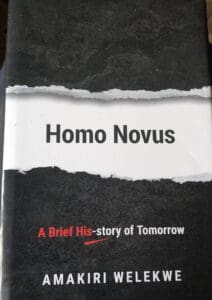 IN this book, Amakiri Welekwe has set for himself the task of laying clear to the world what he thinks is the problem of the certainty of creation which has become more pronounced in the world of today. In writing this rather challenging book, the author makes it known that the writing was influenced by his reading the groundbreaking books of the Israeli scholar Yuval Noah Harari titled Sapiens: A Brief History of Humankind and Homo Deus: A Brief History of Tomorrow.
These are two big titles that have held the world’s attention and continue to draw debate and attention to the views propounded by their author. In acknowledging the influence of these two books, Welekwe goes ahead to strongly state his views and stand as to the origin and place of man in the world, deploying his experience as a technologist and Bible scholar.
Stating his view by listing the four theories of creation known to him viz Steady-state theory, Holographic universe theory, Big Bang theory, and the Intelligent Creator theory, he goes ahead to explain all the theories. Of course, from his perspective as a Bible scholar, the Intelligent Creator theory carries the day and he goes to a great length to explain why. He presents a different perspective to the one presented by Harari in his books.
As someone who has worked for a considerably long time in the technology sector, Welekwe deploys his deep knowledge of this sector and his understanding of the Bible to delineate for the readers how technology rather than contradict the creation story goes ahead to affirm its solidity. He believes that the “uncontrolled proliferation of new technologies, the risk of artificial intelligence becoming dominant, and the spectre of human extinction all hang a cloud over us” if we don’t take care in deploying them.
In stating various creation stories around the world, he says man does all these to place its people as being superior to the others by their stories. For instance, in Nigeria alone, various ethnic groups have their versions of how they came to be; the Yoruba have theirs, the Binis too, so the Hausa, Urhobo, etc. In fact, all ethnic groups in the country have theirs. It is faced with this that the Bible version has been variously interpreted and modified by various ethnic groups and nationalities around the world.
Divided into three parts, the book deals with the issues as perceived by the writer. Part One on Humanity Partners with God deals with how man was created and the unity that man enjoyed with his creator before his fall, as well as how man has depended on science to unravel some of creation’s mysteries rather than on God. This dovetails into what he calls The Divine Mandate in which he deals with the issue of how man continues to search for his identity and unravel himself. He asks that age-long question that man continues to try and find an answer to: “Who am I? Why am I here? What does it mean to be human? These are important questions that we all ask ourselves at various intervals in our lives. It is stirred by our quest for identity, purpose and meaning” (p32).
Then part two is titled Humanity Breaks Partnership With God. Here he tries to make sense of how humans have reshaped the world far away from what God intended and offers reasons why the world is the way it is today, why it is in a deep mess, who bears the responsibility for this condition, and how it may be able to find its way out of the morass created by him. He believes “The real world is a far cry from God’s vision. We are far below the mark. Life in our world – and indeed our reality – does not conform to the original blueprint” (p46).
How then do we as humans get out of this quagmire? This he proffers a solution to in part three which he titles: Humanity Renews Partnership with God. The picture on the canvas presented before us in this section by the writer is that of a new world where the human has reconciled with his creator and is finding his glory back in the kingdom initially intended for him. But to get his place back, many steps have to be taken. He takes a look into the place of Artificial Intelligence in the life of humans and asks what species could replace the current one. How does this happen? Through bioengineering, Cybernetic upgrade, mind upload, or divine intervention?
The process to get to this world is clear to the writer and he does not think there is going to be a shortcut to the New Humanity. He writes, “With Jesus back on the earth, and Satan, the beast, the false prophet, and their collaborators out of the way, is this now the end of the world and the human race? Well, not exactly. It will not be the end of the world, but it is the end of the world as we know it.” (p221).
Welekwe has no doubt written a very good book that is bound to attract the interest of readers and lovers of theology, science, technology, history, and knowledge. He has added to the body of knowledge a very valuable book to enrich the quest of man for understanding creation, God, and his universe. Those who have read Harari’s books will find Welekwe’s book a fitting companion to compare and contrast their views of the world. From Welekwe’s religious perspective to Harari’s take on the history of humanity.

