
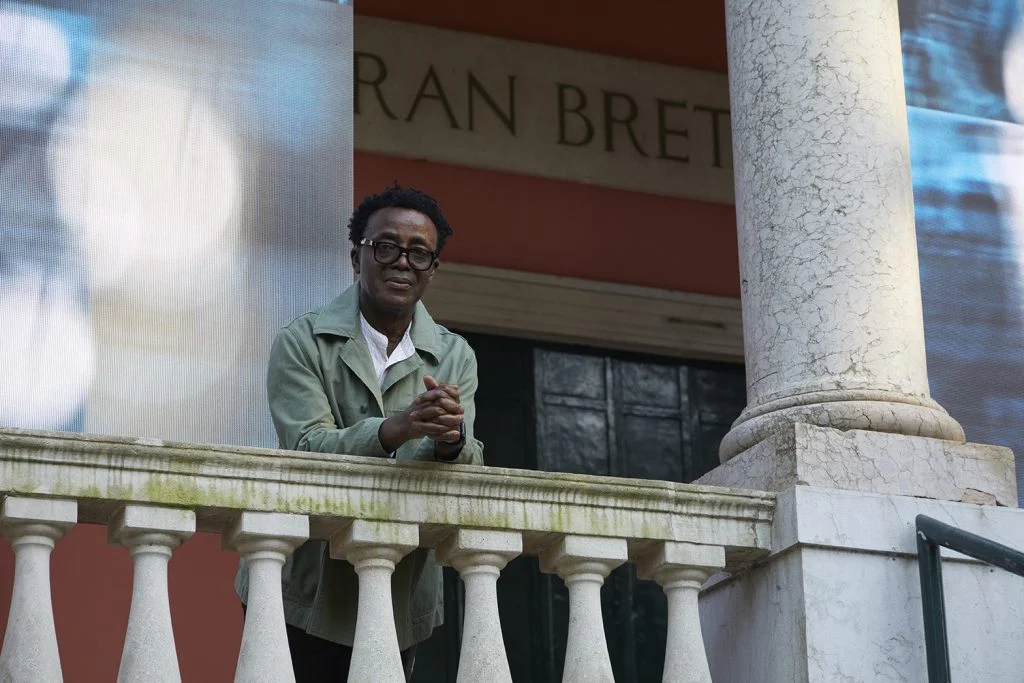


Sir John Akomfrah RA. British Pavilion, 60th International Art Exhibition of La Biennale di Venezia, 2024. Photo: Jack Hems.
The Olympics-style structure of the Venice Biennale is special because it’s unique, but it is also unique for a reason: art and nationalism—even the soft, cultural kind—rarely align in their goals. This consideration was on Sir John Akomfrah’s mind as he prepared to represent the United Kingdom at the prestigious exhibition.
The 66-year-old artist, well-known for his poetic multi-screen film installations, has been considering the implications of his position. “It’s only once I said ‘yes’ that I thought, ‘Huh, John, so do you think people might be expecting you to be either super political or super obedient?” the affable artist recalled as if reenacting a conversation with himself.

John Akomfrah, “Listening All Night To The Rain,” British Pavilion, 60th International Art Exhibition of La Biennale di Venezia, 2024. Photo: Jack Hems
Though he was born in Ghana, Akomfrah has lived in England since he was eight years old, and considers it home. The nation has embraced him as much as he’s embraced it: he was appointed Officer of the Order of the British Empire in 2008, then knighted last year. But that wasn’t always the case. For a long time, Akomfrah’s artistic and political identities were wrapped up in his status as an outsider—an immigrant, a leftist, a Black man—and his works have, at times, been critical of the country. Even when projects take him away from home, the context of the artist’s upbringing still peeks through, and the country—a force of the Global North—is implicated in his broader investigations of capitalism, colonialism, and climate change.
Two of Akomfrah’s oldest preoccupations, he explained, are the questions of “becoming” and “inscription”—that is, in his words: “How beings come about and how they are written into histories, narratives, cultures.” He was born in Accra, Ghana in 1957, less than two months after the country declared independence from Britain. His father worked in the cabinet of socialist politician Kwame Nkrumah, who led the liberation effort and became the country’s first Prime Minister and President. But in the lead-up to a 1966 coup that unseated Nkrumah, Akomfrah’s father was killed, and he and his mother fled to London.

John Akomfrah, “Listening All Night To The Rain,” British Pavilion, 60th International Art Exhibition of La Biennale di Venezia, 2024. Photo: Jack Hems
In Africa, he was Ghanaian. In England, he was suddenly, simply, Black. Migrancy has continually been a theme coursing through the artist’s work. In some pieces, it is the overt focus; in others, an idea that hangs around the edges, glimpsed through insertions of his own autobiography, or cast as a metaphor for the broader conditions of displacement and otherness. Again and again, Akromfrah has arrived at the same sad paradox: the migrant experience is both uniquely isolating and increasingly universal.
In 1982, Akomfrah and six other Portsmouth Polytechnic-educated students co-founded the Black Audio Film Collective (BAFC), a group united under the goal of examining Black British life through sound and moving pictures. After years of rangy, experimental projects, the cohort’s shared vision fully coalesced in 1986, when it released Handsworth Songs, a provocative documentary—directed by Akomfrah— about the 1985 riots in Birmingham and London.
Full of inventive mashups of song, still images, newsreel footage, and intimate interviews, Handsworth Songs was met with both praise and confusion. As is often the case with landmark artworks, the radicality of the film is hard to appreciate today as its innovations have, through time and the hands of imitators, been flattened into conventions. But it hasn’t lost its potency. Handsworth Songs resonates now both because the racial violence it depicts has again (and again and again) come to a head, and its influence is vast. (You can see it in the work of Arthur Jafa, say, who would later assist Akomfrah on the 1993 film Seven Songs for Malcolm X, or that of Steve McQueen, who represented Britain at the 2009 Venice Biennale.)

John Akomfrah, “Listening All Night To The Rain,” British Pavilion, 60th International Art Exhibition of La Biennale di Venezia, 2024. Photo: Jack Hems
Compared to Akomfrah’s more recent, ruminative work, Handsworth Songs is taut and to the point. But in it, too, are the impulses that would later become hallmarks of the artist’s practice. More than a documentary about racial strife, the film is a portrait of a system that reinforces and profits from that strife. It opens with a shot of a big, whirring motor—a ruthlessly efficient apparatus of rhythmic clangs and gears that groan with every revolution: this is the sound of systemic disenfranchisement and racial violence humming right along.
Since BAFC disbanded in 1988, Akomfrah’s work has continually grown bigger in budget, size, and scope. The last 15 years have, in particular, seen him pushing his distinct artistic language to increasingly ambitious ends. The artist’s first time showing at the Venice Biennale came in 2015, when his three-channel film Vertigo Sea (2015)—the first in an ultra-ambitious trilogy about humanity’s impact on the environment—was included in the main show organized by late Nigerian curator Okwui Enwezor. The series’ second installment, the six-channel installation Purple (2017), premiered at London’s Barbican in 2018, while the third and final work, Four Nocturnes (2019), saw Akomfrah again return to the Biennale, this time across three screens in the inaugural Ghana Pavilion of 2019.
John Akomfrah, “Listening All Night To The Rain,” British Pavilion, 60th International Art Exhibition of La Biennale di Venezia, 2024. Photo: Jack Hems.
Akomfrah’s newest Venice project, Listening All Night to the Rain, is a culmination of these recent efforts and a dramatic leap forward. Commissioned and managed by the British Council, the show takes its name from the 11th-century Chinese writer Su Dongpo and comprises a series of eight interconnected multi-media installations called “Cantos.” The subtitles nod to Ezra Pound, but also the Latin root word for “song.” Sound has long been a critical element in Akomfrah’s practice, but here it is foregrounded like never before. On the artist’s mind of late has been the theory of “acoustemology,” a portmanteau of “acoustic” and “epistemology” coined by Steven Feld to express the ways in which sonics shape and mirror our culture. With this show and beyond, Akomfrah implores us to listen. In contrast to visuality, which is “about being in the present,” the artist says, “the act of listening always presupposes an elsewhere. Sound beckons from a beyond.”
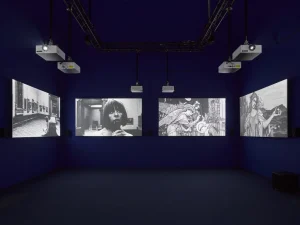
John Akomfrah, “Listening All Night To The Rain,” British Pavilion, 60th International Art Exhibition of La Biennale di Venezia, 2024. Photo: Jack Hems
Canto I, a three-screen film, greets guests on the facade of the British Pavillion’s neo-classical building before the rest unfold over a sequence of intimate rooms accessed through the back. Each features distinct imagery and audio and takes on a different topic—Canto VI looks back at the mid-century independence movements of colonized countries in the Global South. Canto VIII revisits the Windrush generation of Caribbean immigrants that settled across England from the 1950s through the ‘70s—though recurring motifs blur them together, a murky memory or a half-remembered dream. Throughout are clocks, cages, oranges, and rubber ducks. Playing on the many poster-sized screens of Canto II are shots of a shallow stream rushing over pearls, roses, and old family photos. In Canto V is John Everett Millais’s 1851–52 painting of Ophelia clutching flowers while she drowns in a river.
As in Venice, there is water water everywhere in Listening All Night to the Rain. Akomfrah’s made this a prominent theme in past work, a way of looking at the history of the transatlantic slave trade or the effects of climate change, but here it functions as a “kind of vessel,” the artist says, then points to a controversial 1988 study by the French immunologist Jacques Benveniste which claimed that water physically retains memory. “If water doesn’t have memory, it certainly can be commandeered to speak poetically about questions of memory.”

John Akomfrah, “Listening All Night To The Rain,” British Pavilion, 60th International Art Exhibition of La Biennale di Venezia, 2024. Photo: Jack Hems.
Akromfrah knows that his participation in the Biennale is not an either/or proposition. Making the art he wants to make doesn’t necessarily mean betraying the aims of the country paying for him to make it—probably the opposite, in fact. For him, the question is more personal. How does the artist of today—Sir John Akomfrah, OBE—square his privileged, inside status with the outsider of his youth?
“This is really the most complicated question for me, but also the simplest in a way. I realized quite early on that forces that shaped me would in some way be indicative of broader forces in the culture,” the artist said. “I haven’t changed my sense of pride or my belief in [the country] over the last 40 years. I’ve gone through moments of disenchantment with it, but disenchantment is what you feel after falling out of love with something. For me, the love has always been present.”
British Pavillion Artist John Akomfrah Uses Water and Sound to Synthesize Big Ideas
*******
John Akomfrah: ‘What are the histories, the questions, the narratives?’
The British artist and film-maker’s Biennale exhibition will build on his past investigations of race, memory, and identity
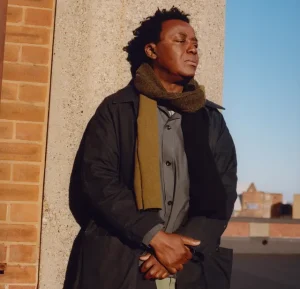
“I’ve never been interested in bashing or pointing fingers”: John Akomfrah says his work, often centring on race, colonialism and identity, is about reflections on the national pastPhoto: Christian Cassiel; ©️ John Akomfrah; courtesy of Lisson Gallery
JOHN Akomfrah is known for his dramatic, richly layered multiscreen video installations that use archive material and newly shot footage to challenge the conventions of film-making, and explore issues including racial injustice, colonialist legacies, migration and climate change. Based in London since childhood, Akomfrah first gained recognition making experimental documentary films as part of the influential Black Audio Film Collective, which he co-founded in 1982; and he still works collaboratively today. In 2019 he participated in the inaugural Ghana pavilion at the Venice Biennale and last year he received a knighthood for services to the arts. For the British pavilion, commissioned by the British Council, he has made eight interconnected screen, sound and time-based works under the collective title of Listening All Night to the Rain.
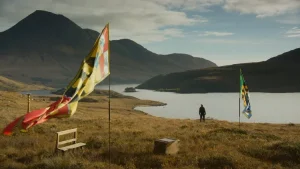
A still from Akomfrah’s 2023 film Arcadia. The artist says his Venice show has links to the work, which reflects on the trade between the Old and New Worlds© Smoking Doygs Films; courtesy Smoking Dogs Films and Lisson Gallery
How do you feel about representing Britain at the Venice Biennale?
When I was first told, I was absolutely thrilled. And then what followed was panic, because I’ve been going to Venice for decades and I’ve seen quite a few British pavilions and I thought, “Jesus, what more can I add to this?”. Then it dawned on me that the point about having all that insight and experience and knowledge is to have a conversation with that history, with the things I’ve seen and admired, and to have a total conversation with the pavilion.
Occupying the pavilion is inevitably intertwined with ideas around nationalism. Has this played into your new work?
The business of a national identity and who will it include and exclude has been an ongoing concern [of mine] and this work is not any different. But I’ve never been interested in bashing or pointing fingers, that was never the aim of any of the projects. They were about reflections on the national past and where things were uncomfortable you tried to mention them, because without doing so, people like me can’t feel part of it. You need to create the pathway through the national space for yourself, to be able to feel comfortable walking through it, with it, and in it.
So I’m still preoccupied with the mainstays: what are the histories, the questions, the narratives—ecological, political and philosophical—that need addressing at this moment in our evolution? I’m still trying very much to connect the earlier questions that I was interested in—race and ethnicity and national identity—and then to see how they in turn intersect with other questions, ecological or otherwise. This work is another step in that direction, another attempt to clarify what the point of these intersections is.
You’ve said that each piece you make expands on aspects of the work that preceded it. Your last major work, Arcadia (2023) reflected on the Columbian Exchange: the transfer of plants, animals, commodities, populations, technologies and diseases between the New World and the Old World from the 15th century onwards. Are there elements from Arcadia that you are exploring further in Venice?
There are lingering questions that snake their way through all the works. But in Venice there are also very specific questions that arise. The business of the winds, what winds do and what both metaphorically and literally is carried on the wind, is what I am obsessed with in this project. And that’s very much connected with Arcadia and the whole Columbian Exchange. This time we aren’t in the 15th, 16th or 17th centuries, but there are historical dimensions. This new set of interconnected works seeks to somehow insinuate itself into every crevice of the [British] Venice pavilion. It is concerned with histories and with questions of identity, but crucially it is concerned with memory: mine and others’.
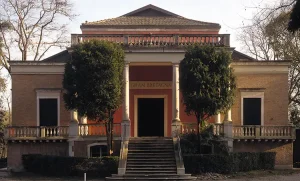
The British pavilion in the Giardini first became a Biennale exhibition space in 1909© John Riddy
What’s the thinking behind the title, Listening All Night to the Rain?
The two operative words are “listening” and “rain” and they both feature prominently. They are the cohesive agents for all the pieces. I don’t very often do stuff about poetry—even though I read poetry more than just about anything else—but the title is a phrase from a poem by an 11th-century Chinese poet called Su Shi, also known as Su Dongpo, whose work I love.
Venice is a location that encapsulates so many of your concerns—from its long history as a trading centre to the fact that it is incredibly sensitive to climate change. Has this context fed into the work?
Venice is very much the unseen guest in every one of the chapters in these works: it is the silent partner. And for all the reasons you mention: its centrality as part of the expansion of the mercantile capital world in the 15th and 16th centuries, and of course because the pavilion is there! A fascination with what one would call the “aquatic sublime” is one of the lingering connections that connects the work both to contemporary as well as to historical places.
You’ve described your personal aesthetic as “bricolage”, the combining of different elements that come to hand.
At the beginning of working on this piece I went straight to one of the figures who’s shaped profoundly the way in which I think about working, and that was Kurt Schwitters. I haven’t referenced him directly but Schwitters is a very big influence on the pieces in Venice. Some of the ethical and aesthetic things I picked up from that early art history initiation were to do with how the new comes into being. I believe that somehow the collision of different, non-related elements generates propulsion and fusion. It just animates things a lot more. This insight has become both a mantra and a credo, because it is not just an aesthetic approach but also an ethical one. It’s about how things co-exist and how you get things—and that includes narratives and people—to live together. It’s really about cherishing difference and trying to give difference, in the broadest sense of the term, a role and a value in one’s work.
******

