
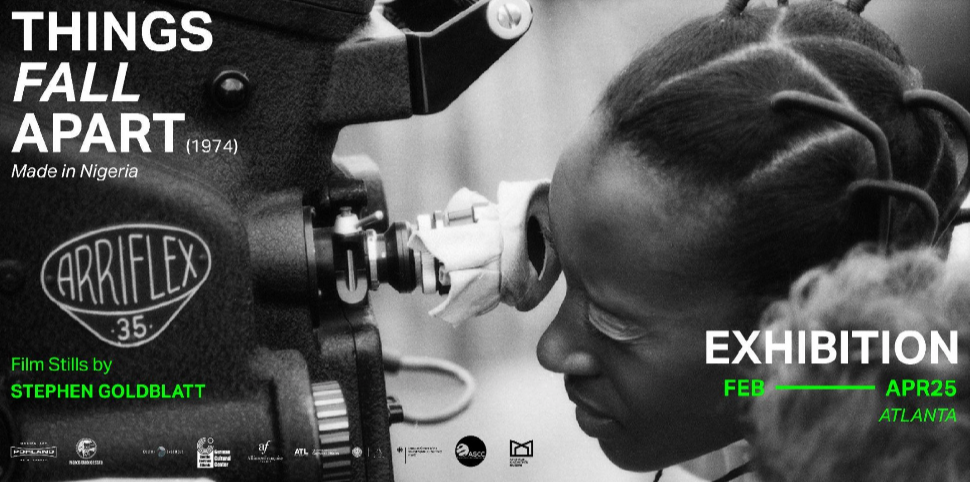

Produced by Nigeria’s pioneer legendary filmmaker, Francis Oladele (late), the film has not really enjoyed the aide viewership it deserves. The Atlanta screening will be preceded by a Reception at 6: pm. with Oladele’s son, Lanre , who has remained the keeper of Oladele’s film estate, as Guest of Honour
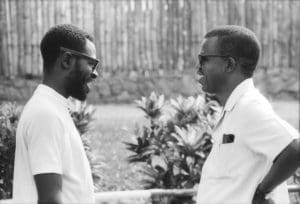
Oladele with Achebe on set of the film in 1971. Photo: Stephan Goldblatt.
Executive Nigerian Producer Francis Oladele (1933-2015) established Calpenny Nigeria Films Limited – the first independent film production company in Nigeria – in 1965 to provide a platform for artistic expression more profoundly and open the Nigerian arts to an international audience… Things Fall Apart, Oladele‘s second feature film, is another key part of the beginnings of Nigeria’s Pre-Nollywood movie industry
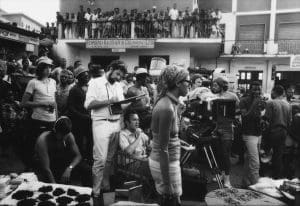
Cast and crew on set of TFA in 1971
FIFTY years after it was produced, the film adaptation of Chinua Achebe’s classic novel, Things Fall Apart, has returned as subject of attention at an international gathering in the United States.
On February 20 at the GALLERY 72 / 72 Marietta StNW, Atlanta, the fil will be screened to a gathering of culture literati, cineastes and academia.
Organised and promoted by Modern Art Film Archives, the Atlanta programme is curated by Mireya Palmeira of Kultur Ensemble Atlanta, with support of the German Federal Foreign Office, and cooperation of @goethezentrumatl; @gallery72atl; @thetaraatlanta;
@cityofatlantaga; @atlantaoca; @germanyatlanta; @afatl; @deutschekinemathek, and Kultur Ensemble Atlanta.
The project is coordinated by Mareike Palmeira, Project Development officer of the Modern Art Film Archives.
On Things Fall Apart
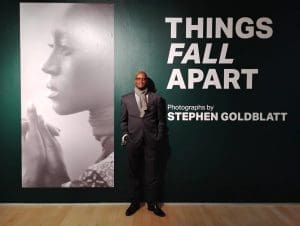
Lanre Oladele standing in front of the poster of the Feb 20 event at the venue
PRODUCED by Nigeria’s pioneer legendary filmmaker, Francis Oladele (late), the film has not enjoyed the aide viewership it deserves.
The film was first screened in Lagos in 2021, courtesy Lagos Film Society in collaboration with Modern Art Film Archive as part of the Lagos Photo Festival and Festival of Forgotten Films, curated by Didi Cheeka. This followed the rediscovery of the film by the Deutsche Kinemathek in Berlin.
The Atlanta screening will be preceded by a Reception at 6: pm. with Oladele’s son, Lanre, who has remained the keeper of Oladele’s film estate, as Guest of Honour. A trained theatre artiste himself, who, however, had an illustrious career in the Oil & Gas sector, Lanre will be fielding questions from the audiences.
Also accompanying the screening will be an exhibition of the still photographs taken in the course of the production by Stephan Goldblatt. The exhibition is described as “An exploration of the complexities of cultural conflict and change.” It is curated by Mallam Mudi Yahaya, Nigeria’s photographer and culture enthusiast, who in a 2021 testament, after a similar outing of the project in Lagos, said, “When the Bullfrog jumps in the sun why Things Fall Apart is still a very relevant black film till this day.”
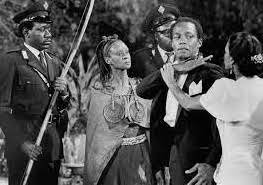
A scene from the film
*****
Notes on the project by the curators:
“THE Black Economic Union (BEU) was a group of African American professional athletes with three goals: to use the money of African Americans collectively for the benefit of all, to put together loans with a focus on the interest rates for Blacks in business and industry, and, finally, to increase the number of Black people in business and industry. The BEU promoted economic empowerment and the use of “green power” as a means of obtaining freedom, justice, and equality, which in some political quarters was seen as an ideological twin of Black nationalism. The face of the BEU and its most visible founder was Jim Brown, Cleveland Browns football star turned actor. Jim Brown was one of the big investors of Bullfrog In The Sun/Things Fall Apart.«
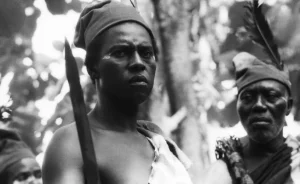
Okonkwo (John Sekka) and Obierika (Orlando Martins) as captured by Bolaji Alonge (EyeofaLagosBoy).. when the film was first screened in Lagos in 2021.
WHEN Obi Okonkwo completes his studies in England and returns to Nigeria, he finds himself in a country marked by rapid industrialisation and deep political change. In a time of social upheaval, Obi represents modern Nigeria. Through his gaze, his own expectations, those of his environment and the woman he loves become visible. And the disappointment of these expectations. Obi experiences the spreading corruption, the dominance of the Europeans and conflicts with the values of traditional societies. In flashbacks, his struggle is interwoven with that of his grandfather Okonkwo. The latter experiences the first foreign influences in his village of Umuofia, from the arrival of the Christian missionaries to British colonialism.
In Germany, the film opened the so-called Africa Days in Bonn in 1971 under the patronage of the then-German Foreign Minister Walter Scheel. A newspaper report from October 1971 stated: “The participation of the Federal Foreign Minister in the opening was of special significance since the Federal Foreign Minister started his trip to five West African countries immediately afterwards so that the Africa Days practically expressed the growing importance of the German-African partnership within the framework of the overall concept of German foreign policy.«
Also in the States, the premiere is a socio-political event. Under the patronage of Maynard Jackson, the first African-American mayor of Atlanta, the African-American society comes to the premiere in 1974. Chinua Achebe is among the guests, Francis Oladele has arrived, he is Maynhard‘s brother-in-law, the media reports on the reception afterwards with two hundred guests. In the States, the film premiered a full four years after production in Nigeria. Correspondence in the production files reveals that one of the reasons for this delay was apparently the difficulty in finding a distributor for the film. So, without further ado, the first »black-oriented« film distributor was founded.
Cast: Obi Okonkwo, Johnny Sekka | Clara Okeke, Elizabeth of Toro | Obierika, Orlando Martins | Joseph, Carey Andrew-Jaja | Peter, Steve Allis | Bushnell, Stephen Goldblatt | Bisi, Iyabo Aboaba | Government Minister, Femi Marquis | Editor, Boniface Afoko | General, Sam Siller
Crew: Director, Jason Pohland | Asst.Director, Tunde Adeniji, Heinz Freitag | Screenplay, Fern Mosk | based on / Chinua Achebe (novel) | Director of Photography, Michael J. Davis | Assistant Camera, Terence Bulley, Ganiyu Ojo | Still photography, Stephen Goldblatt | Art Director, Dave Aradeon | Make-up, Trixie Ashby | Costume, Funke Curtis | Editing, Christa Pohland | Asst. Editor, Alhaji Arulogun | Sound, Ivan Sharrock | Sound assistant, Andreas Pohland, Niran Alabi | Consultant, S.O. Alabi (technical advice)
Production Company / Cine 3 (FRG), Calpenny Nigeria Films Limited (NG), Nigram (US) | Producer, Wolf Schmidt (Cine 3), Francis Oladele (Calpenny Nigeria Films Limited) | Executive producer, Edward Mosk | Associate producer, John Schmeding | Unit Production Manager, Martin Häussler | Production assistant, Tom Mosk
******
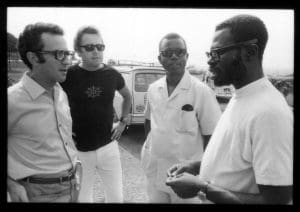
Wolf Schmidt, Jason Pohland, Chinua Achebe, Francis Oladele during the production of “Things Fall Apart”… on set in 1971
The Director
Jason Pohland was born in 1934 in Berlin. At the age of 21, he found his first production company. In the following six years, more than 30 short films are produced, some of which win awards at international film festivals. In 1962, together with Alexander Kluge, Edgar Reitz, Herbert Vesely and others, he took advantage of the publicity at the Oberhausener Shortfilm Festival to proclaim a manifesto called Papa‘s Cinema is Dead. They want to break with current conditions of production and demand an end to the prevailing lethargy to make possible the New German Cinema. At this time Pohland has already produced his first feature film Tobby. His second feature, The Bread Of Those Early Years premieres in Cannes. It is awarded with the Filmband in Gold in five categories. When the state began to subsidize films in 1965, his film Cat and Mouse was one of the first supported projects. Even before the premiere, the film caused the greatest political film scandal in the Federal Republic of Germany. “The film was one of the final impulses for me to choose politics,” says Federal President Frank Walter Steinmeier today. The Rebels Of Oberhausen, Pohland‘s last film of 2011, recalls those events. Pohland died on May 17, 2014 in Mande- lieu-Napoule near Cannes.
*****
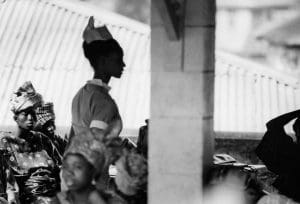
…Exhibition
“Film Stills by Stephen Goldblatt”
IN time for the 50th anniversary of the film adaptation of Things Fall Apart and No Longer at Ease by Nigerian writer Chinua Achebe, the icon of postcolonial literature, more than 2000 unpublished film stills, various production papers, correspondences, as well as a film print of the production from 1970 has been found in the estate of the Berlin filmmaker Jason Pohland (1934-2014). Things Fall Apart was made in Nigeria shortly after the Biafra war and had been lost for decades. As a result, little was known about the circumstances and the creation of this film.
Executive Nigerian Producer Francis Oladele (1933-2015) established Calpenny Nigeria Films Limited – the first independent film production company in Nigeria – in 1965 to provide a platform for artistic expression more profoundly and open the Nigerian arts to an international audience. His debut film Kongi‘s Harvest (1970) already set standards. The film is based on a play by Wole Soyinka, who also plays the lead role. Oladele succeeded in hiring the American Ossie Davis, a close friend of Malcolm X and very active in the civil rights movement, as director for this first project. Things Fall Apart, Oladele‘s second feature film, is another key part of the beginnings of Nigeria’s pre-Nollywood movie industry. The film, made by a few international but mostly local crew members, was directed by Jason Pohland.
Goethe-Zentrum Atlanta will present a selection of this archive’s findings. The photographs show Chinua Achebe on set, the Ugandan princess, lawyer and later diplomat Elizabeth of Toro, who shortly after shooting becomes Uganda‘s foreign minister, 1899 in Lagos born actor Orlando Martins – Nigeria‘s first international film star – in his last role as Obierika, John Sekka, the popular Senegalese actor in the leading role of Obi Okonkwo, or co-founder of Lagos Freedom Park Iyabo Aboaba in her role as Bisi.
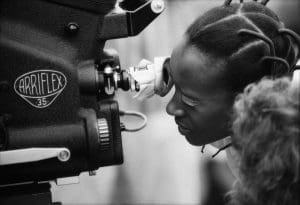
Some crew members have later made great careers: the still photographer Stephen Goldblatt became a director of photography, shot Batman films and was nominated twice for an Oscar, the assistant editor Alhaji Arulogun became one of Nigeria’s pioneer broadcasters and later headed several ministries for the state government of Oyo State, Ivan Sharrock, the sound mixer, won two Oscars.
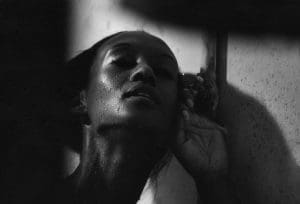
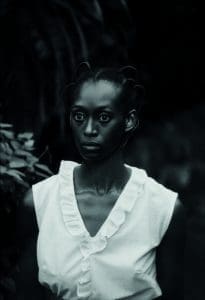
Elizabeth of Toro as Clara Okeke. Photo: Stephan Goldblatt.
*****
The Curators
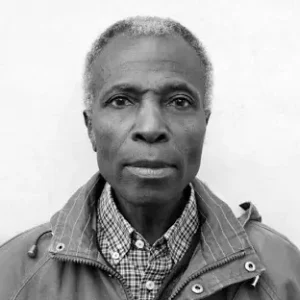
Akinbode Akinbiyi
BERLIN-based Akinbode Akinbiyi is one of the well-known African photographers. His photographs of everyday life in African cities bring viewers closer to urban life
in Africa and convey an impression of its undergoing rapid change. Akinbode Akinbiyi is also an intercultural mediator through his curating work. He has curated several exhibitions for the Institut für Auslands- beziehungen, including Spot on … DAK’ART (2009). A pan-African project he co-initiated has also made him an important mentor of young photographers from Africa.
Gisela Kayser
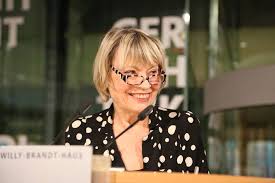
AFTER twenty-five years and three hundred exhibitions of documentary, political and artistic photographs at the Willy Brandt Haus in Berlin, Gisela Kayser has experience like few others in this field. As artistic director and managing director of the Freundeskreis Willy Brandt Haus, she and her team were responsible for the cultural programme of the house and gave important impulses to the social discourse. She accompanied and supported other exhibition projects in museums and galleries as a curator, was a jury member at various award ceremonies at the Berlin University of the Arts, a nominator at the International Center of Photography New York and a jury member of the Alfred Fried Photography Award 2019. Since July 2021, Gisela Kayser has been working internationally as a freelance curator for selected projects.
******
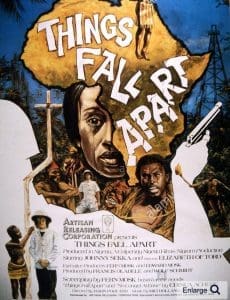
Background Information on Things Fall Apart
When The Bullfrog Jumps In The Sun
Why Things Fall Apart is still a very relevant Black film till this day
By Mudi Yahaya
A LITTLE-known fact is that the “Nigerian film” Things Fall Apart (1971) also known as Bullfrog In The Sun, was in many respects an extension of the 1960s identity struggle tradition of independent African American cinema. It was based on the Nigerian novelist Chinua Achebe’s novels Things Fall Apart (1958) and No Longer at Ease (1960).
It comes as no surprise that Achebe eventually lived and taught in the United States of America due to academic interests in the sophisticated identity subtext in his writings’ resonance with black society in Africa and the African diaspora. All African studies courses in American universities now include Achebe as a requirement. Things Fall Apart eventually earned Achebe the Man Booker International Prize in Literature.
Given that Achebe was an early proponent of post-colonial deconstruction in African literature, this production of Things Fall Apart – there, subsequently was a Nigerian Television mini-series version – is perhaps the earliest cinematic attempt of aesthetic post-colonial deconstruction in Nigerian and possibly African cinema.
Co-producing the film were American, German, and Nigerian companies. The film was directed by Hansjürgen Pohland, also known as Jason Pohland (1934-2014), and executive produced by American Edward Mosk with German Wolf Schmidt and Nigerian Francis Oladele as producers. It features Ugandan Princess Elizabeth of Toro, British-Senegalese Johnny Sekka, and the first international Nigerian film star Orlando Martins, born in Lagos in 1899, in his final role as Obierika.
Francis Oladele (1932-2015), founded the first independent film production company in Nigeria, Calpenny Nigeria Films Limited, in 1965 with the intention of fostering artistic expression and introducing Nigerian cinema to a larger public. Things Fall Apart, Oladele’s second film, was almost completely shot in Nigeria, except for a single London sequence. Ibadan, which is 80 miles inland from Lagos, was where most of the film locations were. Before a print was „rediscovered“ in Jason Pohlands’ estate, the movie was believed to have been lost after its contentious release – for various reasons – in the United States, Germany and Nigeria.
Details about the final cut were one of the contentious issues surrounding the movie, so two versions of the movie were published. The American cut, which varied considerably from the German version, was titled Things Fall Apart, and the first version used for the German world premiere was titled Bullfrog In The Sun.
The phrase “Whenever you see a bullfrog jumping in broad daylight, know that something is after its life“ is an African proverb that served as the inspiration for the title Bullfrog In The Sun.
The film is set in Igbo land, South-Eastern Nigeria, but filmed in Ibadan in South-Western Nigeria, less than six months after the end of the Nigerian civil war. The film presents the story of conflict in the lives of three generations of Nigerians coming to terms with the white man as told from an African viewpoint in a Technicolor film production also known as Coup de Soleil in French. It is a tale of two lives, of a parallel fate responding to an unnatural and possibly destructive influence. It is an investigation into the causes and foundations of the black-white conflict. It is an effort to get at the causes of racial strife.
The narrative of Bull frog In The Sun/Things Fall Apart centers on Okonkwo, a renowned figurehead in the south-Eastern Igbo town of Umuofia. As a great wrestler and farmer, Okonkwo puts in a lot of effort to maintain his reputation. As white missionaries travel from town to town converting the Igbo people to Christianity, many villagers, including Okonkwo, want to maintain indigenous traditions but discover that their heritage and culture are being lost.
The film expands on Achebe’s original message in the two books the film is based on. Themes of community breakdown are explored in both of Achebes’ novel and the film, which depicts how the white missionaries have split the villagers. The conflict between tradition and change is another subject that runs through both the novels and the film. In the movie, characters use persuasive speech to dispel popular misconceptions about tribal culture.
To appreciate Bull frog In The Sun/Things Fall Apart place in history, a bit of background knowledge is required about the period when Bull frog In The Sun/Things Fall Apart was produced and filmed. The films of the 1960s had and till this day still has a big impact on modern films. In the 1960s, television movies first gained widespread appeal. More than
at any other point in the twentieth century, the United States was on the verge of social upheaval as a result of the 1960s‘ profound cultural and political changes. American cinema also experienced significant change at the same time. The Production Code was replaced by a new ratings system after the studio structure collapsed. Hollywood underwent significant changes to the film-making industry in the 1960s, and the vertically integrated studio structure failed.
The big Hollywood studios were no longer able to solely control and influence the making, distributing, and exhibition of films based on their factory-like system. In the 60s, the studio structure that had flourished during Hollywood’s Golden Age came to an end. However, it was still challenging for small production companies, in the 60s, to break into the American film market, not to mention films that were about black nationalism, culture, history or politics. Between 1946 and 1950, there was a brief but intriguing time in Hollywood history when the „passing“ genre was used to explore racism and anti-Semitism as white people struggled to understand „the other.“ Hollywood promoted films with light-skinned Black actors who were cast as outsiders who could „pass“ and benefit from white privilege while denouncing racism in what it termed „Negro tolerance“ movies. Major companies would make low-risk bets on relatively inexpensive Black movies at the time in the hopes of making immediate large profits.
Since its inception, Hollywood has depicted African Americans in a variety of ways, such as in Birth Of A Nation as primitive beings, Gone With The Wind as contented former slaves, and the 1970s „blaxploitation“ period as hypersexual heroes. More nuanced portrayals were battled for by movements like the L.A. Rebellion and the Harlem Renaissance, which had some Black Panthers as their members. Prior to this, Black actors had to compete for fewer and fewer parts in post-World War
II Hollywood, all but disappearing from the screen. Ironically following World War II, Black characters began to be given more humanity and depth, but it wasn’t until the arrival of Blaxploitation that the early film caricatures of servile maids and butlers were totally turned on their heads. The first group of Black film students, who attended UCLA starting in the late 1960s, grew tired of Blaxploitation’s flat characters and cartoonish violence. They led the L.A. Rebellion, an independent movement subsequently inspired by arthouse movements such as the Italian Neorealism and the Brazilian Cinema Novo.
Prior to the late 1960s, black directors were actively prohibited in Hollywood until when the studios confronted financial collapse. The 60s was the period when television and movies became a vehicle for African Americans to contest, imagine, and revision racism as a historical illness and its effects on current identity and values problems. This was also a time when the Black Power and Civil Rights organizations entered the national dialogue about how the United States dealt with decades of discrimination supported by White supremacy. This keyed in with the mission of the Negro Industrial and Economic Union (NIEU), later renamed the Black Economic Union (BEU), which was founded in the 1966.
The BEU was a group of African American professional athletes with three goals: to use the money of African Americans collectively for the benefit of all, to put together loans with a focus on the interest rates for Blacks in business and industry, and, finally, to increase the number of Black people in business and industry. The BEU promoted economic empowerment and the use for “green power” as a means of obtaining freedom, justice, and equality, which in some political quarters was seen as an ideological twin of Black nationalism. The face of the BEU and its most visible founder was Jim Brown, Cleveland Browns football star turned actor.
Jim Brown was one of the big investors of Bull frog In The Sun/Things Fall Apart. A new African American film audience developed a taste for movies that reflected the social reality of the black man and with the new popularity of international film festivals and as a result of the civil rights movement and counterculture; all black people. As an actor Jim Brown was very aware of the claim or ideology of Hollywood of the 60s that films made by people of color in general are not commercially successful the excuse then was that all the cultural and social references within these films would fly over the head of the American audience. The conventional thinking then in Hollywood was that black actors and films couldn’t appeal to audiences outside of the United States, hence why Hollywood generally failed to support black films and actors during the 1960s.
To complicate matters more, Jim Brown was being “watched” by the FBI. In March 1968, the FBI/COINTELPRO implemented a program under the direction of Director J. Edgar Hoover with the goal of „neutralizing“ Black Nationalist organizations, including those the agency designated as “hate groups.“ The FBI watched the BEU and many of its members even though it was not one of the main groups it wished to spy on.
Edgar Hoover was fully aware that the film industry was as is still more than just movies; it is a significant economic force that is closely linked to several sectors, including the apparel and fashion industry, travel and leisure destinations, sports and entertainment, both domestically and internationally. With a mandate to destroy any black nationalist advancement black independent films and filmmakers were as a matter of “policy” being directly frustrated as they were seen as forms of the expression of black nationalism.
Despite being proudly Nigerian Francis Oladele was categorized as an African American filmmaker of sorts as he was deeply connected by marriage to the African American political and social elite circles of Atlanta, Georgia and by extension to the civil rights movement of the time. To underscore his social connections in the African American society of the times, Francis Oladele’s marriage was mentioned in Jet Magazine, a magazine founded in 1951 by John Johnson of the Johnson Publishing Company with a tagline “The Weekly Negro News Magazine.”
Francis Oladele’s wife, Jeanne Jackson was a sister to Maynard Holbrook Jackson Jr. the first black mayor of Atlanta and the second-longest serving mayor in the city’s history. Maynard who was a lawyer and politician
who a close associate of reverend Martin Luther King Jr. Under J. Edgar Hoover, the FBI who had started monitoring Reverend King since the December 1955 Montgomery bus boycott waged a vigorous effort to harass and discredit Martin Luther King Jr. through its domestic counterintelligence program, COINTELPRO beginning with the 1963 March on Washington and continuing through his assassination in 1968. This was the same FBI program that was watching Jim Brown.
An open racist, J. Edgar Hoover was born and raised in Washington, D.C., which was a deeply segregated metropolis before the Civil Rights Act of 1964. Hoover had a particular vendetta against Reverend King. He was outraged by practically everything King stood for and was resolved to bring about King’s downfall by spreading the myth that the civil rights activist was under the influence of communists. Dr. King, who at that time was the youngest man to have received the Nobel Peace Prize at the age of thirty-five, was outspokenly angry with FBI agents and had called the FBI “completely ineffectual in resolving the continued mayhem and brutality inflicted upon the Negro in the deep South.”
Most Southern cities practised segregation in their movie theatres until the middle ofthe decade, either by segregating individual theatres with balconies reserved for Black patrons or by having distinct theatres for Black and white patrons. Less common than their white-only peers, black-only theatres were managed by African Americans but frequently owned by white people. They mainly screened second- or third-run movies. With the advancement of the civil rights struggle, desegregation of movie theatres was made possible as a result of picketing efforts, many of which were headed by students in urban Southern areas. The majority of Atlanta’s downtown cinema theatres started their desegregation efforts in May 1962 by allowing a few African Americans to sample each showing for a few weeks before fully integrating. This was a common Southern theatre practice.
So important was the film industry to the politics of America in the ’60s, that Attorney General Robert Kennedy commended exhibitors for advancing voluntary integration in May 1963 when he called significant exhibitors to the White House in an effort to win their support for President Johnson’s civil rights legislation. It was believed that the voluntary desegregation of movie theatres — visible centres for both Black and white communities—might spread to other industries. This was the America where, in 1947, The House Un-American Activities Committee (HUAC), which was looking into communism in the country, questioned unfriendly witnesses from the film industry.
THIS was the backdrop of the situation and sociopolitical climate that Bullfrog In The Sun/ Things Fall Apart was being planned and conceived. This clearly political film had the odds stacked against it from the start. It should have been no surprise that Bullfrog In The Sun/Things Fall Apart would encounter distribution problems. In a September 1st 1972 letter correspondence between the Executive producer Edward Mosk and the film director Jason Pohland, Edward Mosk is quoted as saying “It seems clear at this time that we will not get a major distribution deal, although we are still showing to major distributors in New York. The problem is that they do not feel that the quality meets their standards for national distribution, and they are not equipped for the kind of specialized distribution that the picture demands.”
Jason Pohland who was selected as director of Bullfrog In The Sun/Things Fall Apart, specifically for his political film leanings and professional reputation would have found any observation of poor quality very surprising.
Pohland, the award-winning German filmmaker and producer, was not a stranger to the political influence of literature as this was a well-observed practice in Germany. Pohland directed the 1966 film adaptation of Nobel Prize winner Günter Grass’s book Cat and Mouse, which was one of the earliest pioneering examples of “Young German Cinema“ and the topic of what is arguably the most divisive political discussion regarding Post-World War II German Cinema.
The excuse of doubtful quality was at best an intentional ruse. Indeed, the cast and crew of Bullfrog In The Sun/Things Fall Apart would in later years excel and be celebrated in their diverse capacities. Michael J. Davis the director of photography who also acted as a white missionary in the film went on to be the director of photography of several episodes of popular British TV series including The Professionals, Rumpole Of The Bailey, Minder and Inspector Morse to name a few. Academy award-winning South African-born British cinematographer, Stephen Goldblatt, was the still photographer on Bullfrog In The Sun/ Things Fall Apart. He became well-known for his work on multiple high-profile movies with directors Tony Scott on The Hunger (1983), Francis Coppola on The Cotton Club (1984), and Richard Donner on Lethal Weapon (1987) and Lethal Weapon 2 (1989), before becoming known for his collaborations with Mike Nichols and Tate Taylor. Goldblatt entered
the Batman series in the 1990s, working with director Joel Schumacher to produce Batman Forever (1995) and Batman and Robin (1997). Terence Bulley, a British director and director of photography who worked as a camera operator on Bullfrog In The Sun/Things Fall Apart, has directed and shot more than 500 hours of prime-time television drama and motion pictures. On both Assassin’s Creed and Star Wars 8: The Last Jedi, he served as the aerial director of photography. The French films Lisa et le Pilot D’Avion (2006) and Le Nécrophile (2004), as well as the American films Fly Boy (2006), Ballad of the Nightingale (1999), and Jake Speed (1986), were among the more than a dozen theater feature films Bulley has worked on. Ivan Sharrock, English sound engineer, was sound engineer on Bullfrog In The Sun/Things Fall Apart. He won an Oscar for Best Sound in Bernardo Bertolucci’s The Last Emperor (1987) and has been nominated for U-571 (2000), Gangs of New York (2002), Blood Diamond (2006) in the same category. He has worked on more than 100 films since 1967. On the soundtrack of the American version (Things Fall Apart) Milt Holland made the soundtrack. Milt also made the sound- track for many award-winning films like Around The World In 80 Days (1956), The King And I (1956), Breakfast at Tiffany’s (1961), The Man from U.N.C.L.E. (1964) and Roots (1977) among many soundtracks. Nigerians, Tunde Adeniji and Alhaji Arulogun were assistant director and assistant editor of Bullfrog In The Sun/Things Fall Apart and were among the founding pioneers of Nigerian Television. Art direction was by Nigerian David Aradeon, who later became a celebrated curator, urban planner and professor of architecture at the university of Lagos. In addition, he was a founding partner of the architectural firm Studio 4 Associates, which was shown at Documenta 12 in Kassel.
The Bullfrog In The Sun/Things Fall Apart ensemble was equally impressive. Obi and Clara were portrayed by John Sekka and Elizabeth of Toro in the main parts. Sekka, a Senegalese-born performer, had leading roles in the films South Star (1969) and Khartoum (1966) alongside Charlton Heston, Laurence Olivier, and George Segal. Additionally, he appeared in Women of Straw (1964), East of Sudan (1964), and The Wild and the Willing (1962) alongside Sean Connery and Gina Lollobrigida. The westend title character in Mr Johnson, which Sidney Portier played on Broadway, was created by Sekka for the British stage. Sekka portrays both Obi, a Nigerian with a contemporary education, and his grandfather Okonkwo, a warrior and village elder who battles the first generation of white men at the turn of the century, in Bullfrog In The Sun/ Things Fall Apart.
The first black model to appear on a Harper‘s Bazaar cover was the Ugandan Princess Elizabeth of Toro. She had previously appeared on the covers of prestigious international publications. Elizabeth of Toro, who earned a law degree from Cambridge, made a brief appearance in Ossie Davis’ blockbuster Cotton Comes To Harlem (1970). The first starring role Elizabeth of Toros played was in Bullfrog In The Sun/Things Fall Apart. Obierika was portrayed by Orlando Martins. He was a groundbreaking stage and screen actor from Nigeria. He was one of Britain’s most well-known and famous black actors in the late 1940s. Bisi was played by Iyabo Aboaba who later became one of the most accomplished Nigerian cultural managers and administrators.
It was clear to Jason Pohland that the politics of Biafra could jeopardize the normal distribution of the film when he wrote in correspondence to the German African Society about the enthusiasm of Günter Grass about the film and his intentions to invite Chinua Achebe to Germany. In fact, Pohland himself had privately lobbied Nobel Prize winner Heinrich Böll to recommend Achebe for a Nobel Prize. Pohland had filmed a book adaptation for the first film of the New German Cinema based on the novel by Heinrich Böll The Bread Of Those Early Years (1962). Heinrich Böll contributed to the screenplay dialogues of the film.
At the premiere of Bullfrog In The Sun/Things Fall Apart in Bonn, organized by the German Africa Society on the 13th of October 1971 Wole Soyinka was present as a guest as well as the German Minister of Foreign Affairs Walter Scheel who opened the film festival. The Nigerian government was not in support of the film as Pohland clearly was sympathetic to Chinua Achebe position on Biafra which Mallam Mudi Yahaya (*1968) was not a position entertained by the Nigerian government.
The challenges of the production, distribution and marketing of the mainly black cast of Bullfrog In The Sun/Things Fall Apart is a perfect example to study and understand the structural politics of racial ideology represented in films till this day. White producers and directors dominated mainstream Hollywood of the 60s, which produced and promoted films primarily focused on white audiences because they are more valuable than audien- ces of other racial backgrounds.
One of the lasting universal messages the film offered beyond the obvious was how stereotypical representations impact people’s lives and serve to legitimize discrimination and violence against them. Indeed, film representations are not just images on a screen. Through cultural globalization, they are disseminated and used as a tool for “transnational racialization“ which instills racial hierarchy in those who have not frequently encountered black or white people.
Tunde Adeniji died on the 8th of March 2023 he was the last surviving member of the Bullfrog In The Sun/Things Fall Apart directorial team.
******
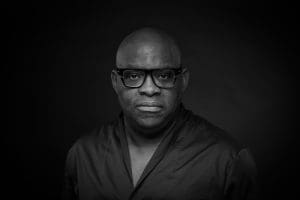
Mallam Mudi Yahaya (*1968)
Visual Artist, Photographer, Filmmaker, Archivist, Writer, Curator
Mallam Mudi Yahaya’s work explores interpretations of African hybrid identities and their varied visual dialects, currencies, and vocabularies. With the massive digitization of media data, Mallam Mudi Yahaya investigates aesthetics that connect postcolonial African identities mediated by still photography and cinema. Mallam Mudi Yahaya’s work further focuses on the relationship and tension between images as they interact with notions and strategies of post-colonial deconstruction of African identities in syncretic African spaces and non-spaces. His interest in identity construction extends to photography archives, where he conceptually explores counter-narratives of photographic representation.

